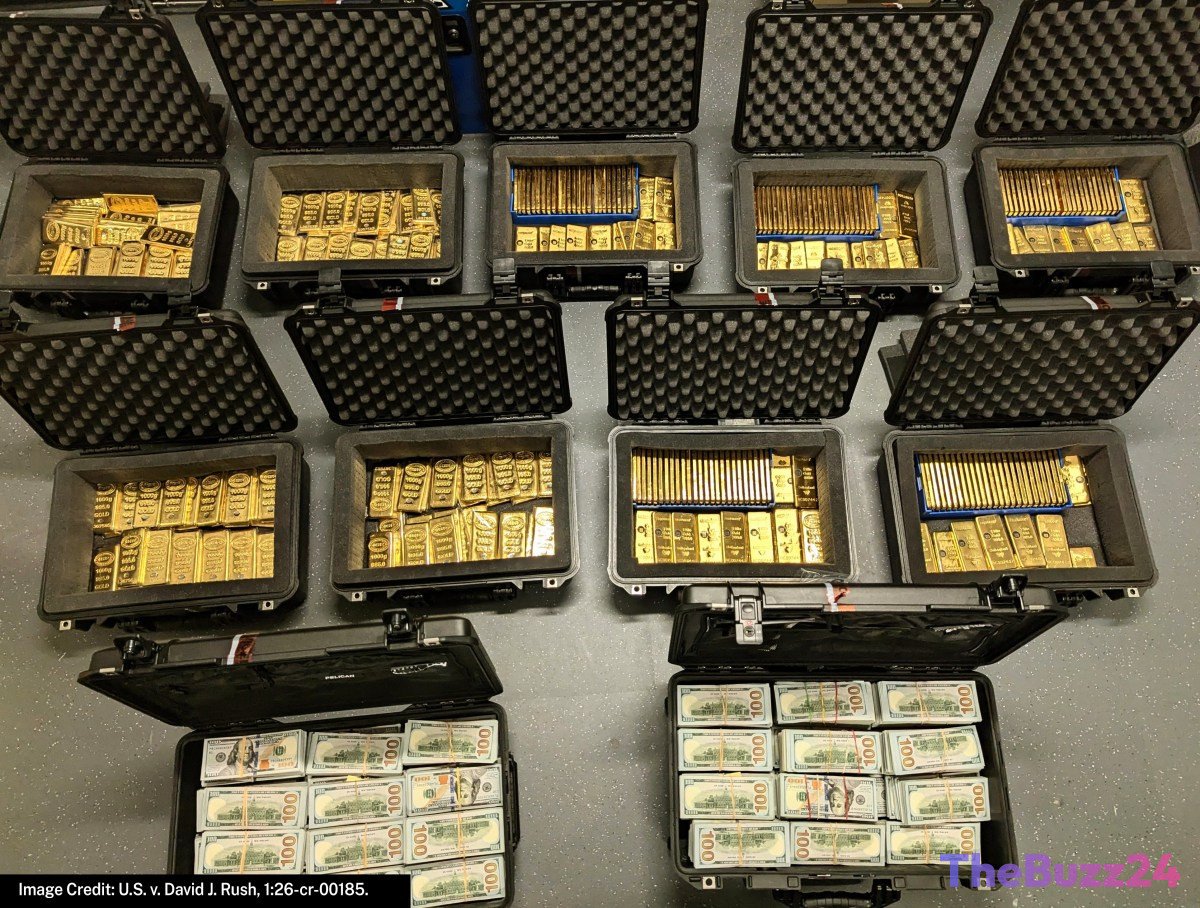
Ex-CIA Officer Pleads Guilty to Creating Bogus Classified Operation to Embezzle $190 Million in Cash and Gold
A former officer with the Central Intelligence Agency has formally pleaded guilty to orchestrating an elaborate, fraudulent scheme in which he embezzled nearly $200 million in taxpayer funds by establishing a fictional, top-secret government operation. Federal prosecutors confirmed that David J. Rush, a resident of Virginia, admitted to one count of wire fraud after exploiting his high-level intelligence access to divert immense public wealth into his own custody.
According to federal filings, Rush’s deception began well before the siphoning of funds; he falsified his educational background and military credentials to successfully infiltrate the intelligence agency in 2010. Over his career, he rose through the ranks to gain substantial authority over intelligence development, eventually working within sensitive units dedicated to crafting cyber tools and clandestine surveillance infrastructure.
Capitalizing on the extreme opacity of classified operations, Rush established a counterfeit Special Access Program (SAP)—a tier of federal initiatives so intensely compartmentalized that they elude standard oversight. Disguised as a vital continuity-of-government project designed to safeguard federal functions during catastrophic emergencies, the rogue program operated with virtually zero internal friction. Rush effectively acted as his own approving authority, manipulating an unnamed defense contractor into acquiring massive amounts of bullion and materials under the cover of legitimate government procurement.
When federal agents closed in, search warrants executed at Rush’s residence uncovered an extraordinary hoard of illicit assets, including more than $46 million in physical gold bars, over $2 million in paper currency, high-end luxury vehicles, and collector watches. By entering a guilty plea, Rush avoids a public federal trial that promised to shine an uncomfortable light on internal vetting deficiencies and structural blind spots within U.S. intelligence spending. He is scheduled for sentencing in late January 2027, where he faces a maximum statutory penalty of 20 years in federal prison.
Key Takeaways
- Former CIA officer David J. Rush pleaded guilty to wire fraud after stealing roughly $190 million through a fake classified program.
- Rush leveraged the hyper-compartmentalized nature of Special Access Programs to approve his own expenditures without oversight.
- Law enforcement seized over $46 million in gold bars alongside millions in cash and luxury goods from Rush's residence; he faces up to 20 years in prison.
Editor’s Analysis & Impact
The David Rush case exposes a catastrophic vulnerability in the management of classified federal black budgets. While the extreme secrecy of Special Access Programs is designed to protect national security, this case demonstrates that excessive compartmentalization can inadvertently create blind spots that facilitate monumental fraud. By functioning as his own oversight authority, Rush highlighted the persistent danger of placing unchecked financial control in the hands of single operatives. In the long term, expect the intelligence community and congressional oversight committees to enforce stringent, multiparty auditing protocols on covert funding, even for programs considered hyper-sensitive. The guilty plea spares the CIA public embarrassment, but the institutional fallout regarding procurement integrity will likely trigger deep internal reforms across defense and intelligence agencies.
Frequently Asked Questions
Q: What is a Special Access Program (SAP)?
A: A Special Access Program is a highly classified government initiative that imposes rigorous safeguarding and access requirements far beyond standard top-secret classifications, strictly limiting knowledge of the program to a small circle of vetted personnel.
Q: How was David Rush able to bypass financial checks?
A: Due to his seniority and the classified nature of the fabricated continuity program, Rush was positioned to act as his own approving authority, allowing him to requisition and spend substantial government funds without external auditing.
Q: What sentence does Rush face?
A: Rush pleaded guilty to one count of wire fraud and faces up to 20 years in federal prison when he is sentenced.
AI Disclosure: This article is based on verified data and official reports. Our Team and AI have cross-referenced every financial detail with primary sources to ensure total accuracy.
More from this Category