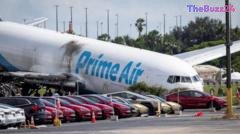
Fatal Runway Overrun at Miami Airport: Black Boxes Retrieved Following Amazon Cargo Plane Tragedy
Federal investigators have recovered both the cockpit voice recorder and the flight data recorder from the wreckage of a Boeing 767-300 cargo plane operating for Amazon, which overran a runway at Miami International Airport over the weekend. The catastrophic crash resulted in five fatalities and left five others critically injured after the incoming aircraft breached airport boundaries and struck multiple vehicles.
The flight, operated by contractor 21 Air, had departed from San Juan, Puerto Rico, on its third route of the day before touching down shortly before 2:00 p.m. local time. Instead of coming to a safe halt, the wide-body jet tore through navigational apparatus, careened through an exterior perimeter fence, and plowed into a commercial cleaning van carrying seven individuals and a passenger sedan carrying three. The aircraft finally came to a rest roughly 1,300 feet past the runway’s end.
National Transportation Safety Board (NTSB) Chairwoman Jennifer Homendy stressed that the immediate priority remains the respectful recovery and identification of the victims before technicians begin intrusive physical analysis of the airframe. The recovered flight recorders are currently en route to NTSB laboratories in Washington for forensic analysis. A multi-disciplinary team is reviewing pilot qualifications, maintenance logs, operational airworthiness, and airframe performance alongside airport radar feeds.
A central focus of the emerging inquiry will scrutinize whether the landing strip was equipped with an Engineered Materials Arresting System (EMAS)—crushable cellular cement beds engineered specifically to decelerate runaway aircraft before they exit paved areas. Furthermore, meteorological data indicating convective storms and gusty wind conditions near the runway threshold at the moment of landing will be rigorously scrutinized. The incident has caused substantial ground delays across southern Florida throughout the busy Labor Day travel period, with half of the airport’s runways temporarily closed for forensic containment.
Key Takeaways
- A Boeing 767-300 cargo plane operating for Amazon overshot the runway in Miami, killing five people and seriously injuring five others after colliding with two ground vehicles.
- Federal safety officials have secured the black boxes and sent them to Washington for forensic readout while search and recovery operations continue.
- The official inquiry will probe adverse weather conditions, pilot performance, and whether an Engineered Materials Arresting System (EMAS) should have been installed on the runway.
Editor’s Analysis & Impact
This deadly incident highlights persistent vulnerabilities at major transport hubs, especially regarding runway safety margins and the interface between commercial perimeter roads and high-speed aviation assets. The focus on Engineered Materials Arresting Systems (EMAS) is likely to reignite regulatory mandates pushing airport authorities to upgrade runway safety areas across the United States. Furthermore, the incident brings scrutinized attention to the operational resilience and safety oversight of third-party air cargo contractors operating under massive logistics banners such as Amazon Prime Air. As air cargo volumes remain high, ensuring identical safety cultures between mainline commercial carriers and contracted freight partners will face renewed regulatory and industry pressure.
Frequently Asked Questions
Q: What is an Engineered Materials Arresting System (EMAS)?
A: EMAS consists of high-energy-absorbing material placed at the end of a runway designed to crush reliably under the weight of an aircraft, safely decelerating and stopping a plane that overruns the runway.
Q: Who was operating the Amazon cargo aircraft?
A: The Boeing 767-300 aircraft was operated by 21 Air, an air charter and cargo transport company contracted to fly freight for Amazon.
Q: Were any flight operations interrupted at Miami International Airport?
A: Yes, two of the airport's four runways were closed following the incident, causing widespread delays and cancellations during one of the busiest holiday travel weekends of the year.
AI Disclosure: This article is based on verified data and official reports. Our Team and AI have cross-referenced every financial detail with primary sources to ensure total accuracy.
More from this Category