France Braces for Renewed Protests Amidst Social Unrest and Political Division
France is on high alert as the nation prepares for a significant day of nationwide protests, scheduled for Saturday, exactly one week after experiencing some of the most severe civil unrest seen in decades. Despite stringent restrictions imposed on demonstrations across the country, a substantial turnout is anticipated in Paris and other major cities. These protests are being organized by a coalition of students, trade unions, and various anti-government factions.
The Ministry of the Interior has announced a massive deployment of 70,000 police officers to bolster security in urban centers. This heightened security measure comes in the wake of accusations from opposition parties that the government failed to anticipate the scale of the disturbances that erupted on October 17th. Interior Minister Laurent Nuñez has vowed a firm stance against any acts of vandalism, looting, or violence, noting that social media has seen numerous calls for unrest originating from far-left groups.
In the aftermath of the previous week’s riots, hundreds of individuals have already faced swift judicial proceedings and have been incarcerated for offenses including vandalism, arson, and looting. The current wave of public discontent is fueled by a growing disillusionment among the French populace, who are grappling with escalating living costs and increasingly grim forecasts of future government spending cuts. The initial protests were sparked by high school students demanding improvements to educational facilities and addressing staff shortages, but the movement subsequently devolved into widespread violence in several locations.
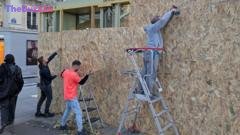
President Emmanuel Macron engaged in discussions with student representatives on Friday, prior to the planned Saturday demonstrations. While students reported that the President made clear commitments, they also urged continued mobilization. Macron’s administration indicated that a series of measures aimed at enhancing high school education would be announced starting Monday. However, the government’s decree earlier this week, permitting only demonstrations organized by recognized trade unions, has been met with varied responses from local authorities. Some cities, like Lyon, Nice, and Montpellier, have implemented outright bans on gatherings, while others, such as Marseille, have reversed earlier prohibitions to allow union-led marches. In Paris, a student and labor-backed march has been confined to a specific route away from the city center, though preparations for potential disturbances in prominent areas are underway, with cultural institutions like the Louvre and Orsay museums announcing closures, and some businesses boarding up windows.
Key Takeaways
- France is facing a second wave of nationwide protests following significant unrest a week prior.
- Authorities are deploying 70,000 police officers amidst stringent restrictions on demonstrations.
- Protests are fueled by cost-of-living concerns, educational issues, and broader anti-government sentiment, with political divisions potentially exacerbating the situation.
Editor’s Analysis & Impact
The renewed protests in France highlight a deep-seated social and economic discontent, exacerbated by political polarization. The government’s response, balancing security concerns with the right to protest, faces a delicate challenge. The involvement of various groups, from students to the revived ‘yellow vest’ movement, indicates a broad spectrum of grievances. The upcoming election period adds another layer of complexity, as political factions seek to capitalize on public dissatisfaction. The economic implications, including potential damage to businesses and tourism, alongside the cost of increased security, are significant. The situation underscores the fragility of social cohesion when economic pressures meet political division, posing a long-term challenge for stability and governance in France.
Frequently Asked Questions
Q: What triggered the initial protests in France?
A: The protests initially began with high school students demanding improvements to school conditions and addressing staff shortages. However, the movement quickly broadened to encompass wider anti-government sentiment and concerns over the cost of living.
Q: What measures are being taken by the French government to manage the protests?
A: The French government is deploying 70,000 police officers nationwide and has imposed restrictions on demonstrations. In some cities, blanket bans on gatherings have been enacted, while in others, specific routes and conditions for approved marches have been set.
Q: What is the role of the 'yellow vest' movement in the current protests?
A: Elements of the 'yellow vest' movement, which gained prominence during Macron's first term, are expected to participate in the current protests. This movement, drawing support from across the political spectrum, has been vocal in its demands, including the resignation of President Macron.
AI Disclosure: This article is based on verified data and official reports. Our Team and AI have cross-referenced every financial detail with primary sources to ensure total accuracy.
More from this Category