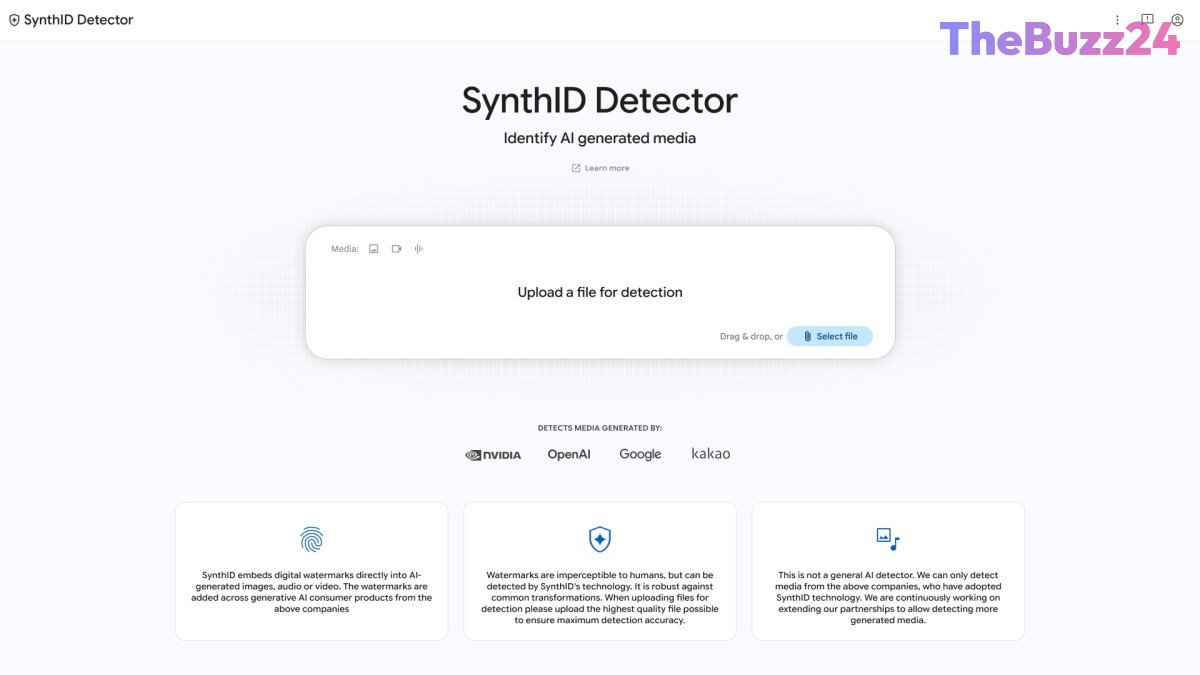
Google Opens Up SynthID Verification Platform to the Public for AI Media Detection
Google has officially launched a public web platform designed to help users determine whether images, videos, or audio files have been created by artificial intelligence. Initially introduced to a restricted group of researchers, journalists, and media professionals during the Google I/O conference last year, the verification system is now accessible to the general public.
The newly opened platform accommodates a wide variety of file formats, ranging from standard image types like JPEG, PNG, and WebP to video containers such as MP4 and WebM, alongside audio formats including WAV, MP3, and FLAC. Underpinning this verification infrastructure is SynthID, a watermarking technology first unveiled by the tech giant in 2023. This tool seamlessly embeds imperceptible digital watermarks into content generated by proprietary systems such as Gemini, Veo, Lyria, and various other creative applications.
Industry adoption of the watermarking standard continues to expand beyond its creator. Major industry players including OpenAI, Nvidia, and Kakao have integrated support for SynthID, with Apple reportedly preparing to incorporate the technology soon. Furthermore, Google has integrated SynthID verification directly into the Gemini application and the Google Chrome browser, processing roughly one million verification requests daily.
Despite these advancements in digital provenance, the broader tech landscape features competing methodologies. Rivals like Microsoft and Meta have developed their own independent verification and watermarking frameworks. However, industry analysts note that these alternative solutions occasionally struggle to reliably flag content produced by their respective developers’ generative models, highlighting the ongoing technical challenges of combating deepfakes and misinformation online.
Key Takeaways
- Google has made its SynthID verification website publicly accessible for checking AI-generated images, videos, and audio.
- The platform supports a broad range of standard file formats, including JPG, PNG, MP4, WAV, and WEBM.
- Major technology companies like OpenAI, Nvidia, and Kakao also support SynthID, with daily verification requests reaching one million.
Editor’s Analysis & Impact
The public rollout of Google’s SynthID verification platform marks a significant step forward in the ongoing battle against deepfakes and synthetic media misinformation. As generative artificial intelligence becomes increasingly sophisticated, distinguishing between authentic and machine-made content has grown challenging for the average internet user. By democratizing access to verification tools and securing cross-industry backing from firms like OpenAI and Nvidia, the tech sector is moving toward a standardized approach to digital provenance. However, the true efficacy of these watermarking systems will depend on widespread, universal adoption and resilience against adversarial tampering. Looking ahead, mandatory content labeling and browser-level integration are expected to become standard cybersecurity protocols, reshaping how digital media is trusted and consumed globally.
Frequently Asked Questions
Q: What is Google's SynthID?
A: SynthID is a watermarking technology developed by Google that embeds imperceptible digital markers into AI-generated images, videos, and audio files to help identify their origin.
Q: What file formats does the new SynthID website support?
A: The platform supports various image formats (JPG, PNG, WEBP, GIF, etc.), video formats (MP4, MOV, WEBM), and audio formats (WAV, MP3, FLAC, AAC, among others).
Q: Which other companies support SynthID?
A: OpenAI, Nvidia, and Kakao currently support SynthID, and Apple is reportedly planning to add support in the near future.
AI Disclosure: This article is based on verified data and official reports. Our Team and AI have cross-referenced every financial detail with primary sources to ensure total accuracy.
More from this Category