Google Unveils Advanced AI Weather Model Promising Unprecedented Accuracy
Google has launched its latest artificial intelligence weather forecasting model, WeatherNext 3, a significant advancement developed by its DeepMind and Google Research divisions. This new AI is designed to provide a clearer view of atmospheric conditions and predict weather patterns with greater frequency and precision than ever before. The insights generated by WeatherNext 3 will be integrated into various Google products, including Search, Google Maps, and Gemini, while also being made accessible to researchers and users via Google’s cloud platforms.
This sophisticated model has already demonstrated superior performance, outperforming leading AI contenders and traditional forecasting methods on the Operational WeatherBench benchmark. WeatherNext 3 surpasses not only other deep-learning models from major tech companies like Microsoft and Nvidia, but also established forecasts from government agencies such as the U.S. National Weather Service and the European Centre for Medium-Range Weather Forecasting (ECMWF). Unlike conventional weather predictions that rely on expensive and time-consuming supercomputer simulations of physical equations, WeatherNext 3 leverages deep learning to analyze vast datasets, learning complex patterns to deliver faster and comparably accurate results.
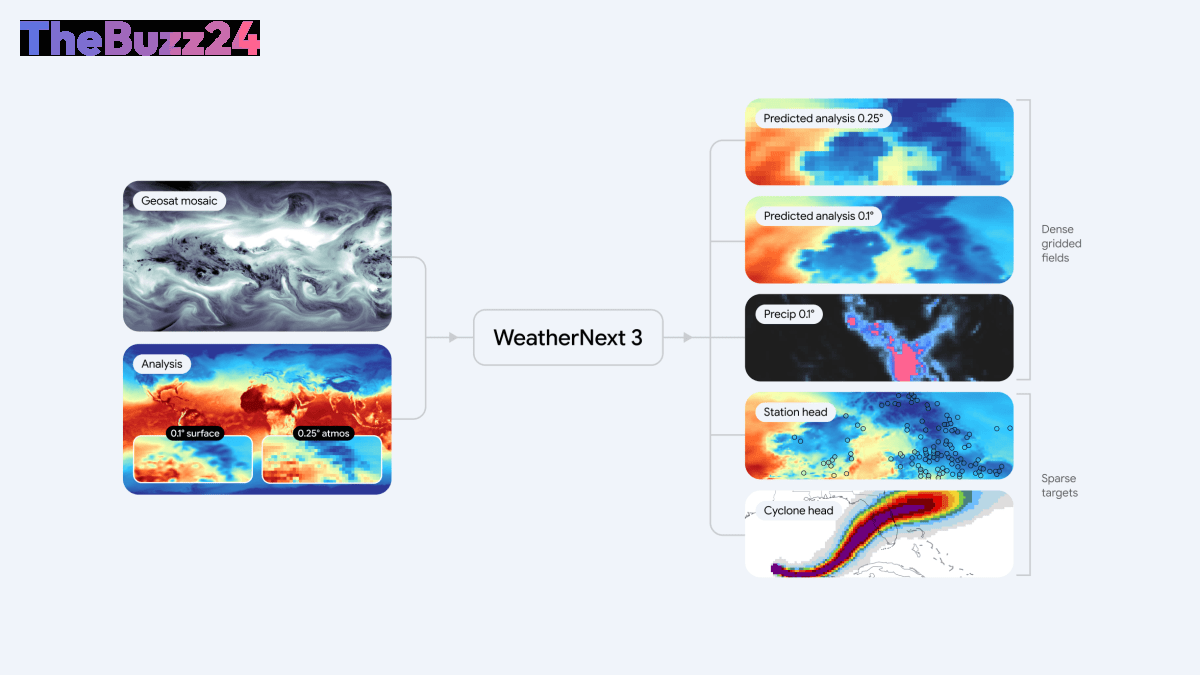
WeatherNext 3 addresses key limitations previously faced by AI weather models. It offers predictions with a significantly improved resolution of up to 5 km, a substantial leap from the broader areas typically covered. Furthermore, its accuracy in predicting rainfall has seen a 60% enhancement compared to its predecessor, and it now provides hourly forecasts, a considerable upgrade from the previous six-hour intervals. These advancements are attributed to a larger model architecture with more parameters and a refined approach to data processing, including the ability to ingest real-time satellite data and target forecasts to specific ground-truth weather stations for more granular and verifiable predictions.
The implications of such advanced AI weather forecasting extend beyond user convenience. The increased speed and reduced cost associated with AI models could democratize access to accurate weather information, particularly benefiting developing regions where sophisticated infrastructure is scarce. Experts suggest that improved forecasts can enhance agricultural yields, support the reliability of renewable energy projects by predicting wind and solar conditions, and ultimately provide more useful, localized weather information to the public.
Key Takeaways
- Google's new WeatherNext 3 AI model offers significantly improved accuracy and resolution in weather forecasting.
- The model surpasses both traditional supercomputer-based forecasts and other leading AI weather prediction systems.
- Advanced AI weather forecasting has the potential to improve agriculture, renewable energy, and provide more accessible, granular weather data globally.
Editor’s Analysis & Impact
Google’s introduction of WeatherNext 3 marks a pivotal moment in meteorological technology, signaling a definitive shift towards AI-driven forecasting. The model’s superior accuracy and granularity challenge the long-standing dominance of traditional physics-based supercomputers, promising not only enhanced user-facing weather information but also substantial economic and societal benefits. By reducing the cost and increasing the speed of high-quality forecasts, this technology could democratize access to critical weather data, empowering sectors like agriculture and renewable energy, especially in underserved regions. The ongoing competition and advancements in this field suggest a future where AI plays an indispensable role in understanding and predicting our planet’s complex climate.
Frequently Asked Questions
Q: How does WeatherNext 3 differ from traditional weather forecasts?
A: WeatherNext 3 uses deep learning AI to analyze vast amounts of data, allowing for faster predictions with comparable or superior accuracy to traditional forecasts, which rely on complex physics-based simulations run on expensive supercomputers.
Q: What are the key improvements in WeatherNext 3?
A: WeatherNext 3 offers higher resolution predictions (down to 5 km), significantly improved rain forecasting accuracy (60% better than its predecessor), and hourly forecast intervals, compared to the previous six-hour standard.
Q: What are the broader implications of this AI weather model?
A: The model's efficiency and accuracy can lead to better crop yields, more reliable renewable energy generation, and make crucial weather information more accessible and affordable for developing countries and various industries.
AI Disclosure: This article is based on verified data and official reports. Our Team and AI have cross-referenced every financial detail with primary sources to ensure total accuracy.
More from this Category