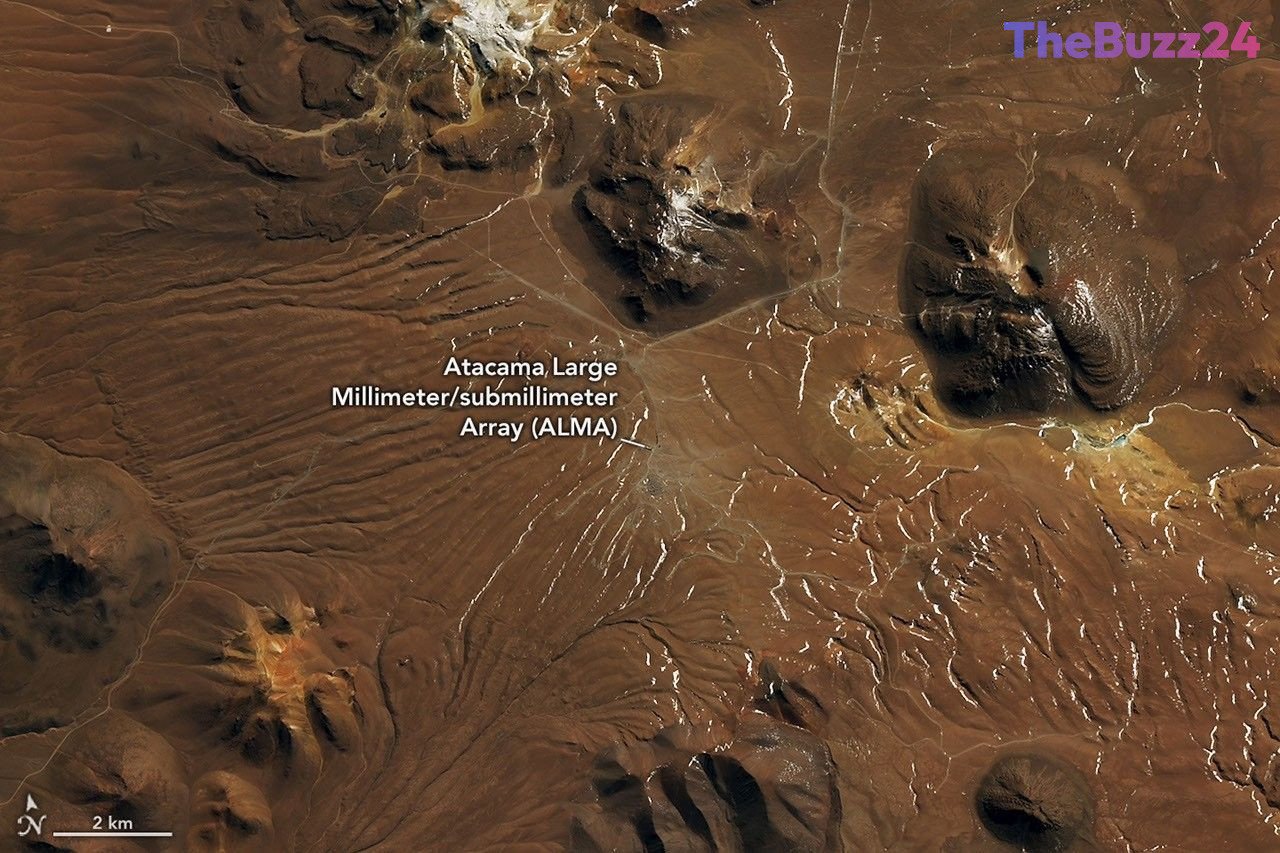
Historic Winter Storm Blankets Atacama Desert, Disrupting Observatories and Causing Flash Floods
Northern Chile’s Atacama Desert, one of the world’s driest regions, experienced an exceptionally rare and widespread snowfall event in August 2026. Satellite imagery captured by the Landsat 8 and Landsat 9 satellites revealed a dramatic transformation of the landscape, with vast areas turning from arid brown to a blanket of white. While the region has seen snow before, notably in 2011 and 2025, the 2026 event was distinguished by its extensive reach, stretching from the high altitudes of the Andes mountains down towards the Pacific coast.
The severe winter storms significantly impacted scientific operations in the area. The Chajnantor plateau, home to the Atacama Large Millimeter/submillimeter Array (ALMA), one of the planet’s most powerful radio telescopes, was completely covered in snow. High winds and heavy snowfall forced ALMA to suspend operations, moving its sensitive antennas into a protective “survival mode.” Further west, near the Chilean port city of Antofagasta, other major astronomical observatories also halted activities as the snow extended across the desert’s hyper-arid core, close to the coastline.
Meteorological analysis indicates that the extreme weather was primarily driven by cutoff low-pressure systems. These systems, which detach from the main jet stream, occasionally reach northern Chile. The late-August 2026 storm originated from an unusually large trough that spanned a significant portion of the Southern Hemisphere. This atmospheric disruption, coupled with abundant moisture from the Pacific, generated precipitation of a magnitude rarely observed in the region. In some coastal areas, such as Taltal, nearly 40 millimeters (1.6 inches) of rain fell in just three days, approximately ten times its annual average.
Beyond the scientific disruptions, the unprecedented precipitation had severe humanitarian consequences. The abundant rainfall and snowmelt triggered destructive mudflows and flash flooding across parts of northern Chile. The National Disaster Prevention and Response Service (SENAPRED) reported that thousands of residents were affected, with hundreds of homes sustaining major damage. Experts note that the strengthening El Niño phenomenon served as a backdrop for this anomalously wet winter, weakening the subtropical Pacific high and shifting the Southern Hemisphere storm track equatorward, thereby increasing the likelihood of such extreme weather events in the region.
Key Takeaways
- The Atacama Desert experienced unusually widespread snowfall in August 2026, extending from the Andes to near the Pacific coast, a rare occurrence for the hyper-arid region.
- The severe weather, including snow and high winds, forced major astronomical observatories like ALMA to suspend operations and enter protective modes.
- The extreme precipitation, linked to cutoff low-pressure systems and a strengthening El Niño, also caused destructive mudflows and flash flooding, affecting thousands of people and damaging hundreds of homes.
Editor’s Analysis & Impact
This extraordinary weather event in the Atacama Desert underscores the increasing vulnerability of even the most extreme environments to climate variability. For the scientific community, particularly astronomy, the disruption to observatories like ALMA highlights the operational challenges posed by unpredictable weather patterns, potentially impacting research timelines and data collection. The broader implications point to the significant influence of global climate phenomena like El Niño, which can dramatically alter regional weather, leading to both rare snowfall and devastating floods. This event serves as a critical reminder for infrastructure planning and disaster preparedness in regions traditionally considered immune to such widespread precipitation, suggesting a need for more resilient systems in the face of a changing climate.
Frequently Asked Questions
Q: How rare is snow in the Atacama Desert?
A: While some snowfall has occurred in recent years (e.g., 2011, 2025), the August 2026 event was notably widespread, covering areas from the Andes to near the Pacific coast, making it a particularly rare occurrence for this hyper-arid region.
Q: What caused this unusual snowfall and precipitation?
A: The extreme weather was primarily caused by cutoff low-pressure systems spinning off an unusually large atmospheric trough, combined with ample coastal moisture. The strengthening El Niño phenomenon is also identified as a significant contributing factor, weakening the subtropical Pacific high and shifting storm tracks.
Q: What were the immediate consequences of the storms?
A: The storms led to the suspension of operations at major astronomical observatories like ALMA, and the abundant precipitation resulted in destructive mudflows and flash flooding across northern Chile, affecting thousands of people and damaging hundreds of homes.
AI Disclosure: This article is based on verified data and official reports. Our Team and AI have cross-referenced every financial detail with primary sources to ensure total accuracy.
More from this Category