Hubble Reveals Dynamic Heart of Distant Spiral Galaxy IC 486
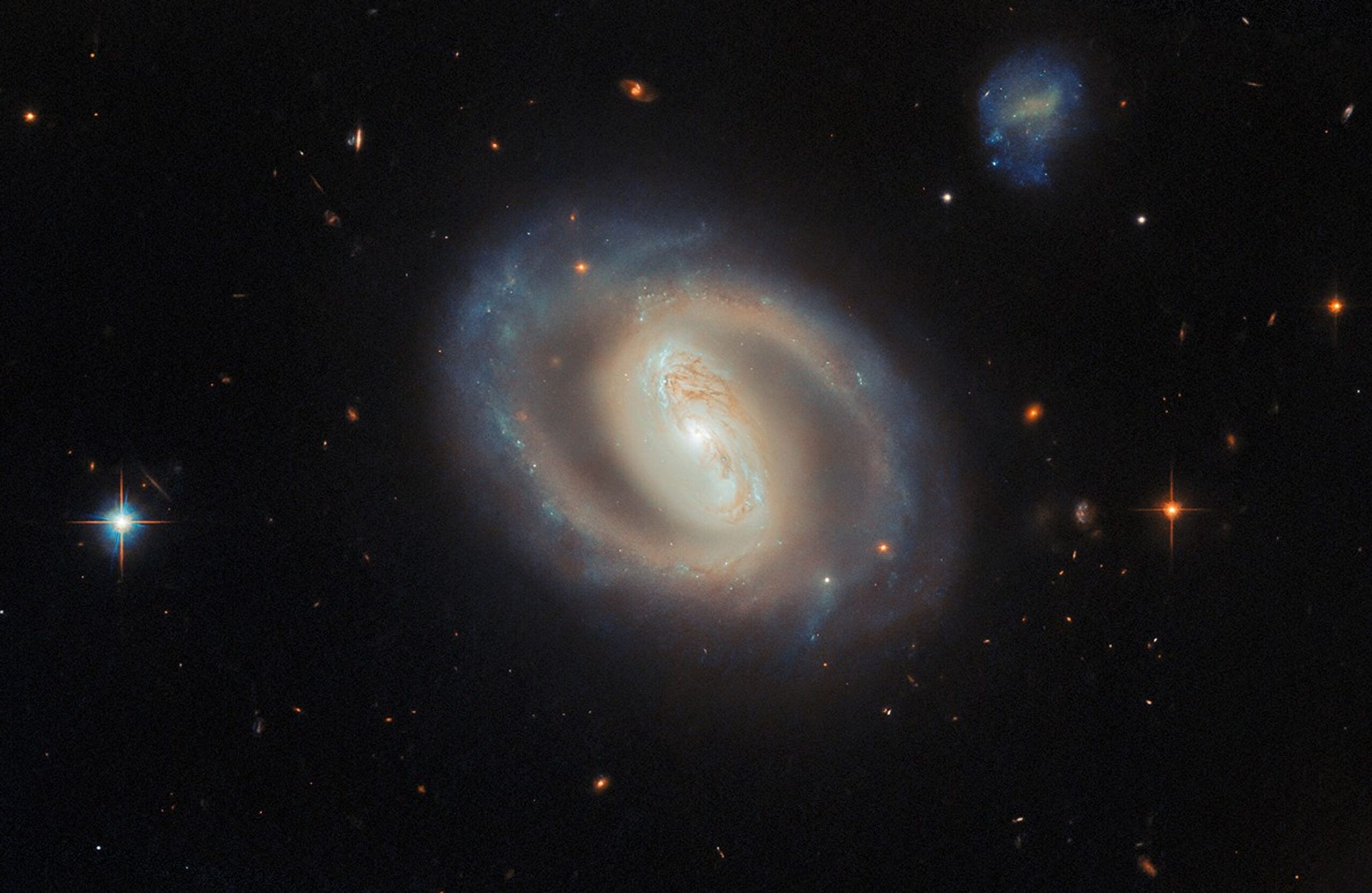
The Hubble Space Telescope has unveiled a striking new image of IC 486, a barred spiral galaxy situated roughly 380 million light-years from Earth in the direction of the Gemini constellation. The galaxy is defined by a prominent central bar that serves as the anchor for its expansive, swirling spiral arms. This high-resolution capture offers astronomers a unique opportunity to observe the contrast between the aging stellar populations concentrated in the core and the vibrant, blue-tinted regions of active star formation located along the outer disk.
At the center of this cosmic structure resides an active galactic nucleus (AGN), powered by a supermassive black hole with a mass exceeding 100 million times that of our Sun. This black hole exerts a profound influence on its surroundings, drawing in vast quantities of gas and dust. The resulting accretion disk generates such immense energy that it frequently outshines the combined light of the billions of stars within the galaxy, marking IC 486 as a critical subject for studying the relationship between central black holes and their host galaxies.
Researchers are leveraging this data to better understand the evolution of galactic morphology. By combining professional analysis with collaborative efforts like the Galaxy Zoo project, scientists are creating robust datasets that are also being used to train machine learning algorithms. These models are expected to be vital for managing the influx of data anticipated from next-generation space observatories. The image also captures the broader cosmic environment, featuring foreground stars with characteristic diffraction spikes and a distant background populated by faint, reddish galaxies.
While the snapshot presents a serene view of the cosmos, IC 486 remains a highly dynamic environment. It is a system in constant flux, shaped by the interplay of gravitational forces and the perpetual cycle of stellar birth and death, providing a window into the complex processes that govern the universe on a galactic scale.
Key Takeaways
- Hubble captured a detailed image of IC 486, a barred spiral galaxy located 380 million light-years away.
- The galaxy features an active galactic nucleus powered by a supermassive black hole over 100 million times the mass of the Sun.
- Data from this observation is being used to train machine learning models to assist in processing future astronomical data.
Editor’s Analysis & Impact
The observation of IC 486 underscores the critical role of high-resolution space imaging in modern astrophysics. By focusing on galaxies with active galactic nuclei (AGN), researchers can better map the feedback loops between supermassive black holes and their host galaxies, a fundamental aspect of galactic evolution. The integration of machine learning into this research represents a significant shift in how the scientific community handles the ‘big data’ era of astronomy. As we prepare for the next generation of space telescopes, the ability to automate the classification and analysis of galactic structures will be paramount. This study not only advances our understanding of specific celestial objects but also refines the computational tools necessary to unlock the mysteries of the deep universe, ensuring that we can interpret the vast amounts of information coming from future deep-space missions.
Frequently Asked Questions
Q: What makes IC 486 an 'active' galaxy?
A: IC 486 is classified as an active galaxy because it contains an active galactic nucleus (AGN). This is a region at the center of the galaxy powered by a supermassive black hole that consumes surrounding matter, releasing intense radiation in the process.
Q: Why are machine learning models being used to study these images?
A: Machine learning is being used to process the massive volumes of data generated by space telescopes. These models help researchers classify galactic morphology more efficiently, which is essential for handling the large datasets expected from upcoming space-based observatories.
AI Disclosure: This article is based on verified data and official reports. Our Team and AI have cross-referenced every financial detail with primary sources to ensure total accuracy.
More from this Category