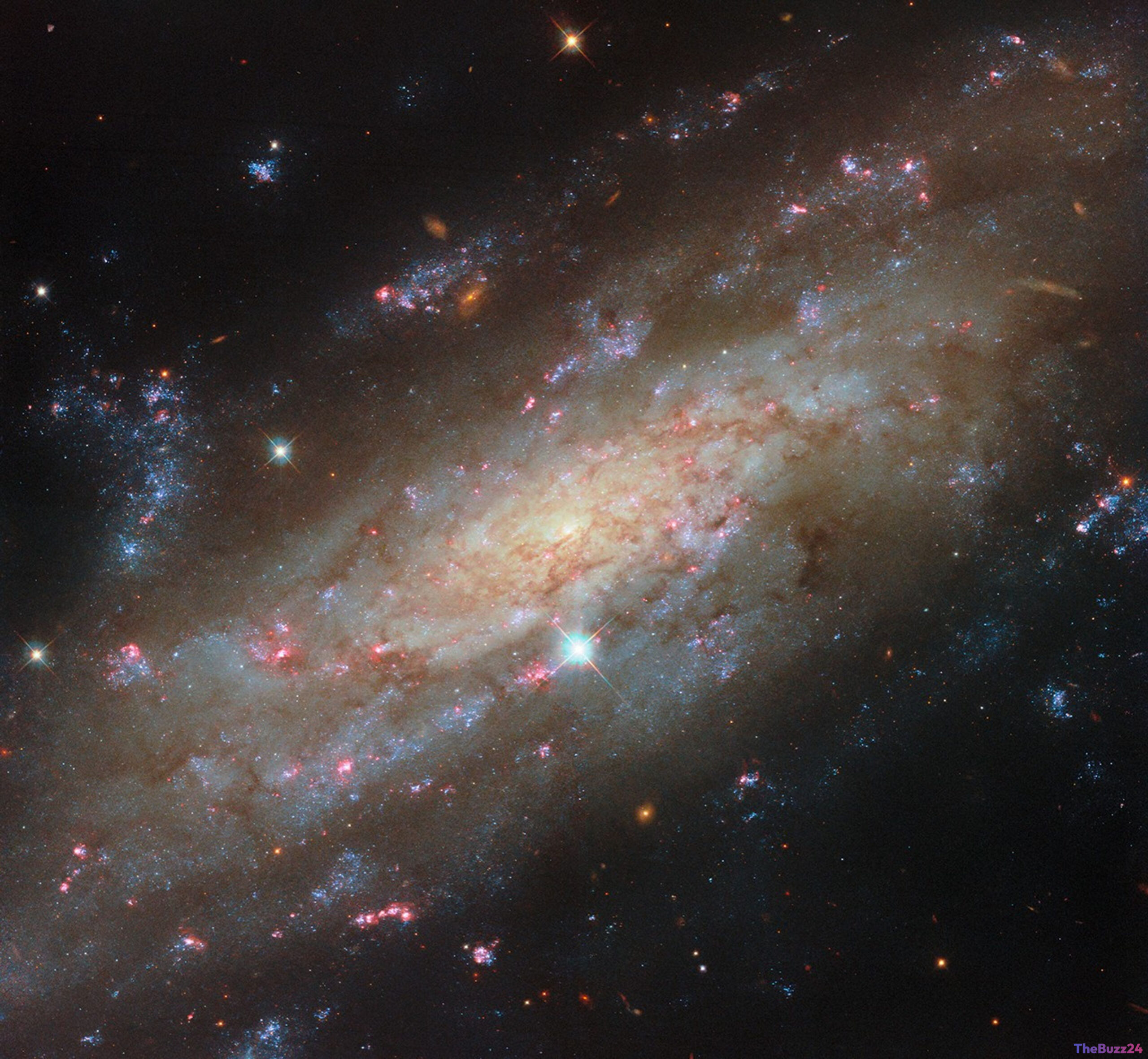
Cosmic Twin: Hubble Captures Stunning Details of Nearby Spiral Galaxy NGC 3137
A spectacular new image captured by the Hubble Space Telescope has revealed the glittering spiral galaxy NGC 3137 in unprecedented detail. Located approximately 53 million light-years away in the constellation Antlia, also known as the Air Pump, this nearby stellar system offers astronomers an exceptional vantage point to study the complex lifecycles of stars. Because of its proximity and structure, the galaxy serves as a vital cosmic laboratory, allowing researchers to draw direct comparisons to our own galactic neighborhood.
NGC 3137 is of immense scientific interest because it belongs to the NGC 3175 galaxy group, a cluster of galaxies remarkably similar to our own Local Group. Just as the Local Group is dominated by two massive spiral structures—the Milky Way and Andromeda—the NGC 3175 group is anchored by NGC 3137 and its companion, NGC 3175. Both groups also host a multitude of smaller dwarf galaxies. While the exact number of dwarf companions in the NGC 3175 group remains unconfirmed, researchers have already identified more than 500 potential candidates. By analyzing the gravitational dynamics of this sister group, scientists hope to unlock secrets about the history and future of our own home galaxy.
Hubble’s highly detailed portrait of NGC 3137 was constructed using observations across six different color bands. The image showcases a highly inclined perspective, offering a clear view of the galaxy’s loose, feathery spiral arms. At its core lies a supermassive black hole estimated to be roughly 60 million times the mass of our Sun, surrounded by a dense network of cosmic dust. The most striking features, however, are the brilliant blue star clusters and glowing red gas clouds scattered throughout the spiral arms. These vibrant regions represent active stellar nurseries, where hot, young stars are currently emerging from their birth nebulae.
These active star-forming regions are the primary focus of an ongoing Hubble observing program targeting star clusters across 55 nearby galaxies. This research is part of the Physics at High Angular Resolution in Nearby Galaxies (PHANGS)-HST initiative. By combining Hubble’s optical and ultraviolet capabilities with infrared data from the James Webb Space Telescope and radio observations from the Atacama Large Millimeter/submillimeter Array (ALMA), astronomers are building a comprehensive, multi-wavelength map of star formation across the local universe.
Key Takeaways
- Hubble has captured a highly detailed, multi-wavelength image of the spiral galaxy NGC 3137, located 53 million light-years away.
- The galaxy belongs to a group that structurally mirrors our own Local Group, providing key insights into Milky Way dynamics.
- The observations are part of the collaborative PHANGS program, which combines data from Hubble, James Webb, and ALMA to study stellar lifecycles.
Editor’s Analysis & Impact
The detailed imaging of NGC 3137 highlights the growing power of multi-wavelength astronomy. By combining the ultraviolet and optical strengths of the Hubble Space Telescope with the infrared precision of the James Webb Space Telescope and the radio capabilities of the Atacama Large Millimeter/submillimeter Array (ALMA), scientists are entering a golden age of cosmic mapping. This collaborative approach, exemplified by the PHANGS program, allows researchers to bypass cosmic dust and observe the earliest stages of star birth with unprecedented clarity. Beyond pure discovery, studying galactic groups like NGC 3175 provides vital context for understanding the evolutionary trajectory of our own Milky Way. As these observational databases grow, they lay the groundwork for future deep-space missions and refine our fundamental models of galactic dynamics and stellar lifecycles.
Frequently Asked Questions
Q: Why is the galaxy NGC 3137 significant to astronomers?
A: NGC 3137 resides in a galaxy group that closely mirrors our own Local Group, featuring two dominant spiral galaxies and numerous dwarf companions. This similarity makes it an ideal laboratory for studying the dynamics and history of our own galactic neighborhood.
Q: What instruments are being used alongside Hubble to study this galaxy?
A: The study of NGC 3137 is part of the PHANGS program, which integrates optical and ultraviolet data from Hubble with infrared observations from the James Webb Space Telescope and radio data from the Atacama Large Millimeter/submillimeter Array (ALMA).
Q: What do the blue clusters and red clouds in the image represent?
A: The bright blue clusters represent hot, young stars, while the glowing red gas clouds signify active stellar nurseries where new stars are still forming from their parent nebulae.
AI Disclosure: This article is based on verified data and official reports. Our Team and AI have cross-referenced every financial detail with primary sources to ensure total accuracy.
More from this Category