Hubble Unveils Stunning New Imagery of Elusive Dwarf Galaxy ESO 490-017
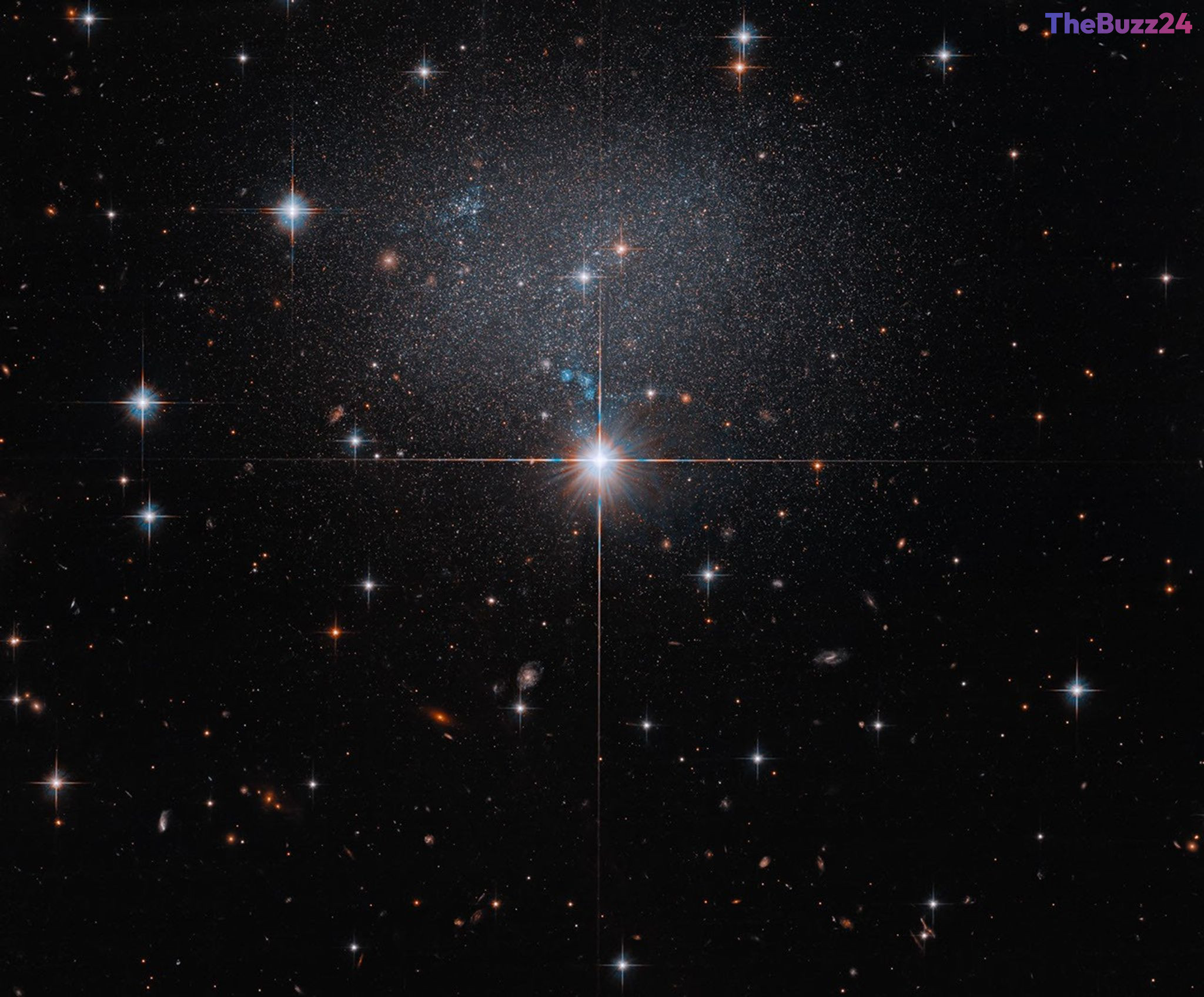
The Hubble Space Telescope has successfully captured high-resolution imagery of ESO 490-017, a dwarf irregular galaxy located approximately 23 million light-years away in the Canis Major constellation. Spanning roughly 12,000 light-years, the galaxy is characterized by its low surface brightness, making it a faint and diffuse collection of stars that is notoriously difficult to observe against the backdrop of deep space. The latest images provide a clear view of the galaxy, framed by bright foreground stars and distant spiral galaxies.
This observation is a vital component of a broader scientific initiative to map the ‘cosmic flow’—the large-scale movement of matter driven by the uneven distribution of gravitational forces throughout the universe. By tracking the trajectories of galaxies and clusters, researchers are working to better understand the underlying structure of the cosmos and the gravitational mechanisms that dictate how celestial bodies evolve over billions of years.
To establish the precise distance to ESO 490-017, astronomers utilized the luminosity of low-mass red giant stars. These stars act as ‘standard candles,’ providing a reliable metric for measuring cosmic distances. This data is being added to an extensive archive of stellar populations in the local universe, which serves as a foundational resource for refining models of galactic evolution and improving the accuracy of maps depicting our immediate cosmic neighborhood.
Key Takeaways
- Hubble captured detailed imagery of the faint dwarf irregular galaxy ESO 490-017, located 23 million light-years from Earth.
- The research supports a larger effort to map 'cosmic flow' and understand how gravity influences the movement of galaxies.
- Scientists used red giant stars as 'standard candles' to accurately calculate the distance to the galaxy.
Editor’s Analysis & Impact
The imaging of ESO 490-017 is a significant milestone in mapping the architecture of our local universe. By targeting low-surface-brightness dwarf galaxies, astronomers are effectively filling in critical gaps in our cosmic map that were previously inaccessible. The study of ‘cosmic flow’ is essential for providing empirical evidence regarding the distribution of dark matter and the gravitational influence of large-scale structures. As this legacy archive of stellar populations grows, the increased precision in modeling galactic evolution will likely yield major breakthroughs in cosmology. This data provides a necessary framework for future deep-space missions, including those involving the James Webb Space Telescope, to further investigate the formation and evolution of diffuse galactic structures.
Frequently Asked Questions
Q: What is a 'standard candle' in astronomy?
A: A standard candle is an astronomical object with a known luminosity, such as a red giant star, which allows scientists to calculate its distance from Earth by comparing its known brightness to how bright it appears in the sky.
Q: Why is the 'cosmic flow' important to study?
A: Studying cosmic flow helps astronomers understand how gravity and the distribution of matter, including dark matter, influence the movement of galaxies across the universe, providing insights into the large-scale structure of the cosmos.
AI Disclosure: This article is based on verified data and official reports. Our Team and AI have cross-referenced every financial detail with primary sources to ensure total accuracy.
More from this Category