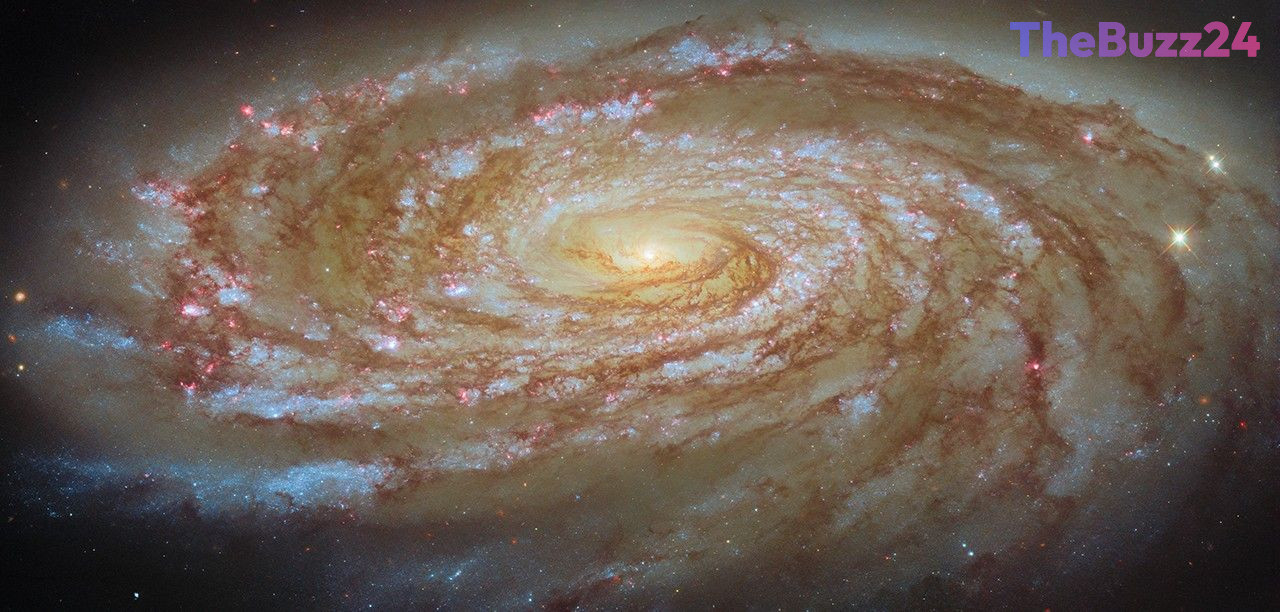
Hubble Telescope Captures the Turbulent Evolution of Galaxy M88
The Hubble Space Telescope has captured a detailed view of Messier 88 (M88), a prominent spiral galaxy located 63 million light-years away in the Coma Berenices constellation. At the center of this galaxy sits a supermassive black hole with a mass approximately 100 million times that of our Sun. This massive core influences the galaxy’s structure, creating a stark visual contrast between the older, reddish stars at the center and the bright, youthful star clusters found within its tightly wound spiral arms.
Currently, M88 is on a gravitational journey toward the heart of the Virgo Cluster, a massive collection of over a thousand galaxies. Within the next 200 to 300 million years, it is expected to reach its closest point to Messier 87, the cluster’s primary elliptical anchor. This trajectory exposes M88 to significant environmental stress, specifically a phenomenon known as ram pressure stripping, where the dense intergalactic medium acts like a wind, forcibly removing the galaxy’s internal gas reserves.
Evidence of this process is already visible, as astronomers have noted that M88’s gas disk is being compressed, similar to snow piling up in front of a plow. The galaxy currently holds less cold gas than expected for its size, indicating that its transit through the crowded cluster is actively suppressing its ability to form new stars. By utilizing the Wide Field Camera 3, researchers are using M88 as a vital case study to understand how the harsh conditions within galaxy clusters dictate the long-term evolution and life cycles of spiral galaxies across the universe.
Key Takeaways
- M88 is a spiral galaxy featuring a supermassive black hole 100 million times the mass of the Sun.
- The galaxy is currently migrating toward the center of the Virgo Cluster, where it will face intense ram pressure stripping.
- Observations show that M88 is already losing cold gas, which is actively hindering its ability to produce new stars.
Editor’s Analysis & Impact
The study of M88 provides critical insights into the environmental factors that dictate galactic evolution. By observing a galaxy in the midst of a ‘cosmic collision’ with the dense intergalactic medium of the Virgo Cluster, astronomers can better model the life cycles of spiral galaxies. The phenomenon of ram pressure stripping is a key mechanism in galaxy quenching, where galaxies transition from active star-forming entities to ‘red and dead’ systems. Understanding this process is essential for mapping the history of the universe and predicting the ultimate fate of galaxies that reside in high-density environments. As observational technology improves, these findings will likely refine our broader understanding of how dark matter and gravitational forces shape the large-scale structure of the cosmos.
Frequently Asked Questions
Q: What is ram pressure stripping?
A: Ram pressure stripping is an astrophysical process where a galaxy moving through a dense intergalactic medium experiences a 'wind' that forcibly removes its internal gas, often halting star formation.
Q: Why is M88 losing its ability to form new stars?
A: M88 is losing its cold gas reserves due to the environmental pressures of traveling through the crowded Virgo Cluster, which strips away the raw materials necessary for creating new stars.
AI Disclosure: This article is based on verified data and official reports. Our Team and AI have cross-referenced every financial detail with primary sources to ensure total accuracy.
More from this Category