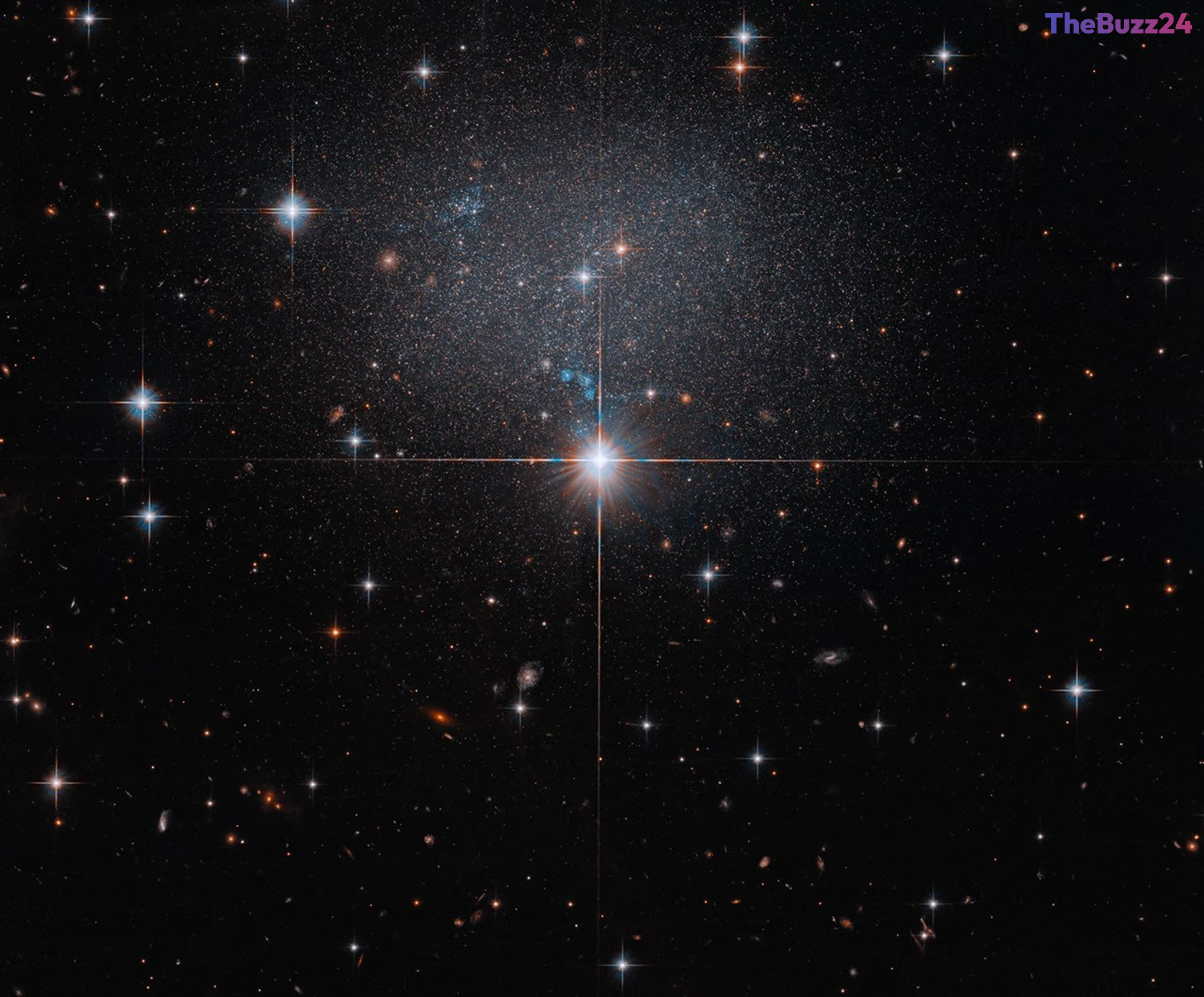
Hubble Telescope Reveals Hidden Beauty of Distant Dwarf Galaxy ESO 490-017
The Hubble Space Telescope has successfully captured a detailed image of ESO 490-017, a dwarf irregular galaxy situated about 23 million light-years from Earth in the Canis Major constellation. Spanning approximately 12,000 light-years, the galaxy is notable for its remarkably low surface brightness, which renders it a faint, shimmering collection of stars that is difficult to observe against the backdrop of deep space. The high-resolution imagery highlights the galaxy’s delicate structure, contrasted against foreground stars marked by distinct diffraction spikes and a distant field of spiral galaxies in various hues.
This observation is part of a significant scientific effort to map the movement of galaxies and clusters across the universe. By tracking these celestial bodies, researchers are working to better understand the ‘cosmic flow,’ a phenomenon influenced by the non-uniform distribution of matter throughout space. Because matter is distributed unevenly, its gravitational pull plays a decisive role in the large-scale evolution and movement of structures within the cosmos.
The data collected from this mission provides essential insights into the gravitational forces that dictate the architecture of the universe. By studying the trajectories of galaxies like ESO 490-017, astronomers are refining existing models regarding how cosmic structures interact and develop over billions of years. These findings are crucial for deepening our comprehension of the fundamental forces that continue to shape the evolution of the universe.
Key Takeaways
- The Hubble Space Telescope captured a high-resolution image of the low-surface-brightness dwarf galaxy ESO 490-017.
- The observation is part of a larger initiative to map 'cosmic flow' and understand how matter distribution influences galaxy movement.
- Data from this study helps astronomers refine models regarding the gravitational forces that shape the evolution of the universe.
Editor’s Analysis & Impact
The observation of ESO 490-017 represents a significant step forward in our ability to map the large-scale structure of the universe. By focusing on low-surface-brightness galaxies, astronomers are filling in gaps in our understanding of how matter is distributed in the cosmos. The ‘cosmic flow’ research is vital because it challenges and refines our current cosmological models, which rely heavily on the influence of gravity on dark and visible matter. As we continue to gather data on these faint structures, the implications for our understanding of dark matter and the expansion of the universe are profound. This research not only provides a clearer picture of our current cosmic neighborhood but also serves as a foundational element for future deep-space exploration and theoretical physics, potentially revealing how the universe will continue to evolve over the next several billion years.
Frequently Asked Questions
Q: What is a dwarf irregular galaxy?
A: A dwarf irregular galaxy is a small galaxy that lacks a distinct regular shape, such as a spiral or elliptical structure, and typically contains lower amounts of heavy elements compared to larger galaxies.
Q: Why is the 'cosmic flow' important to astronomers?
A: The cosmic flow refers to the large-scale motion of galaxies and clusters driven by gravity. Understanding this flow helps scientists map the distribution of matter in the universe and test the accuracy of cosmological models.
AI Disclosure: This article is based on verified data and official reports. Our Team and AI have cross-referenced every financial detail with primary sources to ensure total accuracy.
More from this Category