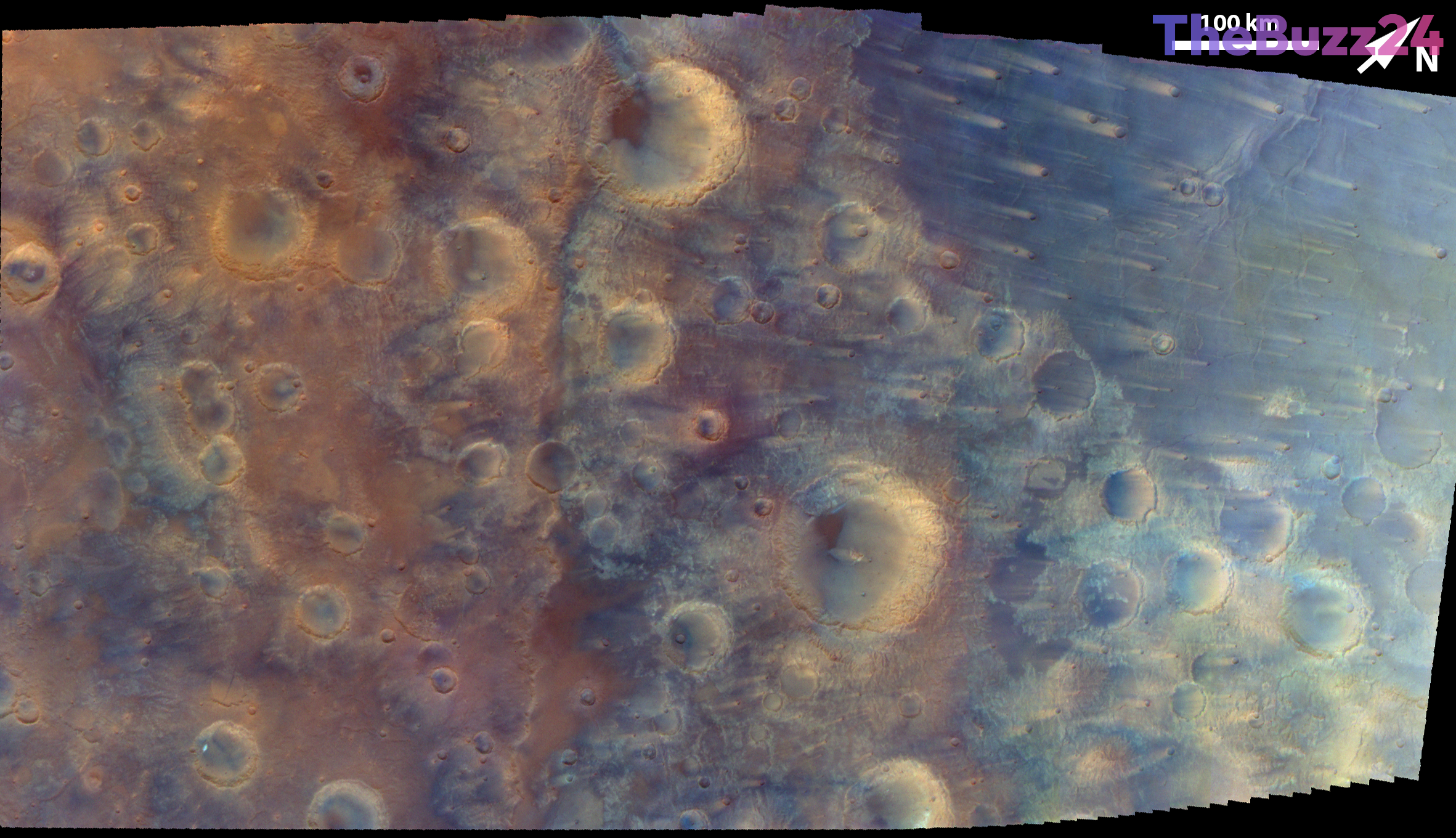
Psyche Spacecraft Captures Stunning High-Resolution Mosaic of Mars During Deep Space Flyby
In a remarkable display of deep-space imaging capabilities, the Psyche spacecraft has successfully captured a highly detailed, enhanced-color mosaic of the Martian surface during a close flyby. Utilizing its advanced multispectral imager, the spacecraft gathered a series of exposures that have been stitched together to reveal the complex geological tapestry of the Red Planet. The flyby, which occurred on May 15, 2026, offered a unique opportunity for the mission to test its scientific instruments while en route to its primary asteroid destination.
The newly released mosaic is composed of four individual images acquired over a brief six-minute window as Psyche traversed the Martian sky from northeast to southwest. Because of the spacecraft’s rapid movement, the resolution of the image varies across the frame, ranging from 381 meters per pixel on the right side to 440 meters per pixel on the left. By combining data from near-infrared, green, and blue spectral filters, scientists have highlighted the stark contrasts between various surface features, including ancient impact craters, wind-swept streaks, rugged ridges, and expansive volcanic plains.
The imaging sweep focused on the Iapygia region, located within the heavily cratered southern highlands of Mars. Among the most prominent features visible is the massive Fournier crater, an impact basin stretching approximately 71 miles (114 kilometers) in diameter. Additionally, the mosaic captures a portion of Oenotria Scopuli, a prominent, irregular cliff system. This scarp is geologically linked to the outer rings of the Isidis impact basin, one of the largest and most significant impact structures on the planet, situated to the northeast of the imaged zone.
While the Psyche mission’s ultimate goal is to study a unique metal-rich asteroid orbiting the Sun between Mars and Jupiter, this Martian flyby serves as a critical operational milestone. The successful calibration and utilization of the multispectral imager during the gravity-assist maneuver demonstrate the spacecraft’s readiness for its upcoming deep-space science operations. The data gathered not only aids in refining the spacecraft’s instruments but also contributes valuable high-resolution observations to the broader planetary science community.
Key Takeaways
- The Psyche spacecraft successfully captured a detailed, four-image mosaic of Mars during a flyby on May 15, 2026.
- The images highlight key Martian geological features, including the 71-mile-wide Fournier crater and the Oenotria Scopuli cliff system.
- The flyby served as a crucial test for the spacecraft's multispectral imager, validating its performance ahead of its primary asteroid mission.
Editor’s Analysis & Impact
The successful imaging of Mars by the Psyche spacecraft represents more than just a stunning visual achievement; it is a vital validation of deep-space optical technology. Gravity-assist flybys are standard orbital mechanics maneuvers used to propel spacecraft toward the outer solar system, but utilizing these brief encounters for high-value science calibration is a masterclass in mission efficiency. By testing the multispectral imager under real-world planetary conditions, mission controllers have ensured that the hardware is fully optimized for its ultimate target: the metal-rich asteroid 16 Psyche. Furthermore, the high-contrast geological data retrieved from the Iapygia region adds another layer of detail to our understanding of Martian history, demonstrating how secondary mission objectives can yield significant scientific dividends. This success bolsters confidence in future multi-target deep-space exploration initiatives.
Frequently Asked Questions
Q: What is the primary objective of the Psyche mission?
A: The Psyche mission is designed to explore a unique, metal-rich asteroid named 16 Psyche, which orbits the Sun between Mars and Jupiter. Scientists believe the asteroid may be the exposed nickel-iron core of an early planetesimal.
Q: How did the spacecraft capture the Martian surface during its flyby?
A: The spacecraft used its multispectral imager, taking four individual exposures over a six-minute period using near-infrared, green, and blue filters to highlight different geological features.
Q: What major geological features are visible in the new Mars mosaic?
A: The mosaic prominently features the 71-mile-wide Fournier crater and Oenotria Scopuli, a long, irregular cliff system associated with the massive Isidis impact basin.
AI Disclosure: This article is based on verified data and official reports. Our Team and AI have cross-referenced every financial detail with primary sources to ensure total accuracy.
More from this Category