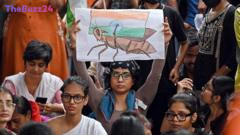
India’s ‘Cockroach’ Protests Escalate: Opposition Joins Thousands Demanding Education Reforms
Thousands of supporters of the ‘Cockroach’ Janta Party (CJP) continue to demonstrate in India’s capital, Delhi, despite heavy rainfall, intensifying pressure on Prime Minister Narendra Modi’s government. The youth-led movement is calling for significant education reforms and the resignation of Education Minister Dharmendra Pradhan. The protests gained considerable momentum on Tuesday when leaders from India’s primary opposition party, Congress, joined demonstrations outside the Prime Minister’s residence.
The Congress party’s involvement followed a contentious police crackdown on Monday’s CJP protest, which resulted in injuries to dozens of protesters and police officers. Videos circulated by Congress showed party MP Rahul Gandhi and other members being detained by police. While later released, the incident fueled further opposition to the government’s handling of the dissent.
On Monday, a massive march organized by the CJP saw tens of thousands converge on central Delhi as the parliamentary monsoon session commenced. Police responded with batons and tear gas to disperse the crowds, and dismantled the protest encampment at Jantar Mantar. However, demonstrators have maintained a continuous sit-in, refusing to vacate the site. The ongoing protest has attracted support from prominent opposition figures, including former Delhi Chief Minister Arvind Kejriwal and veteran politician Sharad Pawar.
Education Minister Dharmendra Pradhan criticized the Congress party for what he termed ‘shamelessly exploiting students as political tools,’ asserting the government’s commitment to reforms and accountability. He suggested the opposition prioritized political spectacle over constructive debate. The CJP, inspired by a controversial remark by India’s chief justice regarding unemployed youth, has evolved into a significant public dissent movement, drawing national attention and support beyond Delhi, with solidarity protests occurring in major cities like Mumbai and Hyderabad. The movement’s visibility has been amplified by activist Sonam Wangchuk, who began an indefinite hunger strike in support of the CJP’s demands and was subsequently taken to a hospital.
Key Takeaways
- Thousands are protesting in Delhi, demanding education reforms and the resignation of the Education Minister.
- The opposition Congress party has joined the protests, criticizing the government's handling of dissent and police actions.
- The 'Cockroach' Janta Party (CJP) movement has grown significantly, drawing national attention and support beyond the capital.
Editor’s Analysis & Impact
The escalating ‘Cockroach’ Janta Party protests highlight a growing public dissatisfaction with the current government’s approach to education and governance. The involvement of major opposition parties signals a potential shift in the political landscape, leveraging public discontent for political gain. The movement’s ability to mobilize large numbers and attract national and international attention underscores the urgency of addressing the underlying issues. The government faces a critical juncture, needing to balance maintaining order with responding to legitimate grievances to avoid further polarization and potential instability. The long-term implications could include increased scrutiny of educational policies and greater public participation in policy-making.
Frequently Asked Questions
Q: What is the 'Cockroach' Janta Party (CJP)?
A: The 'Cockroach' Janta Party (CJP) is a satirical political movement in India that has evolved into a significant protest group. It was reportedly inspired by remarks made by India's chief justice, who used the term 'cockroach' to describe unemployed young people involved in journalism and activism.
Q: Why are people protesting against the Indian government?
A: Protesters, primarily associated with the CJP, are demanding comprehensive education reforms and the resignation of the Education Minister, Dharmendra Pradhan. They also criticize the government's response to their demonstrations, including alleged police brutality.
Q: What role is the opposition playing in these protests?
A: India's main opposition party, Congress, has actively supported the protests. Party leaders, including Rahul Gandhi, have participated in demonstrations and criticized the government's actions, demanding accountability and the resignation of key ministers.
AI Disclosure: This article is based on verified data and official reports. Our Team and AI have cross-referenced every financial detail with primary sources to ensure total accuracy.
More from this Category