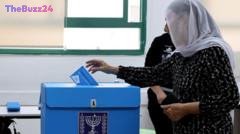
Israel Election Deadlock: Netanyahu and Rival Face Coalition Challenges as Arab Parties Emerge as Potential Kingmakers
Preliminary results from Israel’s general election indicate a deeply divided political landscape, with neither Prime Minister Benjamin Netanyahu nor his main rival, former army chief Gadi Eisenkot, appearing to secure a clear parliamentary majority. The Likud party, led by Netanyahu, has emerged as the largest single party, but its potential coalition with ultra-nationalist and ultra-Orthodox allies falls just short of the 61 seats needed to govern in the 120-seat Knesset. This outcome, however, is subject to change as a significant number of absentee ballots, particularly those from soldiers, are yet to be counted.
Analysts suggest that the current count may be skewed towards areas with strong right-wing support, leaving the final picture uncertain for at least another day or two. In a fragmented political system, both Netanyahu and Eisenkot have addressed their supporters, vowing to form the next government. Netanyahu emphasized the clear majority within the “Zionist public” for a right-wing government, while Eisenkot declared that the public had chosen change and voted against Netanyahu’s continued premiership.
Adding a significant dimension to the potential coalition-building is the performance of parties representing Israel’s Arab minority. These parties, which represent one-fifth of the population and often identify as Palestinian citizens of Israel, appear to have matched or increased their previous seat count. Historically, many Jewish opposition parties have pledged not to cooperate with Arab-majority lists, citing a lack of shared values. However, their increased electoral success could position them as crucial “kingmakers” if other parties are willing to bridge divides and form broader alliances.
The election has been framed by many as a critical juncture for Israel, with debates intensifying over the nation’s trajectory. The current government, led by Netanyahu, has been criticized for pursuing a hardline religious and nationalist agenda. Conversely, a significant portion of the electorate desires a country more firmly rooted in liberal and secular values. The election results, despite the turbulent past four years including the aftermath of the October 7th attacks, have shown remarkably stable voting patterns, underscoring the deep societal divisions that persist.
Key Takeaways
- Israeli election results show a tight race with neither Benjamin Netanyahu nor Gadi Eisenkot securing a clear majority.
- Arab-majority parties could play a pivotal role as 'kingmakers' in forming the next coalition government.
- The election highlights deep divisions within Israeli society regarding the country's political and social direction.
Editor’s Analysis & Impact
The inconclusive results of the Israeli election underscore the persistent political polarization within the country. The potential reliance on Arab-majority parties for coalition formation signals a significant shift, challenging established political norms and potentially forcing a re-evaluation of inter-communal relations. This deadlock could lead to prolonged negotiations, political instability, or even a repeat election. The outcome will have implications not only for domestic policy, particularly concerning judicial reform and societal values, but also for Israel’s international standing and regional dynamics, especially in the current geopolitical climate.
Frequently Asked Questions
Q: What is the significance of the Arab parties in the Israeli election?
A: Arab-majority parties represent a significant bloc within the Israeli parliament. While often facing political marginalization, their increased seat count in this election positions them as potential 'kingmakers,' crucial for forming a governing coalition if other parties are willing to cooperate with them.
Q: Why is forming a coalition in Israel so complex?
A: Israel's political system is highly fragmented, with numerous parties often winning seats. This necessitates complex coalition negotiations where parties must agree on policy, cabinet positions, and budgets to achieve the required majority of 61 seats in the 120-seat parliament. The process can be lengthy and often results in unstable governments or repeat elections.
Q: What are the main issues dividing Israeli voters?
A: Key divisions revolve around the country's direction, with some voters supporting a hardline religious and nationalist trajectory, while others advocate for more liberal and secular values. Benjamin Netanyahu's leadership and his ongoing corruption trial are also central to the political debate.
AI Disclosure: This article is based on verified data and official reports. Our Team and AI have cross-referenced every financial detail with primary sources to ensure total accuracy.
More from this Category