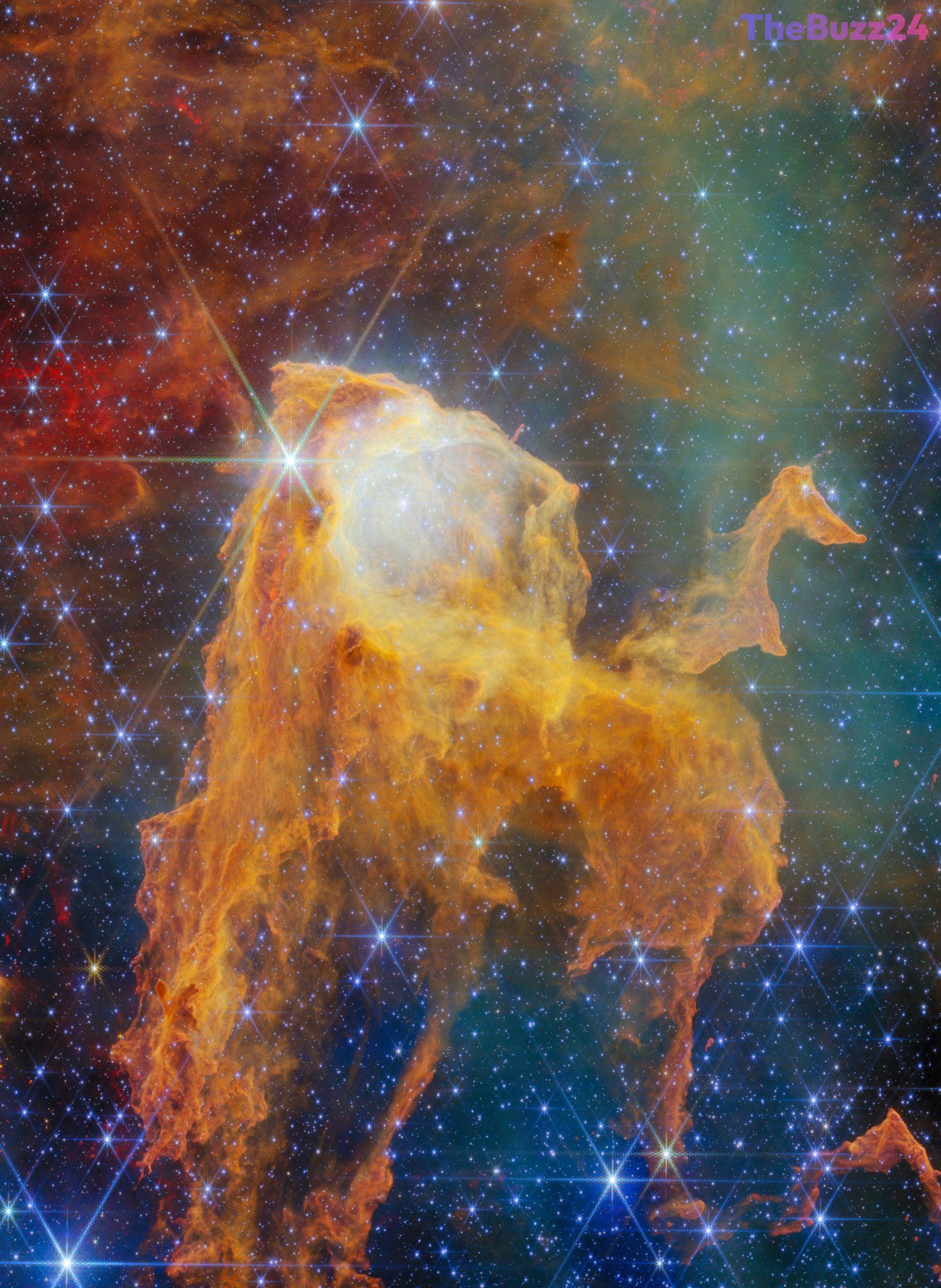
James Webb Space Telescope Reveals Stunning Details of the Carina Nebula’s ‘Treasure Chest’
NASA’s premier infrared observatory has turned its powerful mirrors toward the Carina Nebula, capturing an unprecedented look at a cosmic phenomenon known as the ‘Treasure Chest.’ The newly released imagery, detailed by the space agency, highlights a distinct cometary globule nestled within one of the universe’s most prolific star-forming regions.
The feature itself is an isolated cloud composed of dense gas and dust, characterized by a heavy, darkened head coupled with a sweeping tail that trails behind it. These unique formations are shaped by intense stellar winds and powerful ultraviolet radiation emanating from nearby massive newborn stars, which constantly erode the surrounding interstellar material.
Astronomers utilize the advanced infrared capabilities of the observatory to peer through the thick dust veils that typically obscure these stellar nurseries. By capturing wavelengths invisible to the human eye, researchers can study the intricate physical mechanics governing star formation and the lifecycle of cosmic dust within our galactic neighborhood.
Key Takeaways
- The James Webb Space Telescope captured a detailed infrared image of the 'Treasure Chest' within the Carina Nebula.
- The 'Treasure Chest' is classified as a cometary globule, featuring a dense head and an elongated tail of gas and dust.
- Intense stellar winds and ultraviolet radiation from nearby massive stars actively shape and erode these isolated cosmic clouds.
Editor’s Analysis & Impact
The continuous stream of high-resolution imagery from the James Webb Space Telescope represents a monumental leap forward for observational astronomy and astrophysics. By peering through previously impenetrable dust clouds, researchers are gaining unprecedented insights into stellar genesis and the chemical evolution of galaxies. This ongoing exploration not only deepens our understanding of how stars and planetary systems are born, but it also drives technological advancements in space-based optics and data processing. As these observations continue, the broader implications include refining our models of galactic lifecycle dynamics and potentially uncovering new anomalies that challenge current cosmological theories, thereby sustaining intense public and scientific interest in space exploration infrastructure.
Frequently Asked Questions
Q: What is a cometary globule?
A: A cometary globule is an isolated cloud of gas and dust that features a dense, dark head and a sweeping tail, often resembling a comet.
Q: Why is the James Webb Space Telescope able to see inside the Carina Nebula?
A: The telescope operates primarily in the infrared spectrum, which allows its instruments to pierce through thick layers of cosmic dust that block visible light.
Q: What shapes structures like the 'Treasure Chest'?
A: These structures are primarily shaped and sculpted by the intense stellar winds and powerful ultraviolet radiation emitted by nearby massive newborn stars.
AI Disclosure: This article is based on verified data and official reports. Our Team and AI have cross-referenced every financial detail with primary sources to ensure total accuracy.
More from this Category