Mars Rover Curiosity Reaches Historic One-Kilometer Elevation Milestone on Mount Sharp
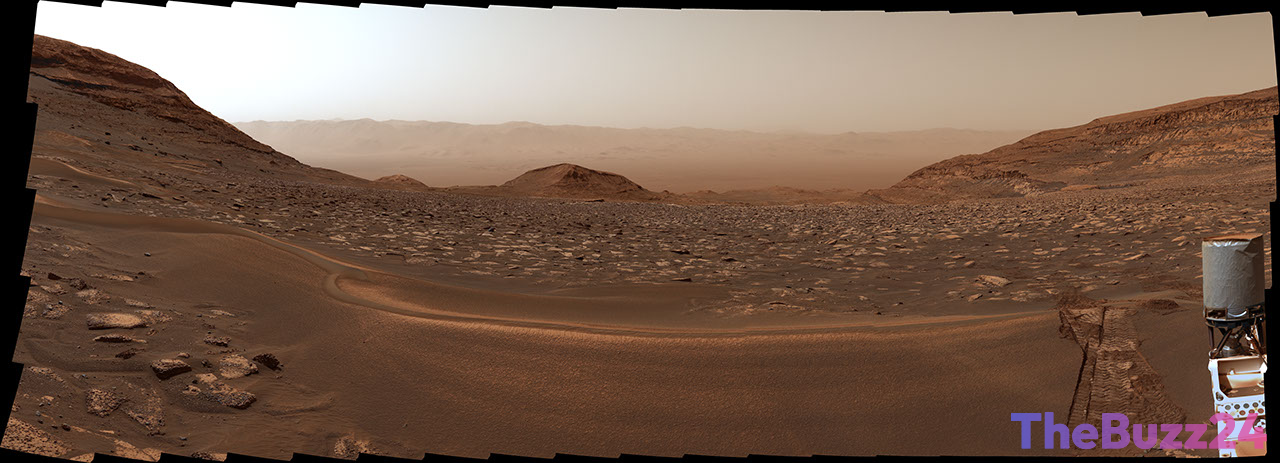
NASA’s Curiosity Mars rover has achieved a major milestone in its long-term exploration of the Red Planet, climbing to an elevation of one kilometer (approximately 0.62 miles) above the floor of Gale Crater. This significant altitude mark was reached on August 26, 2026, marking the 4,996th Martian day, or sol, of the rover’s historic mission. To celebrate the achievement, the robotic explorer captured a stunning, sweeping panoramic view looking back across the vast crater floor it has spent over a decade traversing.
The newly released panorama, captured on September 5, 2026 (Sol 5,006), is a composite of 95 individual images taken by Curiosity’s Mast Camera, or Mastcam. The color of the final image has been carefully adjusted to replicate how the Martian landscape would appear to human eyes under Earth-like lighting conditions. In the foreground, a prominent sand ridge stretches across the frame, featuring a visible trench carved by the rover’s front right wheel. Scientists plan to study the geologic layering, grain size, and composition of this ridge to unlock clues about the environmental forces that shaped the region billions of years ago.
Curiosity has been steadily ascending the lower foothills of Mount Sharp—a massive, three-mile-tall (five-kilometer-tall) mountain situated at the center of Gale Crater—since 2014. By climbing through successive layers of sediment, the rover is effectively traveling through Martian history, helping researchers understand how the planet transitioned from a wet, potentially habitable environment into the frozen desert it is today. The mission continues to be managed by the Jet Propulsion Laboratory (JPL) in Pasadena, California, with Mastcam operations led by Malin Space Science Systems.
Key Takeaways
- Curiosity successfully climbed 1 kilometer (0.62 miles) above the Gale Crater floor, marking a major elevation milestone on its 4,996th Martian sol.
- A newly released 95-image panoramic composite captures the vast crater floor and a detailed sand ridge, color-corrected to match Earth's lighting conditions.
- The rover's ongoing ascent of Mount Sharp, which began in 2014, aims to analyze ancient geological layers to understand Mars' climate transition.
Editor’s Analysis & Impact
Curiosity’s achievement of the one-kilometer elevation milestone highlights the extraordinary engineering and durability of NASA’s Mars science platforms. Operating far past its original prime mission, the rover continues to deliver high-fidelity geological data that is fundamental to our understanding of planetary evolution. By ascending Mount Sharp, Curiosity acts as a robotic geologist, reading the ‘pages’ of Martian history written in sedimentary rock layers. This ongoing research not only answers critical questions about Mars’ past habitability but also lays the groundwork for future human exploration. The success of Curiosity, alongside its younger sibling Perseverance, proves that long-duration mobile science laboratories are highly viable, paving the way for next-generation sample-return missions and deeper autonomous exploration of the solar system.
Frequently Asked Questions
Q: How long has the Curiosity rover been on Mars?
A: Curiosity landed in Gale Crater on Mars in August 2012 and has been actively exploring the planet for over 14 Earth years, recently surpassing 5,000 Martian sols.
Q: What is the significance of Mount Sharp?
A: Mount Sharp, located in the center of Gale Crater, contains sedimentary layers that accumulated over billions of years. Climbing it allows scientists to study how Mars' climate and water availability changed over geological time.
Q: How was the panoramic image of Gale Crater created?
A: The panorama is a composite of 95 individual photos taken by Curiosity's Mastcam. The colors were adjusted to simulate how the scene would look to a human eye under Earth's lighting conditions.
AI Disclosure: This article is based on verified data and official reports. Our Team and AI have cross-referenced every financial detail with primary sources to ensure total accuracy.
More from this Category