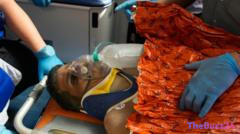
Miracle in Venezuela: Security Guard Rescued Alive After Eight Days Under Earthquake Rubble
In an extraordinary feat of survival and international cooperation, emergency responders in Venezuela have successfully rescued a man who spent eight days trapped beneath the ruins of a collapsed building. The survivor, identified as Hernán Gil, was pulled from the debris more than 100 hours after rescue teams first detected signs of life beneath approximately 140 tonnes of concrete and steel. The complex operation took place in Catia La Mar, following twin earthquakes that devastated the region on June 24, claiming nearly 2,300 lives and leaving tens of thousands missing.
Gil, a security guard, was on duty inside a small concrete booth in the basement parking lot of the Galerias Playa Grande mall when the seismic shocks struck. The reinforced structure of the booth miraculously acted as a protective shield, sparing him from being crushed by the massive weight of the collapsing building. Despite the extreme conditions, Gil emerged from the ordeal remarkably unscathed, with medical personnel reporting no major physical injuries. Throughout his confinement, rescuers managed to funnel water, intravenous fluids, and protective gear—including goggles and a face mask—through narrow access shafts to sustain him.
The rescue operation was described by seasoned emergency workers as one of the most technically challenging missions they had ever encountered. Teams from Venezuela, Chile, Costa Rica, El Salvador, Mexico, Portugal, and the United States worked tirelessly around the clock, battling frequent collapses of the newly dug access ducts. The breakthrough came when a Costa Rican Red Cross paramedic heard Gil’s faint cries for help. Rescuers maintained constant communication with Gil to keep his spirits high, utilizing specialized cameras to monitor his condition and guide their excavation efforts until he was finally brought to safety.
Key Takeaways
- Hernán Gil was rescued alive after being trapped for eight days under 140 tonnes of rubble following twin earthquakes in Venezuela.
- A small concrete security booth in a basement parking lot acted as a protective shield, keeping Gil safe from the collapsing structure.
- The highly complex rescue involved a coordinated international effort with teams from seven countries working over 100 hours to reach him.
Editor’s Analysis & Impact
The miraculous rescue of Hernán Gil highlights both the profound human capacity for survival and the critical importance of international disaster response coordination. In the wake of devastating natural disasters, the rapid deployment of specialized search-and-rescue teams from multiple nations can mean the difference between life and death. This event underscores the necessity for robust building codes, particularly the implementation of reinforced micro-structures like security booths, which can inadvertently serve as survival voids during structural collapses. Moving forward, global emergency management agencies must continue to invest in advanced seismic detection technologies, such as micro-cameras and acoustic sensors, and foster cross-border training initiatives. The successful extraction of Gil under extreme technical difficulties will likely serve as a benchmark case study for urban search-and-rescue operations worldwide.
Frequently Asked Questions
Q: How did Hernán Gil survive for eight days under the rubble?
A: Gil was protected by a small concrete security booth in the basement parking lot of the Galerias Playa Grande mall, which formed a protective shell around him and shielded him from 140 tonnes of falling debris.
Q: Which countries participated in the rescue operation?
A: The highly complex rescue effort involved specialized emergency response teams from Venezuela, Chile, Costa Rica, El Salvador, Mexico, Portugal, and the United States.
Q: What was the scale of the earthquakes in Venezuela?
A: The twin earthquakes struck on June 24, resulting in nearly 2,300 confirmed deaths and leaving tens of thousands of people missing.
AI Disclosure: This article is based on verified data and official reports. Our Team and AI have cross-referenced every financial detail with primary sources to ensure total accuracy.
More from this Category