NASA Accelerates 2028 Moon Landing Plans with Streamlined Lander Designs
NASA, in collaboration with commercial partners Blue Origin and SpaceX, is significantly advancing the development of human landing systems for its ambitious Artemis program. The agency has refined the operational concepts and designs for the landers, aiming to establish a sustained human presence on the Moon by 2028. This accelerated timeline reflects a renewed focus on lunar exploration and the establishment of a permanent lunar base.
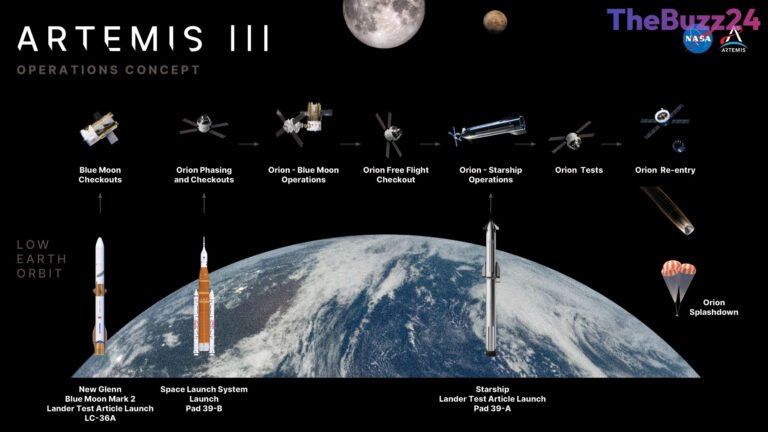
Key to this acceleration is a revised approach to the Artemis III mission, which will now feature rendezvous and docking tests between prototype landers from both Blue Origin and SpaceX with NASA’s Orion spacecraft in Earth orbit. This strategic shift allows for earlier validation of critical systems. Both companies are concurrently developing crew and cargo variants of their landers, essential for upcoming Artemis missions. NASA Administrator Jared Isaacman emphasized the agency’s commitment, stating, “We are executing President Trump’s National Space Policy to complete the long-awaited return of American astronauts to the lunar surface in 2028 and establish a Moon Base.” He highlighted the robust foundation provided by the SLS rocket and Orion spacecraft, coupled with the ongoing development of the two lunar landers.
The operational strategies for the landers have been updated to optimize mission efficiency. SpaceX’s Starship lander will utilize an in-space propellant aggregation system, launching multiple tanker Starships to low Earth orbit to refuel the primary lander before its journey to the Moon. This revised plan involves the Starship lander rendezvousing with Orion in Earth orbit, then propelling the combined stack towards lunar orbit. Blue Origin’s Blue Moon lander will employ a different strategy, using three transfer stages to reach an elliptical polar orbit around the Moon, a departure from the previously planned near-rectilinear halo orbit. This orbital adjustment is expected to reduce propellant requirements and facilitate quicker returns to Orion.
Both Blue Origin and SpaceX are mandated to conduct uncrewed demonstration missions of their landers before they are certified for crewed flights. NASA will meticulously certify these systems to guarantee the safety and success of future lunar landings. The agency has also updated its contracts with both companies to align with these accelerated efforts, ensuring greater insight into development milestones and enhancing astronaut safety. The ultimate selection of which company will perform the first crewed landing in 2028 will be based on lander readiness, with a second landing opportunity to follow.
Key Takeaways
- NASA and its commercial partners, Blue Origin and SpaceX, are accelerating lunar lander development for a 2028 Moon landing.
- Revised operational concepts for both Starship and Blue Moon landers aim to increase efficiency and reduce mission complexity.
- Uncrewed demonstration missions and rigorous certification processes will precede the first crewed lunar landings.
Editor’s Analysis & Impact
The accelerated development and revised operational strategies for NASA’s lunar landers signal a significant push towards establishing a sustained human presence on the Moon. By streamlining designs and optimizing mission architectures, NASA and its partners are demonstrating a proactive approach to lunar exploration. The focus on in-orbit refueling for SpaceX’s Starship and optimized orbital trajectories for Blue Origin’s Blue Moon highlights innovative solutions to complex engineering challenges. This intensified effort not only aims to meet ambitious timelines but also lays the groundwork for future deep-space missions, potentially including Mars. The increased collaboration and shared development milestones between NASA and its commercial partners are crucial for de-risking the program and ensuring astronaut safety, positioning the Artemis program for long-term success.
Frequently Asked Questions
Q: What is the primary goal of the Artemis program's lander development?
A: The primary goal is to develop reliable human landing systems capable of transporting astronauts to the lunar surface and supporting a sustained human presence on the Moon, with initial crewed landings targeted for 2028.
Q: How are SpaceX and Blue Origin's lander concepts different?
A: SpaceX's Starship lander will utilize in-space propellant aggregation in Earth orbit, while Blue Origin's Blue Moon lander will use multiple transfer stages to reach an elliptical polar orbit around the Moon. Both approaches aim for efficiency and mission success.
Q: Will both companies' landers be used for the first Moon landing?
A: While both companies are developing landers and participating in early mission tests, NASA will ultimately select which company's lander will be used for the first crewed landing in 2028, based on readiness and safety.
AI Disclosure: This article is based on verified data and official reports. Our Team and AI have cross-referenced every financial detail with primary sources to ensure total accuracy.
More from this Category