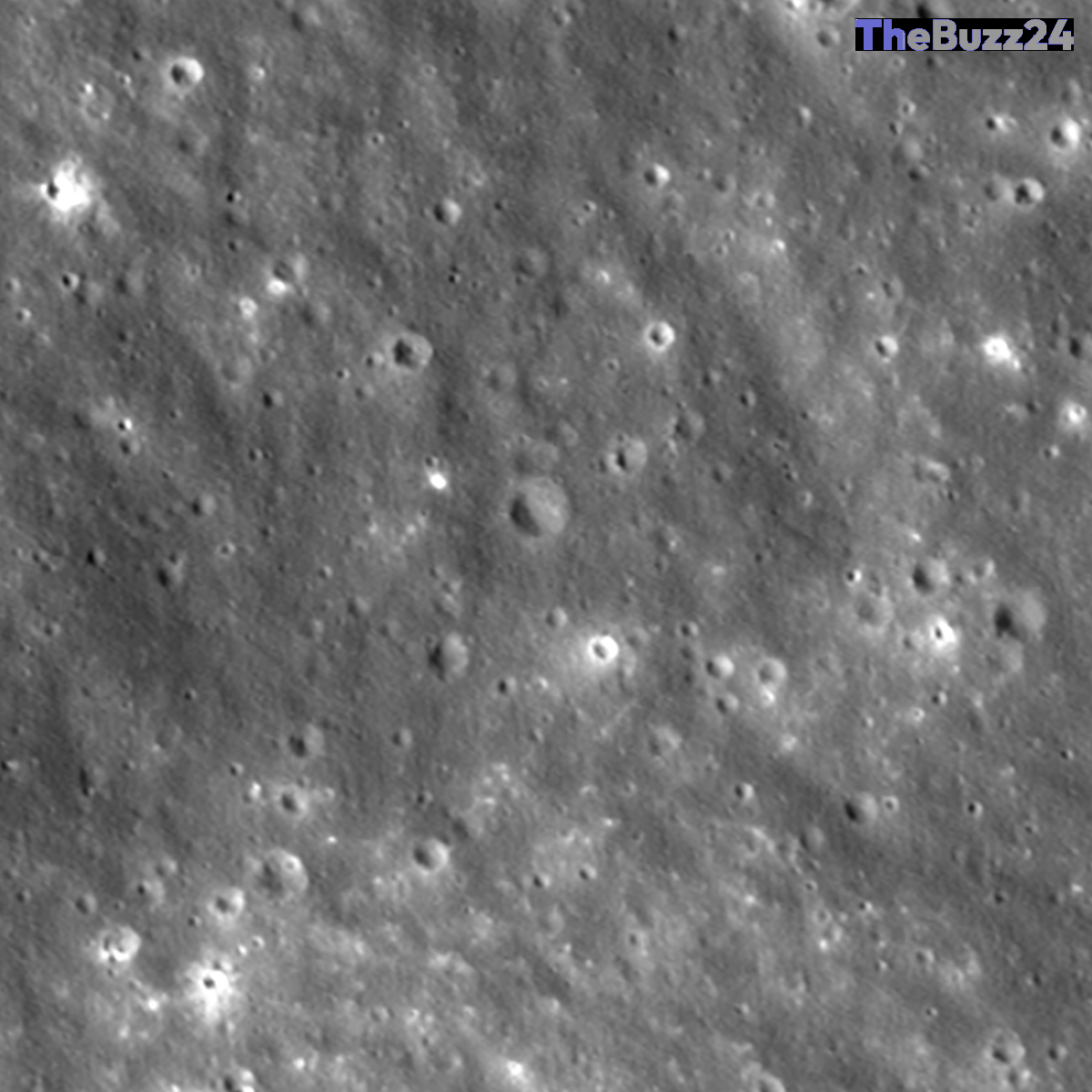
NASA Orbiter Captures High-Resolution Details of SpaceX Rocket Crater on the Moon
NASA’s Lunar Reconnaissance Orbiter has successfully imaged a newly formed impact crater on the Moon, created when a SpaceX Falcon 9 upper-stage booster struck the lunar surface. The collision occurred following the January launch of the Firefly Blue Ghost 1 mission, prompting an international effort to locate and analyze the resulting site. Engineers had to execute precise orbital maneuvers, tilting the spacecraft while it traveled at one mile per second approximately 60 miles above the lunar surface to capture the target.
Achieving these detailed photographs required extreme precision in both positioning and timing. Operating the spacecraft’s Narrow-Angle Camera demanded split-second accuracy, as a deviation of just ten seconds would cause the target to drift significantly out of frame. By utilizing multiple viewing angles and varying solar illumination, scientists were able to analyze the physical dimensions of the impact site, measuring the crater at approximately 60 feet wide and less than 10 feet deep.
The imagery also revealed distinct compositional differences in the lunar material surrounding the impact. Darker streaks extending from the site consist of weathered surface dust and rocks altered over extended periods by solar wind, cosmic rays, and micrometeorites from a depth of about 1.5 feet. In contrast, the brighter rays near the rim represent fresh, unweathered material excavated from deeper underground by the forceful collision.
Locating the exact coordinates required a collaborative effort involving independent astronomers, NASA’s Center for Near Earth Object Studies, and international space agencies. The predictive models were initially tested and refined before being shared with global partners, including the team operating South Korea’s Danuri lunar orbiter. This data sharing ultimately allowed NASA’s Lunar Reconnaissance Orbiter team to pinpoint the precise crater coordinates and conduct comprehensive follow-up science operations.
Key Takeaways
- NASA's Lunar Reconnaissance Orbiter captured high-resolution images of a fresh lunar crater formed by a SpaceX Falcon 9 upper stage.
- The crater measures roughly 60 feet wide and under 10 feet deep, displaying both weathered surface dust and fresh subsurface material.
- International collaboration between independent astronomers, NASA, and South Korea's Danuri mission successfully refined the impact coordinates.
Editor’s Analysis & Impact
The successful imaging and analysis of the Falcon 9 lunar impact site underscore the growing importance of tracking artificial debris in cislunar space. As commercial space endeavors accelerate and lunar missions become more frequent, the ability to predict, locate, and study spacecraft impacts provides invaluable data for planetary defense and space traffic management. This event served as a practical stress test for NASA’s near-Earth object tracking tools, demonstrating robust global cooperation among space agencies and independent researchers. Moving forward, heightened transparency and tracking protocols will be essential for mapping human-made alterations to the lunar environment and ensuring safe operations for future crewed and uncrewed lunar missions.
Frequently Asked Questions
Q: What caused the new crater on the Moon?
A: The crater was created by the impact of a SpaceX Falcon 9 upper-stage booster that struck the lunar surface following a previous launch mission.
Q: How did NASA capture images of the impact site?
A: NASA used the Narrow-Angle Camera aboard the Lunar Reconnaissance Orbiter, carefully tilting the spacecraft and timing its passes to photograph the location from multiple viewing angles.
Q: What scientific details were learned from the crater images?
A: Scientists determined the crater is about 60 feet wide and less than 10 feet deep, and they observed both weathered surface dust and fresh subsurface material excavated by the impact.
AI Disclosure: This article is based on verified data and official reports. Our Team and AI have cross-referenced every financial detail with primary sources to ensure total accuracy.
More from this Category