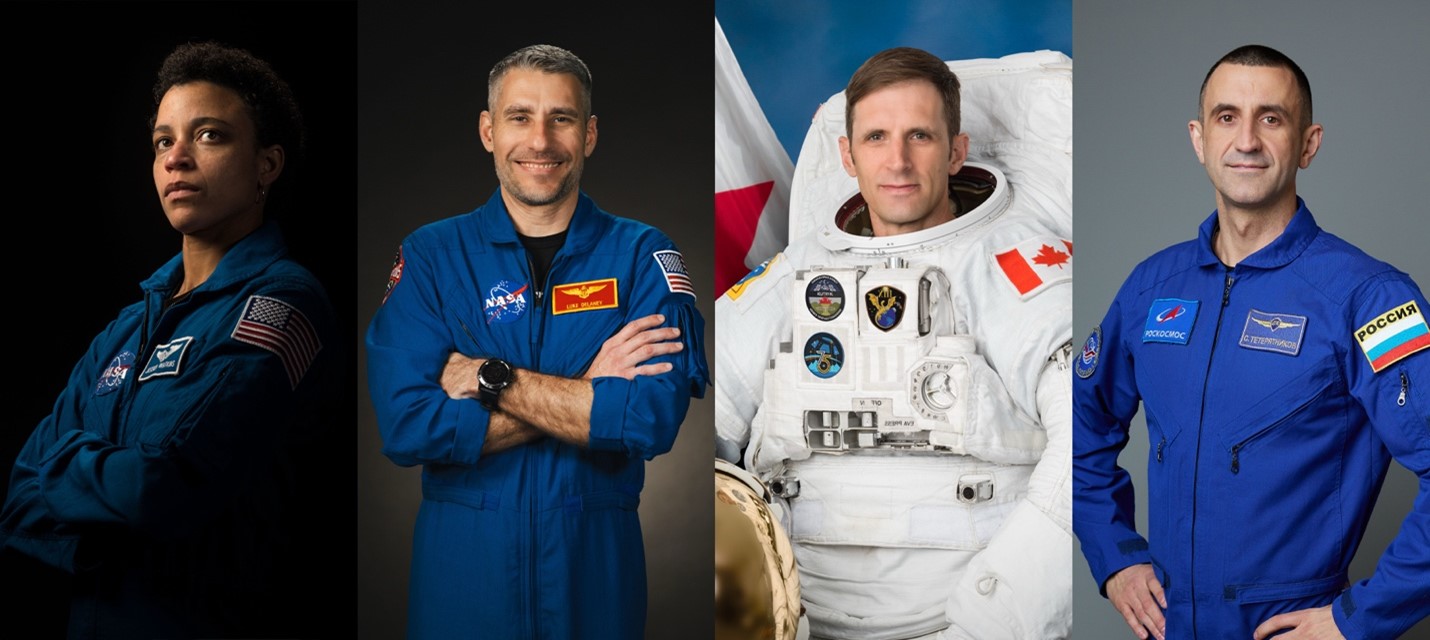
SpaceX Crew-13 Mission Prepares to Advance Deep Space Exploration Protocols
An international team of four astronauts is entering the final stages of preparation for the upcoming SpaceX Crew-13 mission to the International Space Station (ISS). Scheduled for a mid-September launch, the mission represents a strategic collaboration between NASA, the Canadian Space Agency (CSA), and Roscosmos, aimed at expanding the boundaries of scientific research in low Earth orbit.
NASA astronaut Jessica Watkins will lead the mission as spacecraft commander, achieving a historic milestone as the first NASA astronaut to fly twice aboard a SpaceX Dragon vehicle. She will be joined by pilot Luke Delaney, a former naval aviator, and mission specialists Joshua Kutryk of the CSA and Sergey Teteryatnikov of Roscosmos. While Watkins brings previous experience to the flight, the mission marks the first spaceflight for the remaining three crew members, who contribute extensive backgrounds in test piloting and engineering.
Upon arrival at the ISS, the Crew-13 team will join the Expedition 75 crew to execute a rigorous schedule of scientific investigations. The primary objective is to evaluate new software and operational procedures that are vital for future human exploration efforts, particularly those concerning long-duration travel to the Moon and Mars. By utilizing the microgravity environment of the station, the crew intends to gather data that will support the Artemis program while simultaneously fostering technological and medical breakthroughs for use on Earth.
This mission serves as a testament to the success of the Commercial Crew Program, which has significantly bolstered the frequency and reliability of crewed launches to the orbiting laboratory. As the ISS enters its third decade of continuous human presence, the contributions of the Crew-13 team remain essential to humanity’s long-term goal of extending its reach further into the solar system.
Key Takeaways
- The SpaceX Crew-13 mission features a multinational crew representing NASA, the CSA, and Roscosmos.
- Commander Jessica Watkins will make history as the first NASA astronaut to complete two launches on a SpaceX Dragon spacecraft.
- The mission focuses on testing critical software and operational procedures to support future lunar and Martian exploration.
Editor’s Analysis & Impact
The Crew-13 mission highlights the increasing maturity of the commercial space sector and the established reliability of the SpaceX Dragon platform as a primary vehicle for international cooperation. By maintaining a consistent cadence of crew rotations, space agencies are effectively accelerating the pace of microgravity research. The mission’s emphasis on ‘Artemis-ready’ technology underscores a shift in the ISS’s role; it is no longer merely a laboratory for low Earth orbit, but a vital training ground for deep-space logistics. As global space programs look toward the next decade, the ability to sustain long-duration human presence will be the definitive metric for success in the race to establish a permanent lunar base and eventually reach Mars. This mission reinforces that space exploration remains a collaborative, high-stakes endeavor that bridges commercial innovation with geopolitical objectives.
Frequently Asked Questions
Q: What is the primary objective of the SpaceX Crew-13 mission?
A: The mission aims to conduct scientific research and test new software and operational procedures that are essential for preparing for future long-duration human missions to the Moon and Mars.
Q: Who is commanding the SpaceX Crew-13 mission?
A: NASA astronaut Jessica Watkins is the commander, and she will be the first NASA astronaut to launch twice on a SpaceX Dragon spacecraft.
AI Disclosure: This article is based on verified data and official reports. Our Team and AI have cross-referenced every financial detail with primary sources to ensure total accuracy.
More from this Category