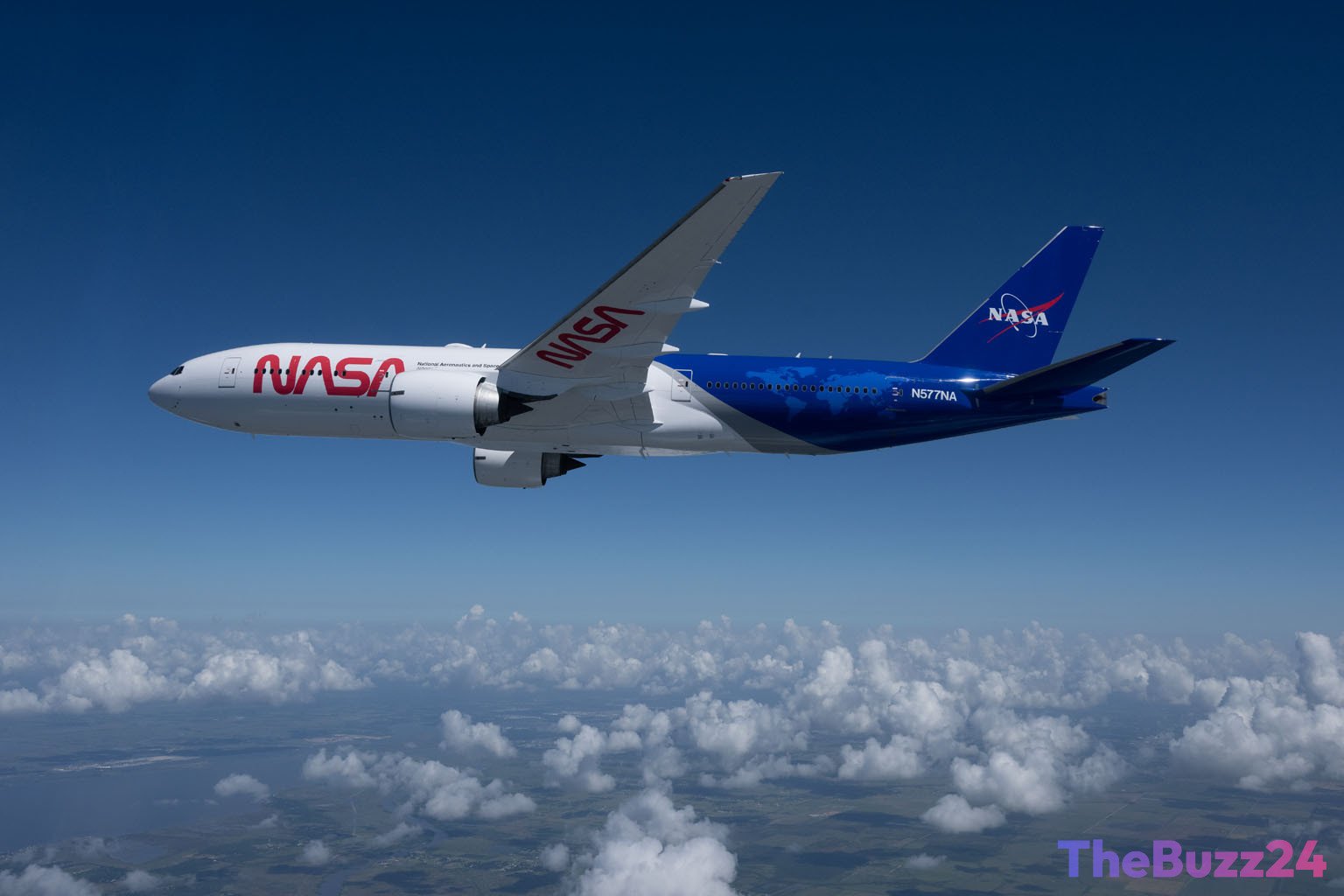
NASA’s Advanced Boeing 777 Unveiled with Striking New Livery
NASA’s state-of-the-art Boeing 777 aircraft has returned to the agency’s Langley Research Center, proudly displaying a completely redesigned paint scheme. This significant upgrade marks a new chapter for the advanced flying laboratory, which is poised to enhance NASA’s Earth science research capabilities.
The newly painted B777, captured in an image dated August 11, 2026, is set to commence operations from the Langley Research Center in Hampton, Virginia, in 2027. This acquisition represents a strategic move by NASA to replace and significantly expand upon the capabilities of the now-retired DC-8 aircraft, which concluded its service in 2024. The B777 is envisioned as a unique platform for global data collection.
Designed as a sophisticated flying laboratory, the B777 will support a wide array of critical NASA projects. Its advanced instrumentation will facilitate crucial tasks such as sensor development, the calibration of satellite sensors, validation of data products, and extensive field studies. These operations are vital for deepening our understanding of Earth system processes, ultimately leading to improved climate models and more informed decision-making for environmental challenges.
Key Takeaways
- NASA's Boeing 777 aircraft has received a new paint scheme and returned to the Langley Research Center.
- The B777 will begin operations in 2027, replacing the retired DC-8 and enhancing NASA's Earth science research capabilities.
- The aircraft will serve as a flying laboratory for sensor development, satellite calibration, data validation, and Earth system studies.
Editor’s Analysis & Impact
The rebranding of NASA’s Boeing 777 with a new paint scheme signifies more than just an aesthetic update; it heralds a significant investment in advanced aerial research platforms. This modernized aircraft is poised to become a cornerstone of NASA’s Earth observation initiatives, offering enhanced capabilities for data collection and analysis. Its deployment underscores the agency’s commitment to understanding complex Earth systems, crucial for developing effective climate models and informing policy. The B777’s global reach and sophisticated instrumentation will likely accelerate progress in fields ranging from sensor technology to environmental science, positioning NASA at the forefront of planetary research.
Frequently Asked Questions
Q: When will NASA's new Boeing 777 begin operations?
A: NASA's new Boeing 777 is scheduled to begin operations in 2027.
Q: What is the purpose of NASA's Boeing 777?
A: The Boeing 777 will serve as a unique flying laboratory for NASA, supporting projects such as sensor development, satellite sensor calibration, data product validation, and field studies to better understand Earth system processes.
Q: What aircraft does the Boeing 777 replace?
A: The Boeing 777 is intended to replace and extend the capabilities of NASA's DC-8 aircraft, which was retired in 2024.
AI Disclosure: This article is based on verified data and official reports. Our Team and AI have cross-referenced every financial detail with primary sources to ensure total accuracy.
More from this Category