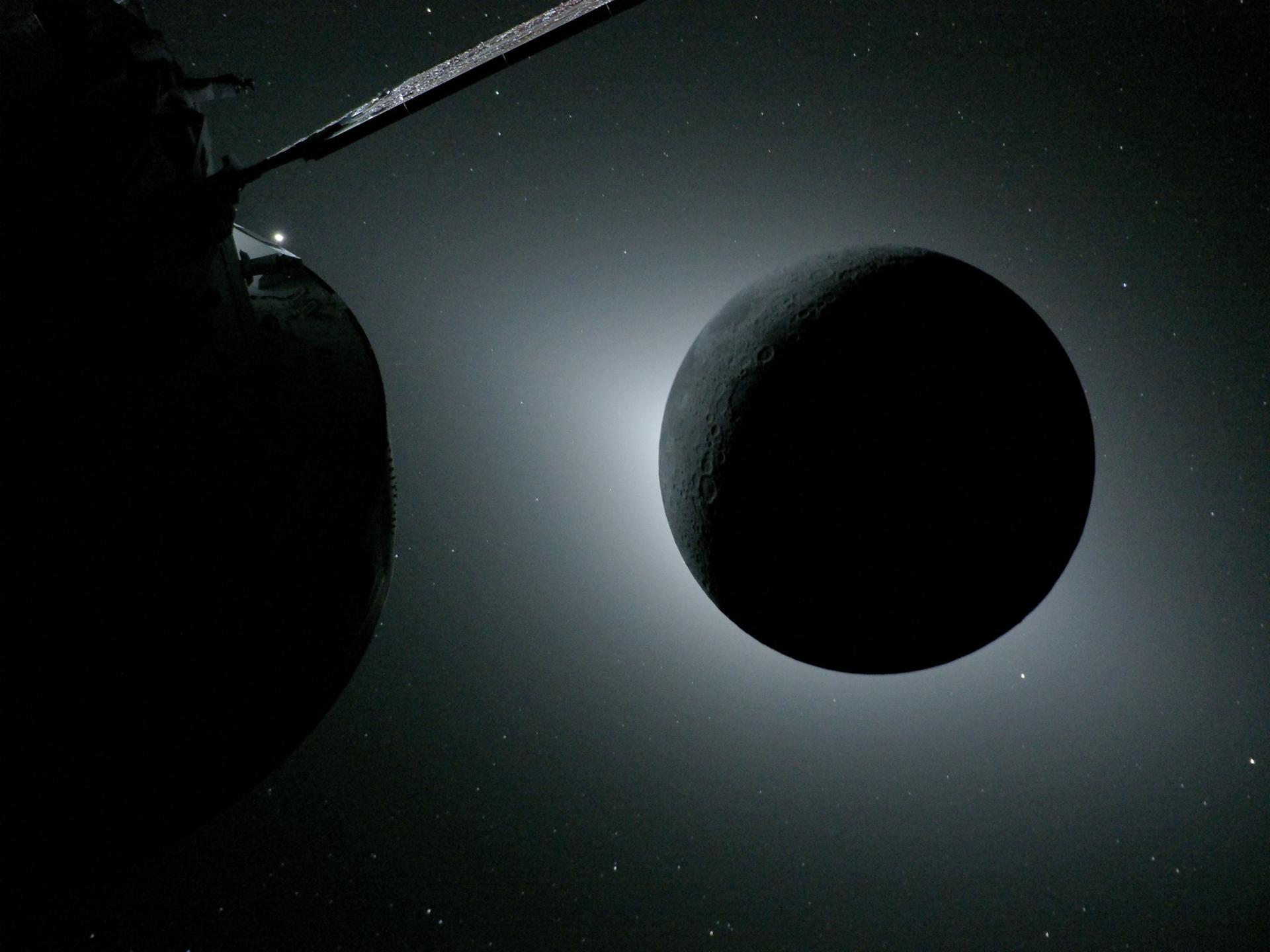
Artemis II Crew Captures Historic Lunar Eclipse and Far Side Imagery
The crew of the Artemis II mission has shared a groundbreaking collection of photographs from their recent lunar flyby, providing the most detailed look at the Moon’s far side to date. Among the highlights of the visual data is a rare capture of a solar eclipse as seen from deep space, where the Moon completely blocked the Sun, allowing the crew to observe the solar corona in unprecedented detail for nearly an hour.
The four-person crew, consisting of Reid Wiseman, Victor Glover, Christina Koch, and Jeremy Hansen, utilized advanced imaging technology to document the lunar surface. Their findings include high-resolution shots of ancient lava flows, surface fractures, and the massive South Pole-Aitken basin. Beyond geological features, the astronauts recorded six distinct meteoroid impact flashes on the lunar surface, providing scientists with new data regarding the frequency of space debris collisions.
One of the most poignant images released shows Earth as a delicate crescent setting behind the lunar horizon, with the continents of Australia and Oceania clearly visible. This mission serves as a critical milestone in human space exploration, acting as a direct precursor to future crewed missions to Mars. As the Orion spacecraft makes its final approach back to Earth, the data collected during this flyby is already being integrated into geological models to support the goal of establishing a permanent human presence on the Moon.
Key Takeaways
- The Artemis II crew captured a rare 54-minute solar eclipse from the perspective of the Orion spacecraft.
- New imagery provides high-resolution data on the Moon's far side, including the South Pole-Aitken basin and evidence of meteoroid impacts.
- The mission serves as a vital testing ground for future human exploration, specifically targeting the eventual goal of crewed missions to Mars.
Editor’s Analysis & Impact
The successful documentation of the lunar far side and the solar corona from deep space represents a significant leap in our ability to conduct remote sensing and geological analysis. By capturing high-resolution imagery of the South Pole-Aitken basin, the Artemis II mission provides researchers with a ‘time capsule’ of the Moon’s early history, which is essential for understanding planetary evolution. From an industry perspective, the mission validates the operational readiness of the Orion spacecraft and the life support systems necessary for long-duration deep space travel. This success not only bolsters public and political support for the Artemis program but also sets a technical precedent for the private-public partnerships currently driving the next generation of lunar and Martian infrastructure. The ability to observe celestial phenomena without atmospheric interference will likely lead to a surge in specialized space-based research initiatives.
Frequently Asked Questions
Q: What was the significance of the solar eclipse captured by the crew?
A: The eclipse lasted 54 minutes from the spacecraft's perspective, allowing scientists to study the Sun's faint corona in a way that is impossible from Earth's surface due to atmospheric interference.
Q: When is the Artemis II crew expected to return to Earth?
A: The crew is scheduled to splash down off the coast of San Diego on Friday, April 10, where they will be recovered by the USS John P. Murtha.
AI Disclosure: This article is based on verified data and official reports. Our Team and AI have cross-referenced every financial detail with primary sources to ensure total accuracy.
More from this Category