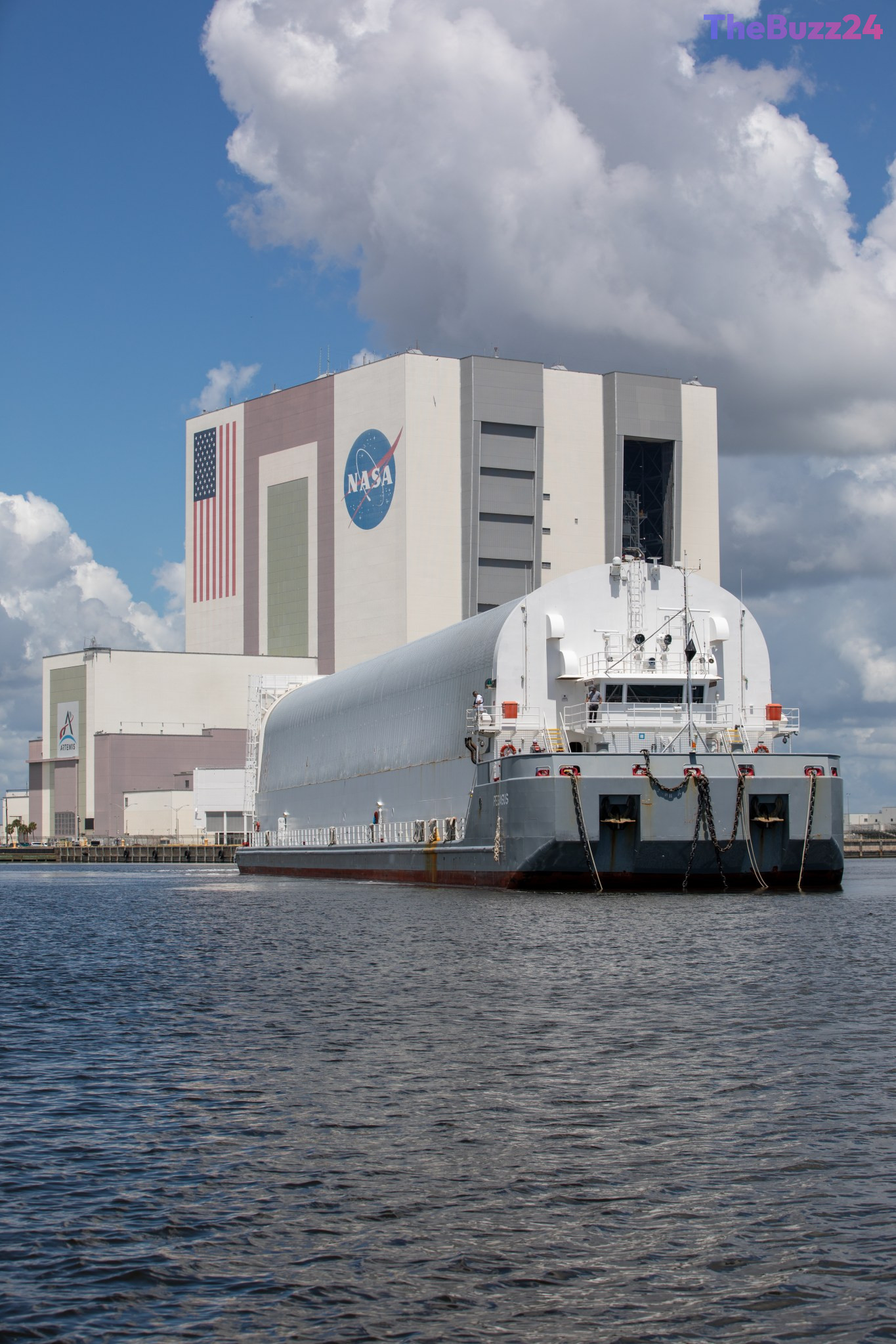
NASA’s Nancy Grace Roman Space Telescope Arrives at Kennedy Space Center for Final Launch Preparations
The Nancy Grace Roman Space Telescope has officially reached the Kennedy Space Center in Florida, marking a critical milestone in the mission’s timeline. The observatory was transported via the Pegasus barge and has since been moved to the Payload Hazardous Servicing Facility, where it will undergo final processing and integration procedures. This arrival sets the stage for a scheduled launch window that begins no earlier than August 30, 2026.
Named in honor of NASA’s inaugural chief astronomer, who is widely recognized as the ‘mother of the Hubble Space Telescope,’ the new observatory is designed to significantly expand humanity’s view of the cosmos. The telescope features a field of view more than 100 times larger than that of Hubble, providing astronomers with an unprecedented ability to survey the deep universe. Its primary mission objectives include the observation of up to a billion galaxies and the direct imaging of exoplanets and their surrounding protoplanetary disks.
Beyond its imaging capabilities, the Roman Space Telescope is expected to provide transformative data regarding the nature of dark energy and the mechanics of infrared astrophysics. By probing these fundamental mysteries, the mission aims to reshape our understanding of the universe’s expansion and the formation of planetary systems. As the team at Kennedy Space Center begins the final phase of pre-launch operations, the scientific community prepares for a new era of space exploration.
Key Takeaways
- The Nancy Grace Roman Space Telescope has arrived at Kennedy Space Center for final launch preparations.
- The mission is currently targeting a launch date no earlier than August 30, 2026.
- The telescope offers a field of view 100 times larger than Hubble, enabling the study of dark energy and the direct imaging of exoplanets.
Editor’s Analysis & Impact
The arrival of the Nancy Grace Roman Space Telescope at Kennedy Space Center represents a major leap forward in observational astronomy. By combining a massive field of view with high-resolution infrared capabilities, the mission is positioned to solve long-standing puzzles regarding dark energy—the mysterious force driving the accelerated expansion of the universe. From an industry perspective, this mission underscores a shift toward wide-field survey telescopes that can process vast amounts of data, moving beyond the ‘deep-field’ focus of previous generations. The success of this launch will likely influence the design of future space-based observatories and provide a wealth of data that will keep astrophysicists occupied for decades. As we move closer to the August 2026 launch, the focus will shift toward the complex deployment and calibration phases, which will be critical for the mission’s long-term scientific output.
Frequently Asked Questions
Q: What is the primary goal of the Nancy Grace Roman Space Telescope?
A: The telescope aims to study dark energy, conduct large-scale surveys of up to a billion galaxies, and directly image exoplanets and planet-forming disks.
Q: How does the Roman Space Telescope compare to the Hubble Space Telescope?
A: The Roman Space Telescope features a field of view that is over 100 times larger than Hubble's, allowing it to capture much broader swaths of the sky in a single observation.
AI Disclosure: This article is based on verified data and official reports. Our Team and AI have cross-referenced every financial detail with primary sources to ensure total accuracy.
More from this Category