NASA’s Psyche Probe Zooms In on Martian Winds Sculpting Ancient Craters
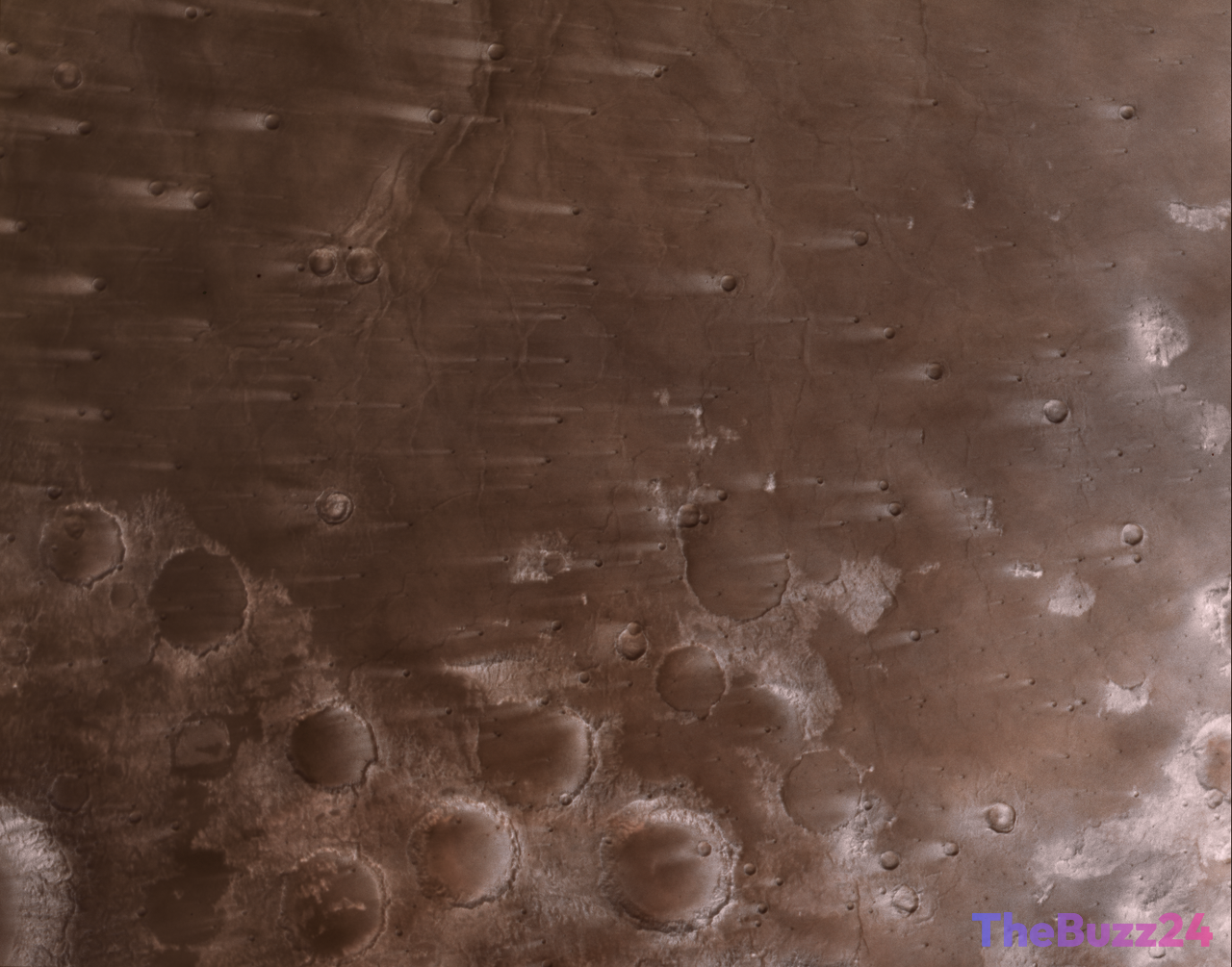
During a recent maneuver, NASA’s Psyche spacecraft captured striking, high-resolution images of the Martian surface, offering an unprecedented glimpse into the planet’s geological history. The probe focused its advanced cameras on the Syrtis Major region, meticulously documenting the enduring impact of Martian winds on the planet’s landscape. These newly released images vividly illustrate distinct linear formations extending across impact craters, providing compelling evidence of the continuous interaction between Mars’ tenuous atmosphere and its rugged terrain.
The detailed imagery reveals striking linear features, some stretching up to 50 kilometers in length. These formations are believed to be the result of wind-driven dust and debris flowing over the rims of craters, a process that has shaped the Martian surface over eons. Several of the craters observed in the captured frames measure approximately 50 kilometers in diameter, underscoring the significant scale of these geological phenomena. By employing a resolution of roughly 360 meters per pixel, the mission team successfully produced color-balanced photographs that closely resemble true-color vision, thereby enhancing our understanding of the composition of Martian dust and rock.
This strategic flyby presented a critical window for scientists to study aeolian processes – the mechanisms by which wind sculpts planetary surfaces – on a grand scale. While these images offer invaluable insights into the dynamics of Mars, the Psyche spacecraft is continuing its primary journey. Its ultimate destination is a massive, metal-rich asteroid, also named Psyche, which researchers anticipate will provide crucial clues about the formation of planetary cores within our solar system.
Key Takeaways
- The Psyche spacecraft captured detailed images of Mars' Syrtis Major region during a flyby.
- The imagery highlights wind-driven erosion creating linear streaks across Martian impact craters.
- Psyche is continuing its journey to study a metal-rich asteroid, its primary mission objective.
Editor’s Analysis & Impact
The Psyche mission’s successful imaging of Mars underscores the efficiency of modern deep-space exploration, where transit phases can yield significant scientific dividends beyond the primary objective. This multi-purpose approach maximizes data return, a trend increasingly favored in space science. Studying Martian aeolian processes through this unexpected lens is crucial for reconstructing the planet’s climate evolution and informing future exploration efforts. The data gathered during this flyby will undoubtedly refine our understanding of planetary geology and demonstrate the value of leveraging every opportunity in the vastness of space to expand scientific knowledge.
Frequently Asked Questions
Q: What is the main goal of the Psyche mission?
A: The primary objective of the Psyche spacecraft is to travel to and study a unique, metal-rich asteroid named Psyche, located in the main asteroid belt, to learn more about planetary core formation.
Q: Why did the Psyche spacecraft photograph Mars?
A: The spacecraft performed a flyby of Mars as part of its trajectory towards the asteroid belt. This provided a valuable opportunity to capture high-resolution images of the Martian surface and study its geological features, particularly those shaped by wind.
AI Disclosure: This article is based on verified data and official reports. Our Team and AI have cross-referenced every financial detail with primary sources to ensure total accuracy.
More from this Category