Cosmic Alignment: Moon and Venus Put on a Spectacular Show Over Washington D.C.
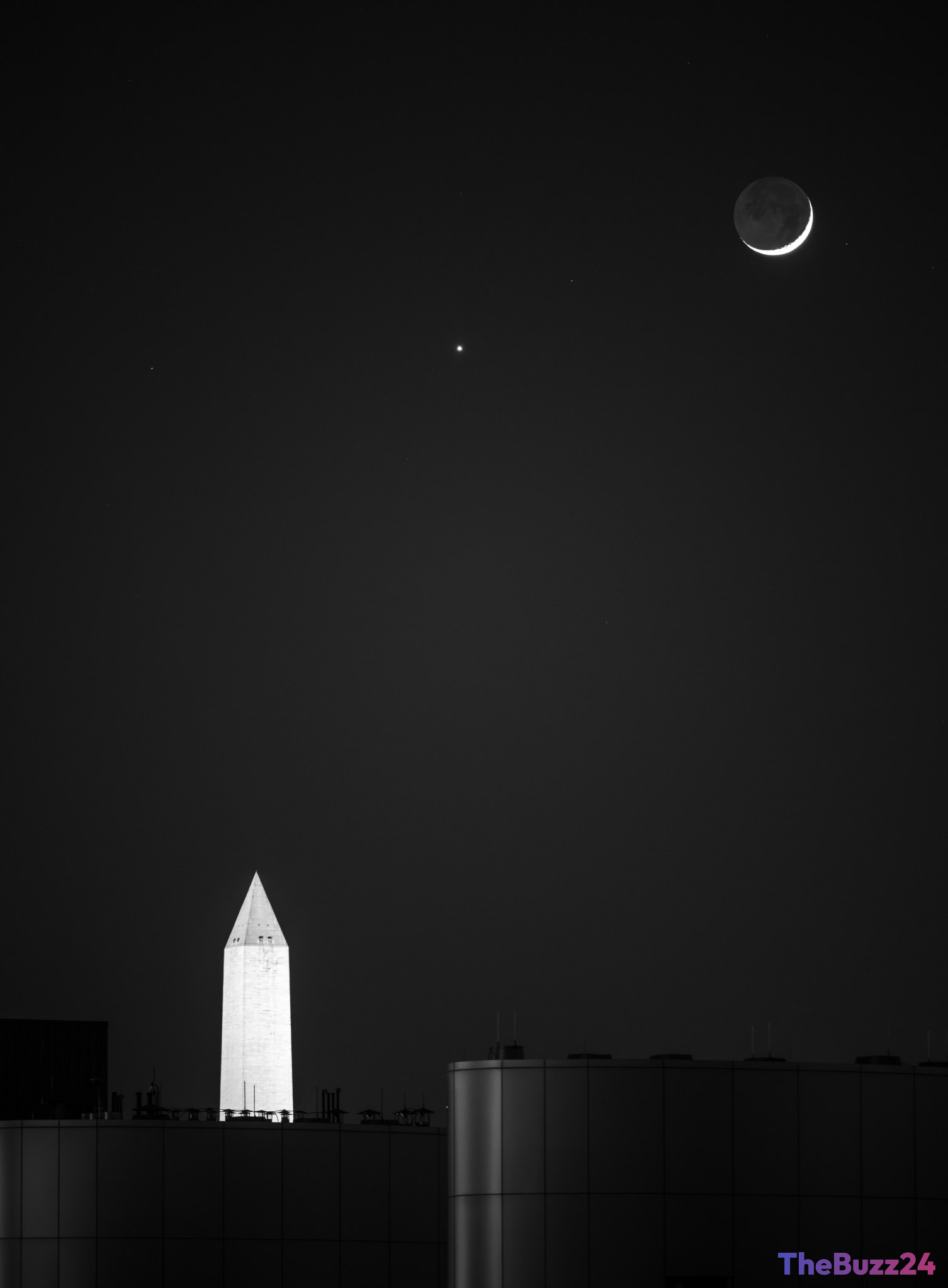
On Monday, May 18, 2026, skywatchers in the nation’s capital were treated to a breathtaking astronomical display as the Moon and Venus aligned in a stunning celestial conjunction. Positioned directly above the historic Washington Monument, the brilliant pairing illuminated the evening sky, drawing crowds of onlookers and photographers who gathered to capture the visual harmony between Earth’s natural satellite and our neighboring planet.
Although the two celestial bodies appeared to be almost touching from the perspective of observers on Earth, the dramatic proximity was merely an optical illusion. In reality, the Moon and Venus remain separated by tens of millions of miles of empty space. This phenomenon, known as a conjunction, occurs when the Moon and a planet share a similar ecliptic longitude, aligning along our line of sight to create the illusion of close contact.
While conjunctions involving the Moon and Venus are relatively common astronomical occurrences, their visibility in specific urban areas depends heavily on local weather conditions and precise timing. For residents and visitors in Washington D.C., the clear skies offered a perfect window to witness this intersection of cosmic movement and iconic architecture.
Astronomers emphasize that these events serve as a vivid reminder of the constant, dynamic motion within our solar system. As the Moon completes its orbit around Earth roughly every 27 days and Venus travels along its own path around the Sun, their paths cross periodically, offering multiple opportunities throughout the year for stargazers to witness these captivating cosmic dances.
Key Takeaways
- On May 18, 2026, a visually stunning conjunction of the Moon and Venus was visible directly over the Washington Monument in Washington D.C.
- The apparent closeness of the two celestial bodies is an optical illusion; they remain separated by millions of miles in space.
- Such conjunctions occur when the Moon and planets share similar ecliptic longitudes, with visibility highly dependent on local weather and timing.
Editor’s Analysis & Impact
This celestial event highlights the growing public interest in astrophotography and accessible astronomy. In an era dominated by digital screens, highly visible astronomical alignments like the Moon-Venus conjunction serve as powerful catalysts for public engagement with science. For urban centers, these events offer a unique opportunity to merge natural wonders with iconic human architecture, boosting local community gathering and interest in science. From an educational standpoint, such occurrences provide practical, real-world demonstrations of orbital mechanics, helping educators demystify the movements of our solar system. As mobile technology and camera capabilities continue to advance, the viral sharing of these events on social media platforms further democratizes science communication, inspiring the next generation of astronomers and space enthusiasts.
Frequently Asked Questions
Q: What is a celestial conjunction?
A: A conjunction occurs when two or more celestial bodies, such as planets or the Moon, appear very close to each other in the night sky from Earth's perspective, sharing the same right ascension or ecliptic longitude.
Q: Were the Moon and Venus actually close to each other during this event?
A: No, their close proximity was an optical illusion. While they appeared to be touching, they were actually separated by tens of millions of miles in space.
Q: How often do Moon and Venus conjunctions happen?
A: Conjunctions between the Moon and Venus occur multiple times a year because of their respective orbital paths, though their visibility from any specific location on Earth depends on local weather and timing.
AI Disclosure: This article is based on verified data and official reports. Our Team and AI have cross-referenced every financial detail with primary sources to ensure total accuracy.
More from this Category