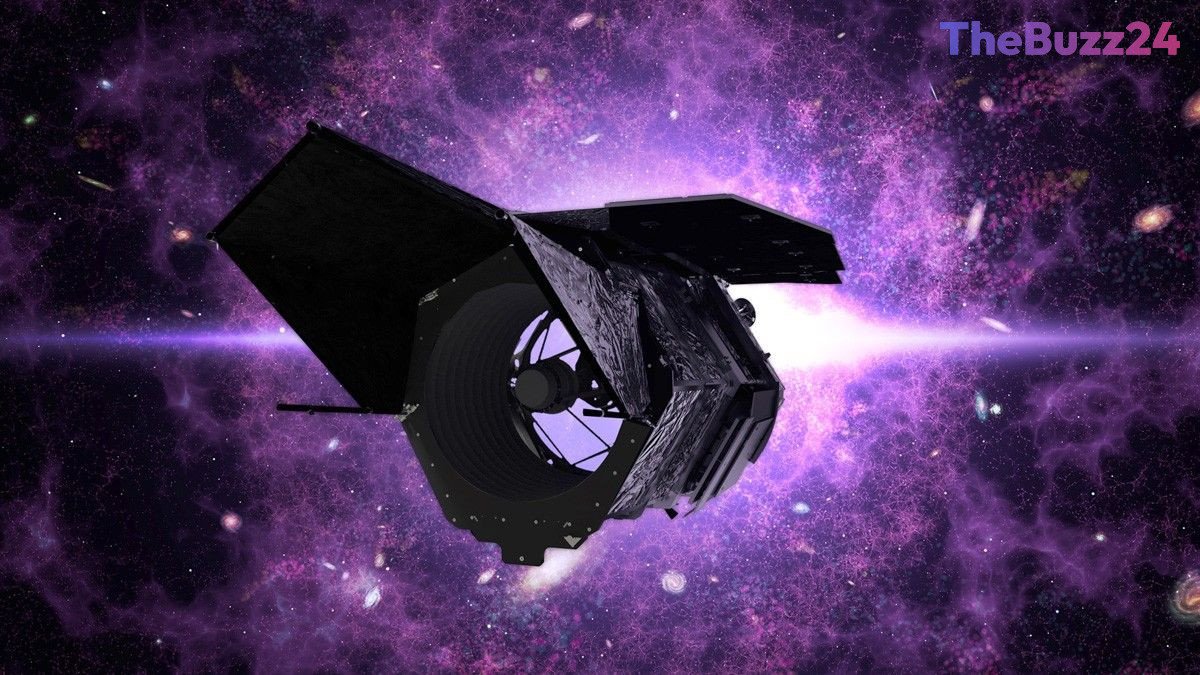
NASA’s Roman Space Telescope: A New Frontier in Cosmic Discovery
NASA is preparing to launch its newest astrophysics observatory, the Nancy Grace Roman Space Telescope, poised to revolutionize our understanding of the universe. Scheduled for liftoff on August 30, 2026, aboard a SpaceX Falcon Heavy rocket from Launch Complex 39A at Kennedy Space Center in Florida, Roman will embark on a mission to unravel some of the cosmos’s most profound mysteries, including dark energy, dark matter, and the vast array of exoplanets.
Once in space, the Roman Space Telescope will journey approximately 930,000 miles (1.5 million kilometers) from Earth to orbit around the second Sun-Earth Lagrange point (L2). This gravitationally stable location offers an unparalleled, unobstructed view of the universe, ideal for its sophisticated instruments. The observatory features a 7.9-foot (2.4-meter) primary mirror designed to gather immense amounts of infrared light, allowing it to peer through cosmic dust and across billions of years of cosmic history. Its two primary scientific instruments are the Wide Field Instrument, a 300-megapixel infrared camera capable of observing the early universe, and the Coronagraph Instrument, the most powerful of its kind ever flown, which will block out the glare of stars to directly image exoplanets that are nearly a billion times fainter than their host stars.
The scientific objectives of the Roman Space Telescope are ambitious and far-reaching. It aims to shed light on dark energy, the enigmatic force believed to be accelerating the universe’s expansion, by observing how its pressure might be shifting over time. Furthermore, Roman will significantly advance exoplanet research, expected to discover thousands more planets beyond our solar system, with a particular focus on identifying Earth-like worlds within habitable zones. The telescope will also investigate dark matter, the invisible gravitational ‘glue’ holding cosmic structures together, by tracing galaxy and galaxy cluster formation to determine the properties of its constituent particles.
The telescope is named in honor of Nancy Grace Roman, NASA’s first chief astronomer and a pioneering female executive. Known as ‘the mother of the Hubble Space Telescope,’ Roman played a pivotal role in championing and developing the iconic observatory. Her legacy continues to inspire, as this new telescope carries forward her vision of exploring the cosmos and pushing the boundaries of human knowledge.
Key Takeaways
- The Nancy Grace Roman Space Telescope, NASA's next-generation observatory, is set to launch on August 30, 2026, aboard a SpaceX Falcon Heavy rocket.
- Its mission will focus on investigating dark energy, dark matter, and discovering thousands of exoplanets using advanced infrared instruments like the Wide Field and Coronagraph Instruments.
- Named after Nancy Grace Roman, a pivotal figure in the development of the Hubble Space Telescope, the observatory will orbit at the Sun-Earth L2 point for optimal cosmic observation.
Editor’s Analysis & Impact
The launch of the Nancy Grace Roman Space Telescope represents a significant leap forward in astrophysics and space exploration. Its advanced capabilities, particularly in infrared imaging and exoplanet detection, are poised to deliver groundbreaking data that could redefine our cosmological models and understanding of planetary systems. For the space industry, this mission underscores the growing reliance on commercial partners like SpaceX for critical launches, highlighting a trend towards more collaborative and cost-effective space endeavors. The scientific community anticipates a flood of new discoveries, potentially leading to a clearer picture of the universe’s expansion, the nature of dark matter, and the prevalence of habitable worlds. This mission not only promises to expand human knowledge but also serves as a powerful inspiration for future generations in STEM fields.
Frequently Asked Questions
Q: When is the Nancy Grace Roman Space Telescope scheduled to launch?
A: The Nancy Grace Roman Space Telescope is slated for launch on August 30, 2026, from NASA’s Kennedy Space Center in Florida, utilizing a SpaceX Falcon Heavy rocket.
Q: What are the main scientific objectives of the Roman Space Telescope?
A: Its primary goals include unraveling the mysteries of dark energy and dark matter, and discovering and characterizing thousands of exoplanets, particularly those in habitable zones.
Q: Who was Nancy Grace Roman, and why is the telescope named after her?
A: Nancy Grace Roman was NASA's first chief astronomer and a pioneering female executive, known as 'the mother of the Hubble Space Telescope' for her crucial role in its development. The telescope is named in her honor to recognize her profound contributions to space astronomy.
AI Disclosure: This article is based on verified data and official reports. Our Team and AI have cross-referenced every financial detail with primary sources to ensure total accuracy.
More from this Category