NASA’s Roman Space Telescope Launches, Poised to Revolutionize Cosmic Understanding
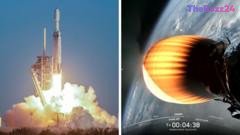
The next-generation Nancy Grace Roman Space Telescope has successfully launched from Florida, embarking on a mission to unravel some of the universe’s most profound mysteries, including dark energy, black holes, and the vast expanse of exoplanets. This powerful observatory promises to deliver panoramic views of space, boasting a field of vision 100 times larger than its predecessors, the Hubble and James Webb space telescopes.
Following its Sunday morning liftoff from the Kennedy Space Center, the Roman telescope began a 100-day journey to its operational vantage point, approximately one million miles from Earth. Once in position, it will commence charting planets beyond our solar system, known as exoplanets, and mapping billions of galaxies. Nicky Fox, a NASA administrator, emphasized the telescope’s transformative potential, stating, “Roman is going to change the way we look at the Universe.” The successful separation from its SpaceX Falcon Heavy rocket about 30 minutes post-launch marked a critical milestone in its journey.
Named in honor of physicist Nancy Grace Roman (1925-2018), often referred to as the “mother of Hubble” for her pivotal role in the Hubble Space Telescope’s approval, this new observatory carries a legacy of groundbreaking discovery. Roman, NASA’s first chief astronomer and a pioneering female executive, was instrumental in shaping modern astrophysics. The telescope is designed to operate for a primary mission of five years, with a goal to extend its lifespan to a decade, providing unprecedented data.
Scientists anticipate the Roman telescope will discover tens of thousands, potentially even 100,000, new exoplanets. This pursuit is central to NASA’s overarching goal of addressing the fundamental question: “Are we alone in the universe?” Furthermore, its crisp, sweeping surveys will be crucial for investigating dark energy and dark matter, which together are believed to constitute about 95% of the universe. By creating “enormous cosmic maps” that illustrate the distribution of galaxies through time, researchers hope to finally understand these enigmatic forces that govern the universe’s expansion and structure.
Key Takeaways
- NASA successfully launched the Nancy Grace Roman Space Telescope from Florida.
- The telescope's mission is to explore dark energy, black holes, and exoplanets with a field of vision 100 times wider than Hubble and James Webb.
- Named after Nancy Grace Roman, the "mother of Hubble," the observatory is expected to revolutionize our understanding of the universe and search for life beyond Earth.
Editor’s Analysis & Impact
The launch of the Nancy Grace Roman Space Telescope marks a significant leap forward in astrophysics and space exploration. This mission is poised to generate an unprecedented volume of data, potentially leading to paradigm shifts in our understanding of cosmology, particularly regarding dark energy and dark matter. For the space industry, it underscores the continued importance of large-scale scientific endeavors and collaborative efforts between government agencies like NASA and private companies such as SpaceX. The telescope’s ability to rapidly survey vast swathes of the cosmos will accelerate exoplanet discovery, fueling the search for habitable worlds and potentially inspiring future crewed missions. Economically, such projects drive innovation in optics, data processing, and propulsion systems, creating high-tech jobs and fostering scientific literacy globally. The long-term implications include a deeper comprehension of the universe’s origins and evolution, directly addressing humanity’s most profound questions.
Frequently Asked Questions
Q: What is the primary mission of the Nancy Grace Roman Space Telescope?
A: The telescope's primary mission is to explore dark energy, black holes, and exoplanets, providing vast panoramic views of space to help scientists understand the universe's expansion, map galaxies, and search for life beyond Earth.
Q: How does the Roman Telescope compare to the Hubble and James Webb space telescopes?
A: The Nancy Grace Roman Space Telescope distinguishes itself with a field of vision 100 times larger than both the Hubble and James Webb space telescopes, allowing it to capture much wider panoramic views of the cosmos in a single observation. While James Webb also orbits a million miles from Earth and Hubble orbits much closer, Roman's strength lies in its expansive survey capabilities.
Q: Who was Nancy Grace Roman, after whom the telescope is named?
A: Nancy Grace Roman (1925-2018) was a pioneering American astronomer and NASA's first chief astronomer and first female executive. She is widely known as the "mother of Hubble" for her instrumental role in planning and securing approval for the Hubble Space Telescope.
AI Disclosure: This article is based on verified data and official reports. Our Team and AI have cross-referenced every financial detail with primary sources to ensure total accuracy.
More from this Category