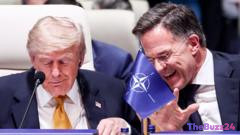
NATO Chief Dismisses Trump Criticisms as ‘Family Quarrels’ and Affirms Alliance Readiness
At the recent NATO summit in Ankara, Secretary General Mark Rutte strongly defended the unity and readiness of the military alliance, dismissing recent critical remarks by US President Donald Trump as typical “family arguments.” Despite Trump’s public frustrations regarding European defense contributions and his disappointment over NATO’s lack of direct involvement in US military actions against Iran, Rutte emphasized that the underlying bond between the United States and its transatlantic allies remains unbreakable.
Rutte expressed absolute confidence in the US commitment to the alliance, pointing out that American military operations heavily rely on European infrastructure. He cited the recent Operation Epic Fury against Iran as a prime example, where thousands of US aircraft utilized European bases under bilateral agreements to project power. Furthermore, Rutte highlighted NATO’s critical role as an early warning system, particularly in monitoring Russian nuclear submarine activity near the Arctic’s Kola Peninsula, which directly protects the US mainland.
The Ankara summit primarily focused on translating defense spending pledges into concrete industrial action to counter Russia’s growing arsenal of drones and missiles. Rutte lauded the significant progress made, noting that European allies and Canada have increased their defense spending by a staggering $250 billion over the past two years. While some member states have yet to establish clear timelines to meet the 3% GDP spending target by 2030, the overall trajectory shows a massive mobilization of resources.
Addressing concerns over potential future conflicts, such as a hypothetical Russian incursion into the Baltic states by 2030, Rutte maintained an unwavering stance on NATO’s preparedness. He asserted that the alliance is fully prepared to defend its territory at any moment. Emphasizing NATO’s defensive nature, he warned that while the alliance will never initiate an attack, any adversary attempting to breach its borders would face an immediate and unified response.
Key Takeaways
- NATO Secretary General Mark Rutte dismissed Donald Trump's critical rhetoric as minor 'family arguments,' asserting that the US remains fully committed to the alliance.
- European and Canadian allies have increased defense spending by $250 billion over the last two years to counter rising threats from Russia.
- Rutte emphasized NATO's strategic value to the US, citing European bases used during Operation Epic Fury and critical monitoring of Russian nuclear submarines.
Editor’s Analysis & Impact
The geopolitical landscape is undergoing a critical transition as NATO attempts to balance internal political friction with external security threats. Mark Rutte’s diplomatic framing of Donald Trump’s criticisms as a “family argument” is a strategic effort to project unity and stability to adversaries like Russia. However, the underlying tension highlights a persistent debate over burden-sharing within the alliance. The substantial $250 billion increase in European and Canadian defense spending demonstrates that member states are taking the threat of Russian expansionism seriously. Moving forward, the alliance’s primary challenge will not just be securing financial pledges, but rapidly scaling up defense industrial production to match Russia’s advanced missile and drone capabilities. NATO’s long-term deterrence strategy depends heavily on maintaining this industrial momentum while navigating potential shifts in US foreign policy.
Frequently Asked Questions
Q: Why does Mark Rutte believe Donald Trump is committed to NATO?
A: Rutte points to the strategic military advantages NATO offers the US, such as the use of European bases for power projection (as seen in Operation Epic Fury) and the alliance's role in monitoring Russian nuclear submarine movements near the Arctic.
Q: How much has NATO defense spending increased recently?
A: European allies and Canada have increased their collective defense spending by $250 billion over the past two years.
Q: Is NATO prepared for a potential conflict with Russia?
A: Yes, Secretary General Mark Rutte stated that NATO is fully prepared to defend its territory immediately and will remain ready to counter any potential aggression, including hypothetical threats to Baltic nations by 2030.
AI Disclosure: This article is based on verified data and official reports. Our Team and AI have cross-referenced every financial detail with primary sources to ensure total accuracy.
More from this Category