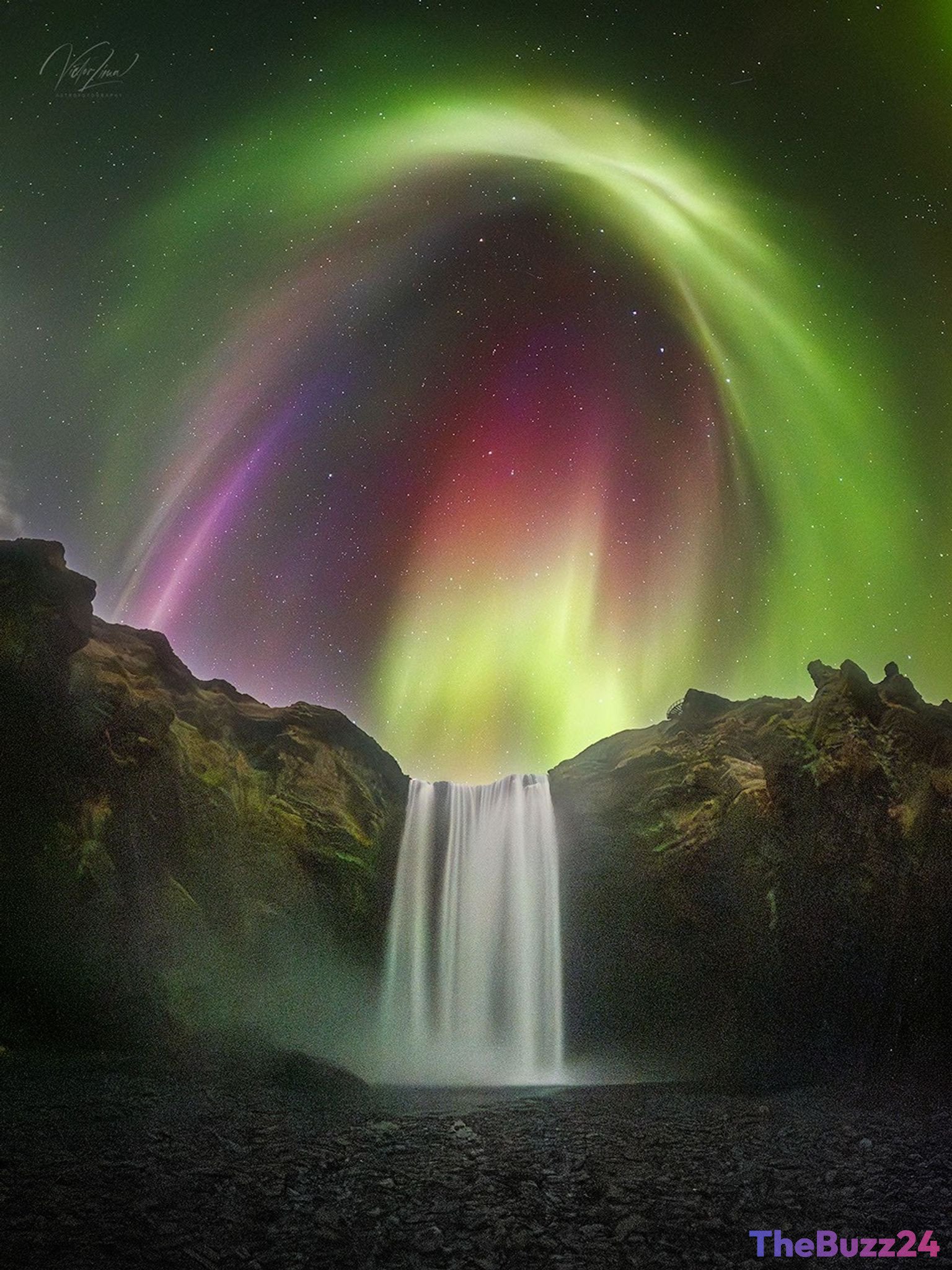
Nature’s Light Show: Stunning Aurora Borealis Illuminates Iceland’s Skógafoss Waterfall
A breathtaking photograph captured by photographer Victor Lima showcases the ethereal beauty of the Aurora Borealis draped over Iceland’s famous Skógafoss waterfall. Taken during a five-second exposure, the image captures a vibrant cascade of colors that appear to rain down directly over the rushing waters, highlighting the majestic synergy between Earth’s geological wonders and cosmic phenomena.
Witnessing the northern lights remains a bucket-list experience for many, but capturing such a vivid display requires a perfect storm of conditions. Observers need high solar activity, clear and dark skies, and a high-latitude vantage point. Interestingly, the northern lights (Aurora Borealis) are far more frequently observed than their southern counterpart (Aurora Australis), primarily because the Northern Hemisphere contains significantly more landmass near the polar regions compared to the vast, open oceans surrounding Antarctica.
The science behind these celestial light shows is rooted in space weather. Auroras are triggered when charged particles carried by solar winds are captured by Earth’s magnetosphere. Guided along magnetic field lines toward the poles, these particles collide with atmospheric gases. The resulting energy release produces distinct colors depending on the altitude and the specific gases involved: oxygen collisions yield brilliant reds and greens, while interactions with nitrogen produce deep blues and vibrant pinks.
Key Takeaways
- Photographer Victor Lima captured a spectacular five-second exposure of the Aurora Borealis over Iceland's Skógafoss waterfall.
- Auroras are caused by solar wind particles colliding with atmospheric gases, with oxygen producing red/green hues and nitrogen producing blue/pink tones.
- The Northern Hemisphere offers better aurora viewing opportunities than the Southern Hemisphere due to a greater abundance of landmass at high latitudes.
Editor’s Analysis & Impact
The capture of such high-quality astrophotography highlights the growing public interest in space weather and celestial events, driven in part by the current solar cycle’s peak activity. As solar maximum approaches, heightened solar winds are triggering more frequent and intense auroral displays, drawing thousands of astro-tourists to high-latitude destinations like Iceland, Norway, and Canada. This surge in ‘eclipse and aurora tourism’ represents a lucrative economic boost for remote northern communities but also underscores the need for robust space weather forecasting. For scientists, these visual spectacles are valuable real-time indicators of the Earth’s magnetospheric health and its ongoing interaction with solar radiation, offering critical data to help protect global satellite and communication grids from severe solar storms.
Frequently Asked Questions
Q: Why are the northern lights easier to see than the southern lights?
A: The northern lights are more accessible because the Northern Hemisphere has significantly more landmass at high latitudes (such as Canada, Scandinavia, and Iceland) where people can easily travel and set up viewing equipment, whereas the Southern Hemisphere's polar regions are mostly open ocean and the icy, remote continent of Antarctica.
Q: What causes the different colors in an aurora?
A: The colors are determined by the type of gas particles colliding with solar winds and the altitude at which the collisions occur. Oxygen collisions typically produce green and red lights, while nitrogen collisions result in blue and pink hues.
Q: What conditions are necessary to view an aurora?
A: To view an aurora, you need high solar activity (which sends charged particles toward Earth), clear skies free of cloud cover, minimal light pollution (dark skies), and a location situated at a high latitude near the polar regions.
AI Disclosure: This article is based on verified data and official reports. Our Team and AI have cross-referenced every financial detail with primary sources to ensure total accuracy.
More from this Category