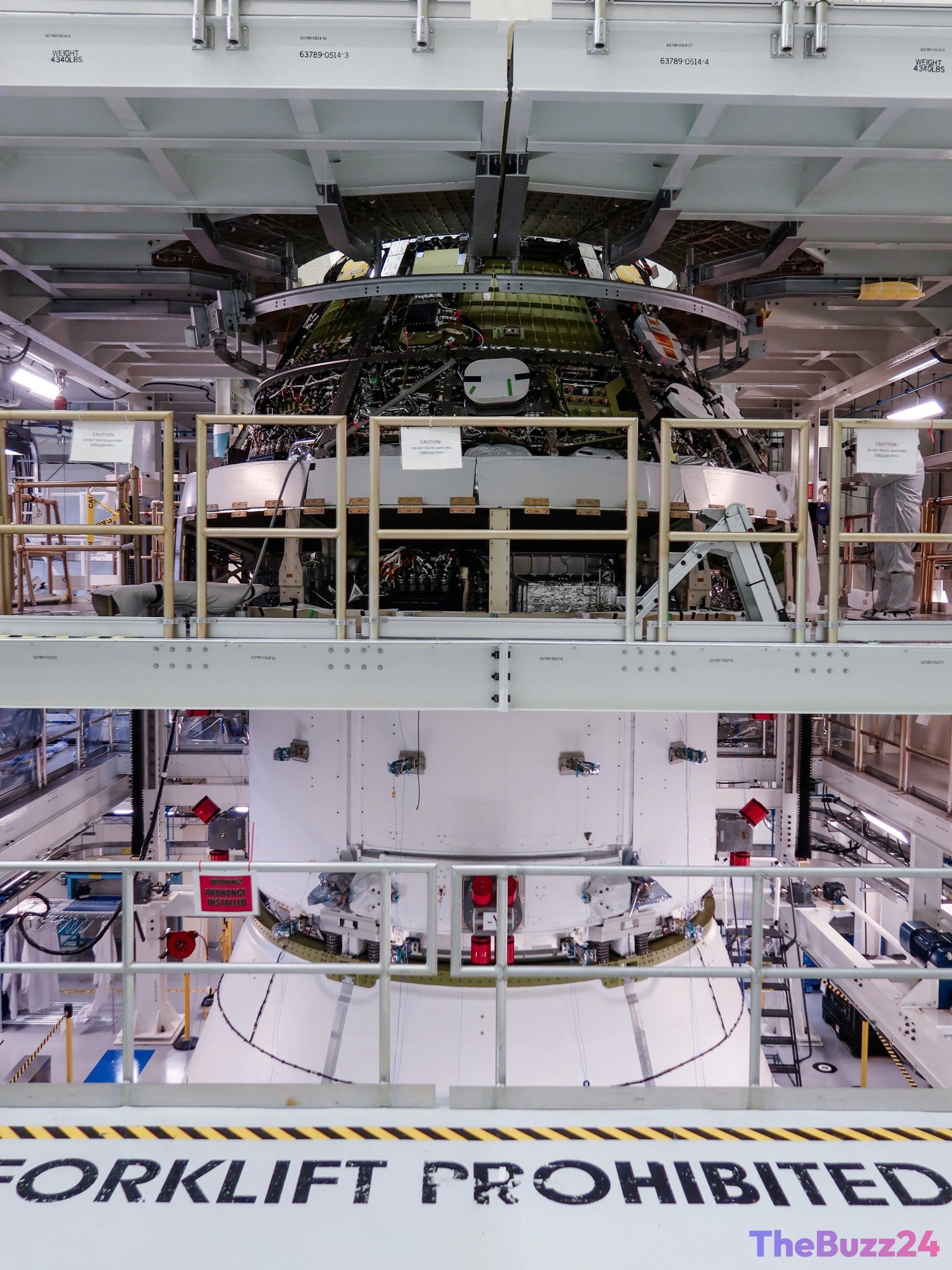
Orion Spacecraft Modules United for Historic Artemis III Mission
In a significant step towards humanity’s return to the lunar surface, technicians have successfully integrated the crew and service modules of the Orion spacecraft. This crucial assembly took place on July 30, 2026, within the Neil Armstrong Operations and Checkout Building at NASA’s Kennedy Space Center in Florida.
The Orion spacecraft is slated to carry a diverse crew of four astronauts on the Artemis III mission. The crew will include NASA astronauts Randy Bresnik, Andre Douglas, and Frank Rubio, alongside European Space Agency (ESA) astronaut Luca Parmitano. This mission aims to test critical rendezvous and docking procedures in preparation for future lunar landings.
During the mission, the service module will provide the necessary power and propulsion for Orion’s journey. A key objective of Artemis III will be to practice docking maneuvers with developmental versions of human landing systems. These test articles are being developed by prominent commercial spaceflight companies, including Blue Origin and SpaceX, highlighting the collaborative nature of NASA’s ambitious lunar exploration program.
Key Takeaways
- The crew and service modules of the Orion spacecraft have been successfully joined for the Artemis III mission.
- The Artemis III crew will consist of four astronauts: three from NASA and one from the ESA.
- A primary goal of the mission is to test docking capabilities with prototype lunar landers from Blue Origin and SpaceX.
Editor’s Analysis & Impact
The successful integration of the Orion spacecraft’s modules marks a pivotal moment in NASA’s Artemis program. This milestone underscores the progress being made towards returning humans to the Moon and establishing a sustainable presence. The mission’s focus on testing commercial landing systems from companies like Blue Origin and SpaceX highlights a strategic shift towards public-private partnerships in space exploration. This approach not only leverages private sector innovation but also aims to reduce costs and accelerate development timelines. The success of Artemis III, particularly its docking tests, will be crucial for paving the way for future lunar missions and potential Mars endeavors, signaling a new era of deep space exploration driven by collaboration.
Frequently Asked Questions
Q: What is the significance of the Artemis III mission?
A: The Artemis III mission is significant as it aims to return humans to the lunar surface for the first time since the Apollo program and will test critical technologies for future deep space exploration, including rendezvous and docking with lunar landers.
Q: Who are the astronauts assigned to the Artemis III mission?
A: The Artemis III crew will comprise NASA astronauts Randy Bresnik, Andre Douglas, and Frank Rubio, along with ESA astronaut Luca Parmitano.
Q: What role do Blue Origin and SpaceX play in the Artemis III mission?
A: Blue Origin and SpaceX are developing test versions, or test articles, of human landing systems. The Artemis III mission will involve testing rendezvous and docking capabilities with these commercial lander prototypes.
AI Disclosure: This article is based on verified data and official reports. Our Team and AI have cross-referenced every financial detail with primary sources to ensure total accuracy.
More from this Category