Perseverance Rover Captures Rare Celestial Dance: Earth and Phobos in Martian Sky
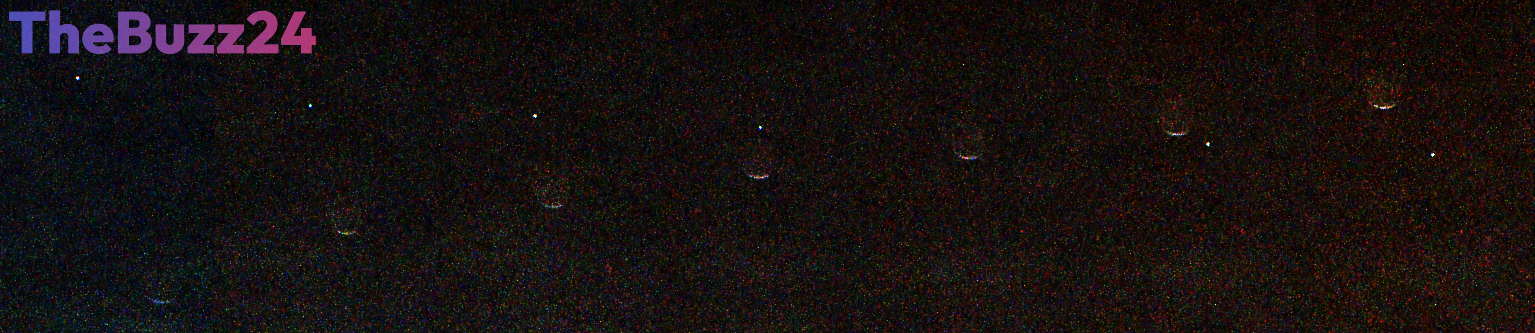
NASA’s Perseverance rover has captured a remarkable celestial event, documenting Earth appearing as a tiny, bright point of light as it passed behind Mars’ moon, Phobos. The images, taken on July 2, 2026, during the 1,907th Martian day of the mission, offer a unique perspective on our home planet from the Red Planet.
The Mastcam-Z instrument aboard the Perseverance rover was instrumental in capturing this phenomenon. A composite of seven images showcases Earth’s transit, moving from the upper left to the lower right of the frame, obscured by Phobos. The striking black background in the processed images is a result of careful manipulation to eliminate extraneous light, thereby enhancing the visibility of the celestial bodies and the details of the occultation.
Further analysis is provided in annotated versions of the images. Figure A includes an inset that specifically highlights Earth’s movement behind Phobos. This inset, composed of five individual images, shows Phobos ascending while Earth descends against the Martian sky. The surrounding sky is depicted in its approximate true color, a blue-gray hue near the horizon that transitions to a reddish-gray higher up, characteristic of twilight approximately 40 minutes after sunset.
Figure B offers additional context by annotating the local solar time on Mars when each of the five images capturing the occultation was acquired. This detailed documentation provides valuable data for scientists studying the orbital mechanics and relative positions of celestial bodies within the Martian system.
Key Takeaways
- NASA's Perseverance rover has captured images of Earth passing behind Mars' moon Phobos.
- The event was observed on July 2, 2026, using the rover's Mastcam-Z instrument.
- The images provide a unique perspective of Earth as a small, bright dot from the Martian surface.
Editor’s Analysis & Impact
This capture by the Perseverance rover is a significant achievement in planetary science and public engagement. It not only demonstrates the advanced capabilities of the rover’s instrumentation but also offers a profound visual reminder of Earth’s place in the cosmos. Such observations contribute valuable data for understanding orbital dynamics and the broader solar system. For the public, it fosters a sense of wonder and connection to space exploration, potentially inspiring future generations of scientists and engineers. The ability to document such precise celestial alignments highlights the ongoing success of the Mars Exploration Program.
Frequently Asked Questions
Q: What is Phobos?
A: Phobos is the larger and closer of Mars' two moons. It is irregularly shaped and is thought to be a captured asteroid.
Q: What is an occultation?
A: An occultation is an event where one celestial body is hidden by another. In this case, Earth was hidden by Phobos as viewed from Mars.
Q: What is the Mastcam-Z instrument?
A: Mastcam-Z is a pair of cameras on the Perseverance rover designed to capture high-definition images and video of the Martian landscape, including geological features and atmospheric phenomena.
AI Disclosure: This article is based on verified data and official reports. Our Team and AI have cross-referenced every financial detail with primary sources to ensure total accuracy.
More from this Category