A Cosmic Photobomb: Perseverance Rover Captures Earth Vanishing Behind Martian Moon
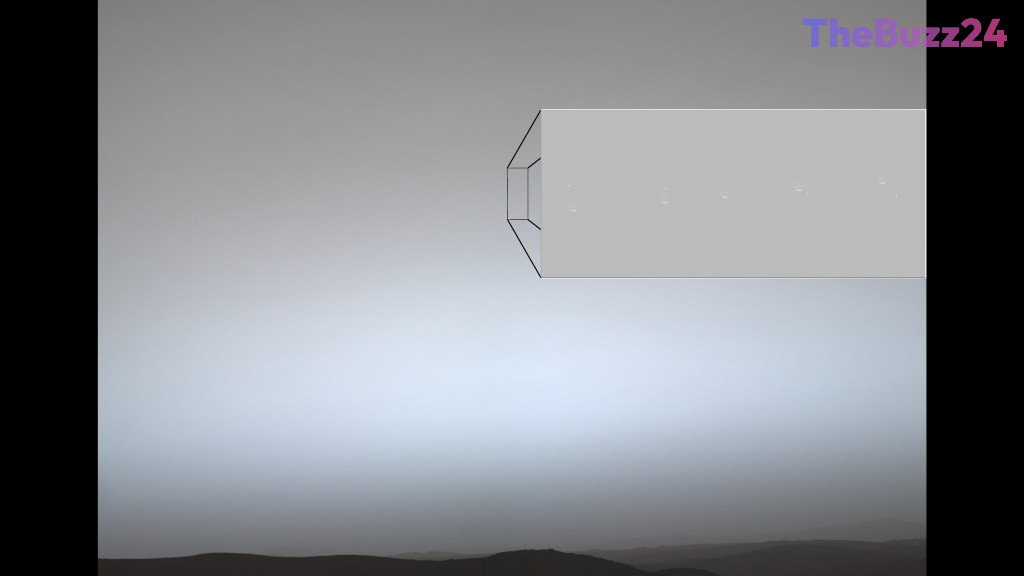
In a historic first for planetary exploration, the Perseverance rover has successfully captured a rare celestial event from the surface of Mars. On July 2, 2026, the rover’s Mastcam-Z instrument recorded Earth as it passed behind Phobos, the larger of Mars’ two moons. This marks the first time humanity has observed our home planet being obscured by another celestial body while viewing from the surface of a different world.
The observation took place during the Martian evening, specifically at 7 p.m. local solar time on the 1,907th sol of the mission. The resulting composite imagery shows Earth appearing as a small, bright point of light traveling across the Martian sky, only to be momentarily hidden by the shadowed edge of the potato-shaped moon. The event, technically classified as an occultation, required precise planning and favorable orbital alignment to capture.
Scientists involved in the mission noted that while Phobos frequently crosses the Martian sky, catching the precise moment of an occultation involving Earth requires significant coordination. From the perspective of the Jezero Crater, where Perseverance is stationed, the two objects presented a stark contrast in scale. While Phobos appeared as a lumpy, irregular shape, Earth was reduced to a singular, pixel-sized dot, highlighting the immense distance of approximately 195 million miles between the two planets at the time of the event.
This successful capture provides researchers with valuable data regarding the orbital mechanics of Martian moons and demonstrates the continued capability of the Perseverance rover to conduct complex astronomical observations. Beyond its primary mission of geological exploration, the rover continues to serve as a vital vantage point for understanding the dynamics of our solar system from an extraterrestrial perspective.
Key Takeaways
- The Perseverance rover captured the first-ever observation of Earth being occulted by a Martian moon from the surface of Mars.
- The event occurred on July 2, 2026, when Earth passed behind Phobos during the Martian evening.
- This observation highlights the precision of the rover's Mastcam-Z instrument and the complex planning required for deep-space astronomical events.
Editor’s Analysis & Impact
The successful capture of this occultation represents a significant milestone in planetary science, showcasing the versatility of current robotic missions. While the primary objective of the Perseverance mission remains the search for signs of ancient life and the collection of geological samples, the ability to perform high-precision astronomical observations enhances our understanding of orbital dynamics within the solar system. As space agencies continue to push the boundaries of long-term planetary surface operations, these ‘opportunistic’ scientific observations become increasingly important for calibrating instruments and refining orbital models. The broader implication is a shift toward multi-purpose robotic platforms that can serve as both geological laboratories and deep-space observatories, providing a unique, long-term perspective on Earth’s place in the cosmos from the surface of our neighboring planet.
Frequently Asked Questions
Q: What is an occultation?
A: An occultation occurs when a larger-appearing celestial body moves in front of and completely blocks a smaller-appearing object from the viewer's perspective.
Q: Why is this observation significant?
A: It is the first time in history that a human-made instrument on the surface of another planet has captured Earth being obscured by another celestial body, providing a unique perspective on our planet's position in the solar system.
AI Disclosure: This article is based on verified data and official reports. Our Team and AI have cross-referenced every financial detail with primary sources to ensure total accuracy.
More from this Category