President Trump Formalizes Ceasefire Extension with Iran at Versailles
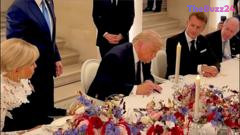
President Donald Trump has officially signed a 14-point Memorandum of Understanding to extend the ongoing ceasefire with Iran. The agreement was finalized during a diplomatic gathering at the Palace of Versailles, located on the outskirts of Paris, following a post-G7 dinner. The signing ceremony was attended by French President Emmanuel Macron and First Lady Brigitte Macron, marking a significant moment in the current international diplomatic landscape.
Beyond the formal ceasefire extension, the administration has signaled a shift in its energy and foreign policy strategy. President Trump indicated that the United States is currently extracting millions of barrels of oil from Iran, a development he noted had not been previously disclosed to the public. This announcement comes amidst a period of heightened tension, as reports indicate that Israel and Iran have recently engaged in renewed missile exchanges, testing the stability of the two-month-old ceasefire.
These developments occur against a backdrop of complex geopolitical maneuvering and domestic scrutiny. While the administration continues to navigate these international agreements, questions regarding campaign promises and the broader scope of US foreign policy remain at the forefront of public discourse. The signing at Versailles serves as a pivotal point in the administration’s efforts to manage relations with Tehran while addressing domestic energy interests.
Key Takeaways
- President Trump signed a 14-point Memorandum of Understanding to extend the ceasefire with Iran.
- The agreement was formalized at the Palace of Versailles in France during a post-G7 event.
- The administration confirmed the extraction of millions of barrels of oil from Iran as part of its current energy strategy.
Editor’s Analysis & Impact
The formalization of a ceasefire extension between the United States and Iran at the Palace of Versailles represents a calculated attempt to stabilize a volatile geopolitical region. However, the simultaneous disclosure regarding oil extraction from Iranian reserves introduces a layer of economic complexity that may complicate future diplomatic efforts. The market impact is likely to be felt in global energy sectors, where uncertainty regarding supply chains and regional stability often drives price volatility. Furthermore, the reported missile exchanges between Israel and Iran suggest that the ceasefire remains fragile. The administration’s ability to balance these aggressive energy policies with the need for long-term regional de-escalation will be the primary indicator of the success of this diplomatic framework. Future implications include potential shifts in international energy markets and a continued reliance on high-stakes, direct negotiations to prevent further escalation.
Frequently Asked Questions
Q: What is the primary purpose of the agreement signed at Versailles?
A: The agreement is a 14-point Memorandum of Understanding designed to extend the existing ceasefire between the United States and Iran.
Q: Has the ceasefire effectively stopped all hostilities between Iran and its regional rivals?
A: While the ceasefire is in place, recent reports indicate that Israel and Iran have engaged in missile strikes, suggesting that the situation remains precarious and the ceasefire is under significant pressure.
AI Disclosure: This article is based on verified data and official reports. Our Team and AI have cross-referenced every financial detail with primary sources to ensure total accuracy.
More from this Category