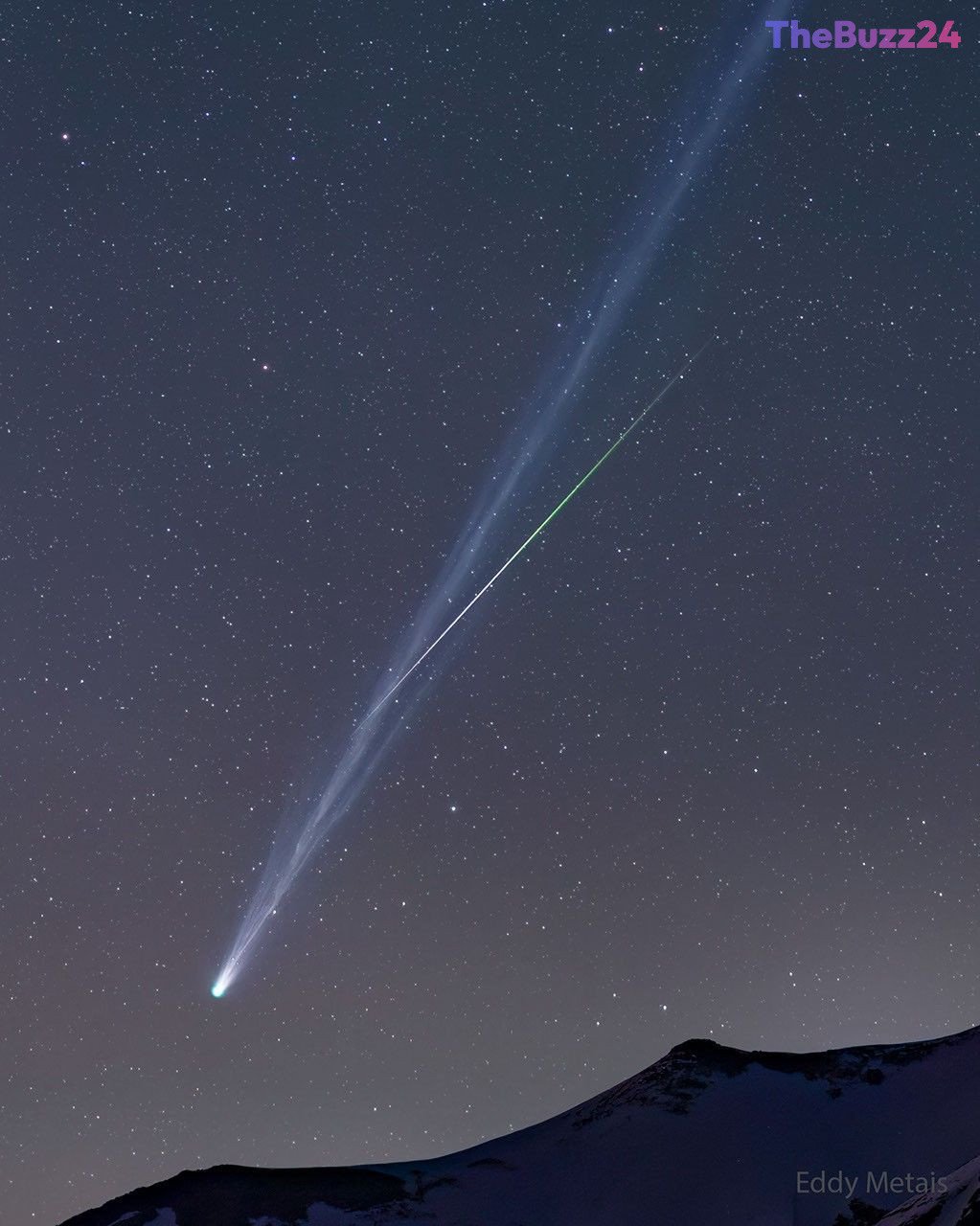
Rare Celestial Alignment Captures Comet PanSTARRS and a Colorful Rainbow Meteor
Stargazers and astronomy enthusiasts are marveling at a stunning cosmic capture featuring Comet C/2025 R3 (PanSTARRS) positioned alongside a vibrant streak known as a rainbow meteor. Photographed from Hautacam, France, the celestial scene showcases the icy wanderer displaying both its distinctive blue ion tail and a trailing dust tail as it journeyed through the inner Solar System.
While comets and meteors frequently share the night sky, astronomers note that connecting a specific shooting star to a particular comet remains a complex scientific puzzle due to the thousands of icy bodies that visit our celestial neighborhood. The prominent foreground streak captured in the image exhibits a striking multicolored appearance, which scientists attribute to a diverse chemical composition as sand-sized debris burns up upon entering Earth’s upper atmosphere.
The breathtaking snapshot arrives just in time for an exceptionally active month of celestial fireworks. November features multiple prominent meteor showers reaching their maximum intensity. The Southern Taurids peak first, followed closely by the Northern Taurids a week later, both tracing their origins back to Comet 2P/Encke. Meanwhile, skywatchers are eagerly anticipating the arrival of the renowned Leonids Meteor Shower, originating from Comet 55P/Tempel-Tuttle, which is scheduled to reach its magnificent crescendo in the coming weeks.
Key Takeaways
- Comet C/2025 R3 (PanSTARRS) was photographed from France displaying prominent ion and dust tails.
- The vibrant foreground streak, or rainbow meteor, features a complex chemical composition as debris enters Earth's atmosphere.
- November features peak activity for multiple meteor showers, including the Taurids and the upcoming Leonids.
Editor’s Analysis & Impact
The regular capture and public appreciation of deep-space phenomena like Comet PanSTARRS and seasonal meteor showers highlight the growing public engagement with astronomy and astronomical photography. As imaging technology improves and becomes more accessible to amateur astrophotographers, public interest in celestial events continues to surge. This heightened enthusiasm not only drives educational outreach in the sciences but also fosters greater appreciation for professional-amateur collaborations in tracking near-Earth objects and atmospheric phenomena. Looking forward, upcoming high-profile astronomical events will likely continue to leverage digital platforms to inspire the next generation of scientists and space explorers.
Frequently Asked Questions
Q: Did the meteor originate from Comet PanSTARRS?
A: While many meteors originate from comets, astronomers clarify that matching specific meteors to distant comets is difficult, and the pictured comet is actually far behind the streaking meteor.
Q: What causes the colorful appearance of a rainbow meteor?
A: The colorful streak indicates a complicated chemical composition as sand-sized rocky debris enters and burns up in Earth's atmosphere.
Q: Which major meteor showers peak in November?
A: November features the peaks of the Southern Taurids, the Northern Taurids, and the famous Leonids Meteor Shower.
AI Disclosure: This article is based on verified data and official reports. Our Team and AI have cross-referenced every financial detail with primary sources to ensure total accuracy.
More from this Category