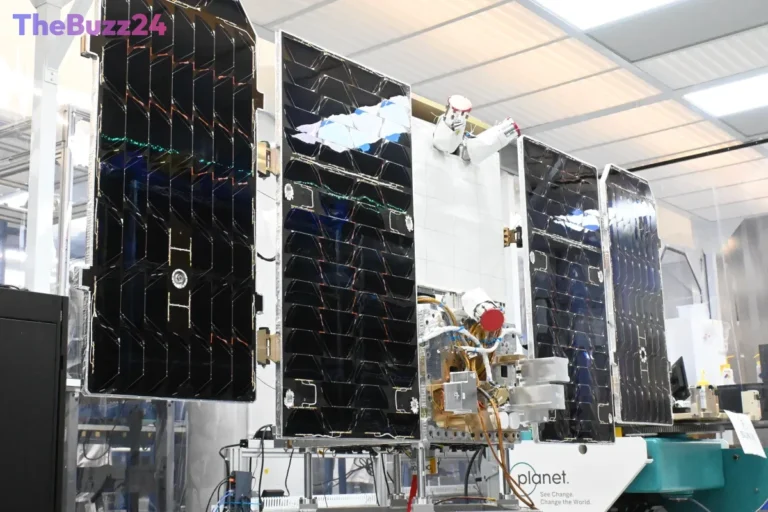
Satlyt Unlocks New Frontiers in Space Computing with Successful Orbital Software Test
Satlyt, a pioneering company founded by Rama Afullo, is making significant strides toward transforming existing satellites into sophisticated, distributed data processing networks. This vision, akin to creating orbital data centers, recently took a major step forward with the successful completion of a critical software test after 13 months of dedicated development.
Working in collaboration with the University of Houston on a NASA-funded research project, Satlyt’s test demonstrated the software’s capability to intelligently distribute computing tasks among various orbital computers. This distribution is dynamically managed based on available communication links and processing power, marking a crucial advancement in autonomous space operations. The core objective is to develop software that can seamlessly connect multiple satellites, enabling them to share computing assignments. Users would simply define permissions, priorities, and operational limits, allowing the software to autonomously manage task allocation within those parameters. Satlyt’s software is already deployed on three satellites currently in orbit, with this recent test serving as a foundational step towards their broader vision.
The technology is designed to tackle persistent challenges faced by space missions, including constrained computing resources, intermittent communication, and the urgent need to transmit actionable information back to Earth. For instance, if a spacecraft detects a wildfire, Satlyt’s software could process the data onboard, enabling much faster transmission of relevant information. The recent test involved a simulated network comprising four computers, four users, and eight services. The software successfully assessed and assigned tasks, accounting for both compute and communication availability. While only one physical computer on an orbiting spacecraft ran the software, with others simulated, it successfully generated and returned results to Earth, proving its in-orbit planning capabilities. Future testing will focus on how multiple physical computers transfer information among themselves in practice.
Despite identifying a trade-off where one optimal approach required more computing power and a minor issue with time-referencing delays, the overall experiment was deemed a success. The software’s development, onboard execution, and output retrieval all performed as intended. Looking ahead, Satlyt plans broader validation and integration, followed by demonstrations of computing work shared across separate spacecraft. The long-term ambition is to empower developers to create applications for space without the need to rebuild infrastructure for every mission, effectively establishing virtual AI data centers in space.
Key Takeaways
- Satlyt successfully tested software designed to transform existing satellites into distributed data processing networks in orbit.
- The technology aims to enable onboard AI and applications, reducing reliance on Earth-based data processing and improving the speed of data return from space.
- Future plans include broader validation, integration, and demonstrating shared computing across multiple spacecraft to establish virtual AI data centers in space.
Editor’s Analysis & Impact
Satlyt’s breakthrough in orbital computing represents a significant leap for the space industry, potentially revolutionizing how satellite data is processed and utilized. By enabling onboard AI and distributed computing, the technology could drastically reduce latency and bandwidth demands, which are critical for real-time applications such as disaster response, defense, and advanced scientific research. This innovation opens new avenues for satellite operators to offer ‘compute-as-a-service’ in orbit, creating new revenue streams and fostering a more autonomous space infrastructure. The broader implications include democratizing access to advanced space computing, accelerating the pace of scientific discovery, and potentially raising new considerations for data sovereignty and security in a distributed orbital network.
Frequently Asked Questions
Q: What problem does Satlyt's software aim to solve?
A: Satlyt's software aims to address the challenges of limited computing resources, intermittent communication, and the need for faster data return from satellites by enabling onboard data processing and AI applications directly in orbit.
Q: How does Satlyt's software work?
A: The software connects multiple satellites to share computing assignments. Users define permissions and operating limits, and the software intelligently distributes tasks among available orbital computers based on communication and processing capacity.
Q: What are Satlyt's long-term goals for this technology?
A: Satlyt's long-term vision is to create 'virtual AI data centers in space,' allowing developers to build and deploy applications for space missions without needing to rebuild infrastructure for each new project, thereby streamlining space-based development.
AI Disclosure: This article is based on verified data and official reports. Our Team and AI have cross-referenced every financial detail with primary sources to ensure total accuracy.
More from this Category