Shattered Worlds: Webb Telescope Unlocks Secrets of Planetary Collisions and Our Solar System’s Violent Past
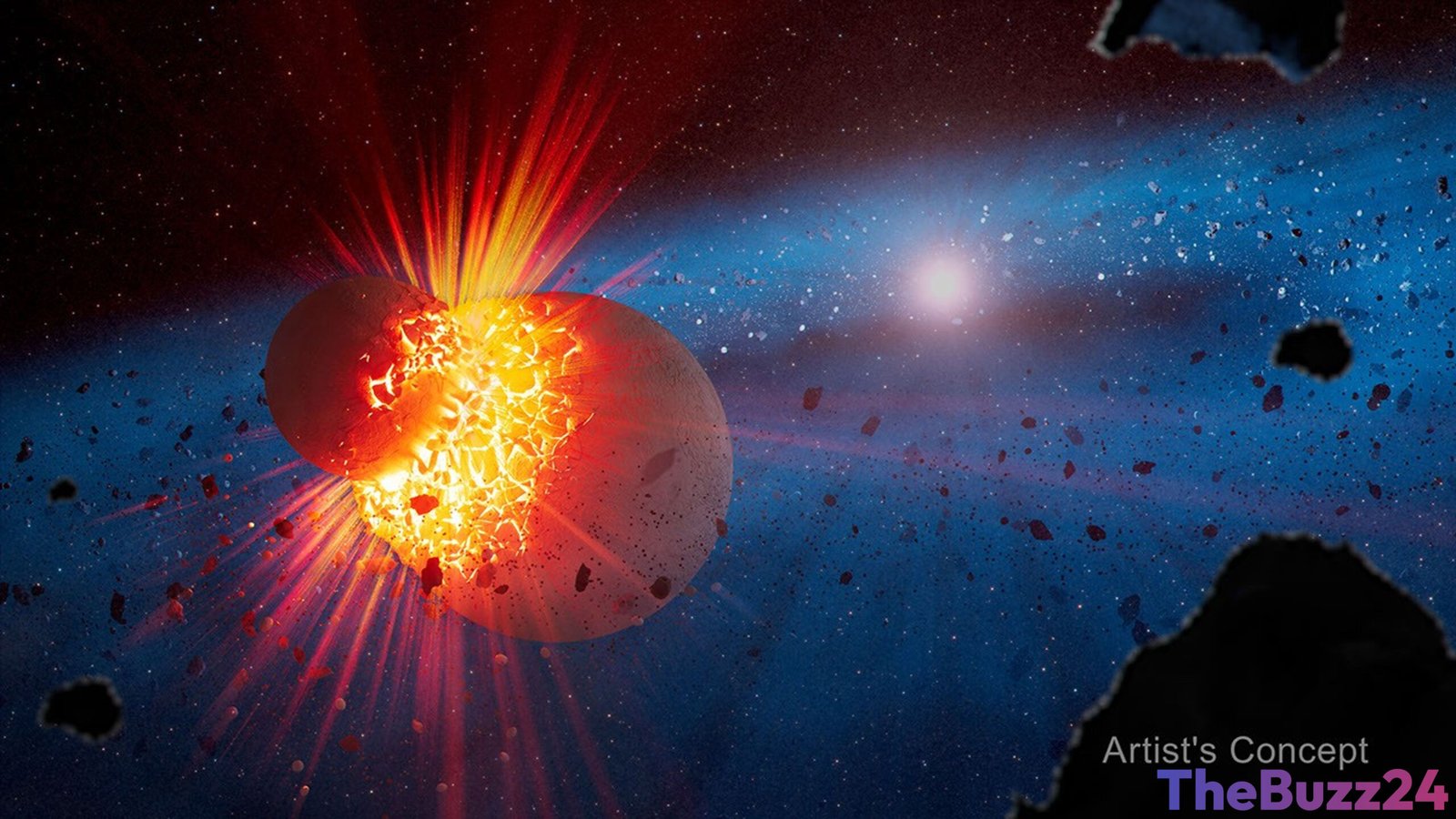
The James Webb Space Telescope (JWST) is offering unprecedented insights into the chaotic early lives of stellar systems, revealing the dynamics of planet-shattering collisions that echo the violent birth of our own Moon. Astronomers have utilized Webb to scrutinize a unique class of young stellar environments known as extreme debris disks, which exhibit signs of intense cosmic upheavals, providing crucial data on the energy and aftermath of these impact events.
These extreme debris disks, initially identified by the retired Spitzer Space Telescope, are characterized by unusually large quantities of warm dust orbiting close to their central stars, in regions comparable to where rocky planets reside in our solar system. Despite theoretical predictions, such environments are rare, observed in only about 1% of young stars. A team of astronomers, led by Kate Su of the Space Science Institute, compiled a sample of 21 such disks, combining archival Spitzer data with new and follow-up observations from Webb. Their detailed analysis, published in The Astrophysical Journal, confirmed three key properties: smaller dust grains, a high concentration of warm dust, and irregular brightness variations, all illuminated by Webb’s mid-infrared spectral capabilities.
Further investigation into the mineralogical composition of these disks allowed scientists to categorize them as either silica-rich or silica-poor. Approximately one-third of the observed disks were silica-rich, indicating high-energy impacts between Mars-sized objects where significant material was vaporized. These are typically found around stars younger than 300 million years. The remaining two-thirds were silica-poor, suggesting less energetic collisions involving Moon-sized bodies, persisting across a broader range of stellar ages and often displaying greater brightness variability. This variability is thought to be driven by the rapid evolution of fresh debris through orbital changes and subsequent impacts.
These findings hold profound implications for understanding our own solar system’s history. The silica-rich disk characteristics align with the theorized formation of Earth and the Moon approximately 100 million years after the Sun, where a Mars-sized object, Theia, is believed to have collided with early Earth to create our natural satellite. Furthermore, the behavior of older, silica-poor disks, with their random infrared brightness fluctuations, could be consistent with the Late Heavy Bombardment hypothesis, a period when migrating gas giants gravitationally disrupted smaller bodies, triggering catastrophic collisions across the inner solar system. While many mysteries remain, ongoing observations with Webb are continually refining our understanding of planetary formation and evolution.
Key Takeaways
- The James Webb Space Telescope has provided unprecedented insights into "extreme debris disks," revealing the aftermath of violent planetary collisions in young stellar systems.
- These disks are categorized into silica-rich (high-energy impacts of Mars-sized bodies) and silica-poor (less energetic impacts of Moon-sized objects), offering clues about the scale and intensity of cosmic smash-ups.
- The findings directly inform theories about our own solar system's formation, including the Moon's origin from a Mars-sized impact and the potential for a "Late Heavy Bombardment" phase.
Editor’s Analysis & Impact
This research significantly advances our understanding of planetary formation, a cornerstone of astrophysics. The ability of the James Webb Space Telescope to characterize the composition and dynamics of extreme debris disks provides empirical data to refine theoretical models of how rocky planets, including Earth, come into being. For the space industry, these findings underscore the immense value of advanced observatories like Webb, driving further investment in next-generation telescopes and data analysis techniques. The broader implications extend to exoplanet research, helping scientists predict the environments and evolutionary paths of distant worlds, which could, in turn, inform the search for habitable planets. This work solidifies Webb’s role as a transformative tool in unraveling the universe’s deepest mysteries.
Frequently Asked Questions
Q: What are 'extreme debris disks'?
A: Extreme debris disks are young stellar systems characterized by unusually large amounts of warm dust orbiting close to their central stars. This dust is believed to be the result of recent, violent collisions between planetary bodies, similar to events thought to have occurred in our own early solar system.
Q: How do silica-rich and silica-poor disks differ?
A: Silica-rich disks are thought to be formed by high-energy impacts between larger, Mars-sized objects, leading to significant vaporization of material. Silica-poor disks, conversely, are believed to result from less energetic collisions involving smaller, Moon-sized bodies. These compositional differences provide clues about the scale and intensity of the cosmic collisions.
Q: How do these findings relate to Earth and the Moon?
A: The characteristics of silica-rich disks align with the leading theory for the Moon's formation, which posits a Mars-sized object collided with early Earth. The behavior of older, silica-poor disks may also support the 'Late Heavy Bombardment' hypothesis, suggesting our solar system experienced a period of intense asteroid and comet impacts after its initial formation.
AI Disclosure: This article is based on verified data and official reports. Our Team and AI have cross-referenced every financial detail with primary sources to ensure total accuracy.
More from this Category