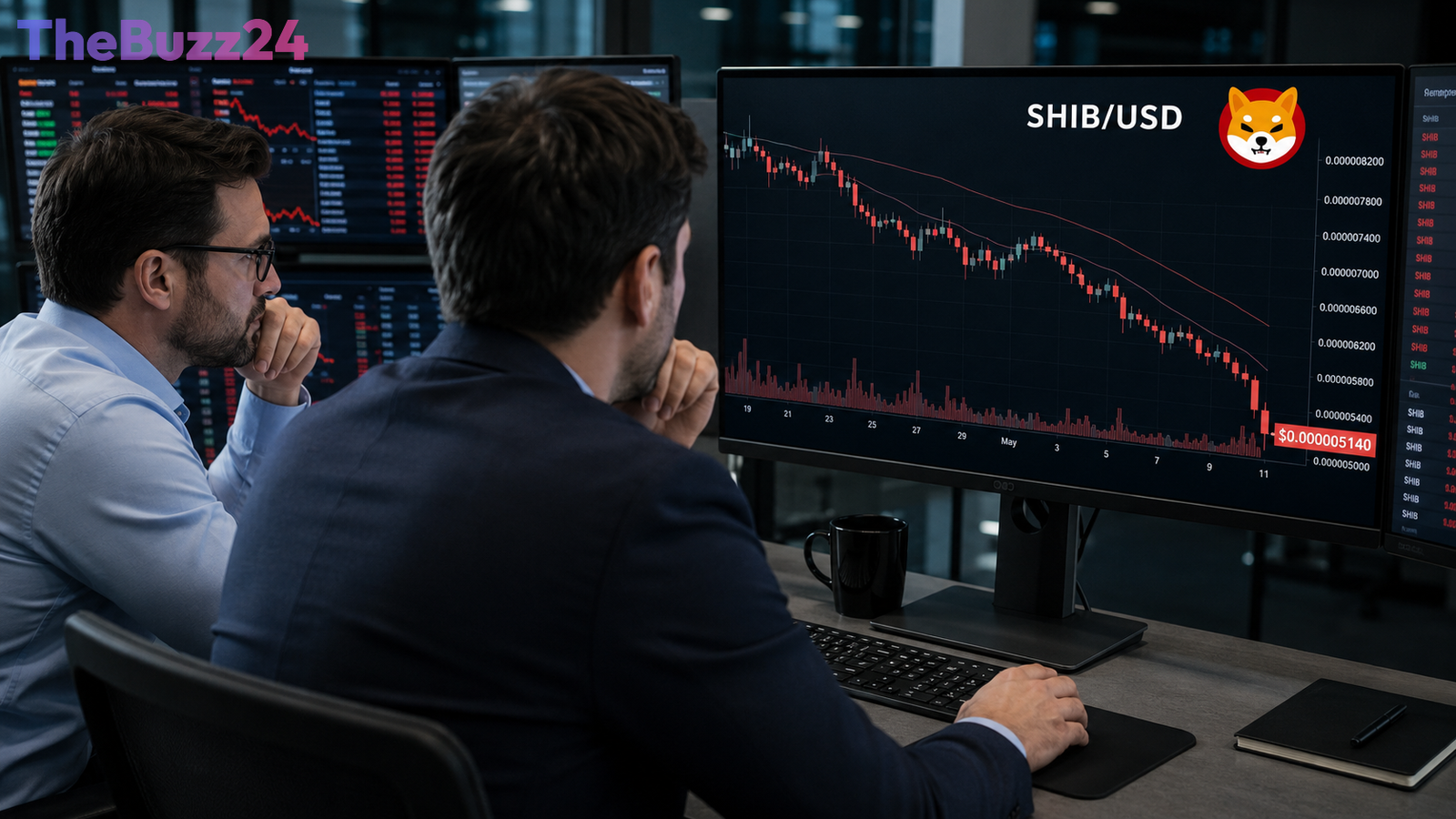
Shiba Inu Navigates Support Levels Amidst Whale Sell-Off and Shifting Market Sentiment
Shiba Inu (SHIB) is currently trading near the $0.00000516 mark, having experienced a notable rebound of nearly 4% earlier this week. Despite this recovery, significant selling activity from large holders, often referred to as ‘whales,’ coupled with cautious signals from the derivatives market, is tempering short-term optimism for the popular memecoin.
Analysis of Santiment’s supply distribution data reveals a trend where wallets holding between 1 million and 100 million SHIB have collectively offloaded approximately 40 billion tokens since August 22. This distribution occurred shortly after a price recovery, suggesting that some larger investors may be capitalizing on the gains rather than anticipating further upward movement. Such sustained selling pressure from major holders could introduce additional supply into the market, potentially hindering SHIB’s ability to maintain its current price trajectory.
In contrast to the larger whales, smaller holders have shown a different pattern. Addresses possessing between 100,000 and 1 million SHIB have accumulated around 990 million tokens during the same period. While this indicates a transfer of assets to a broader base of smaller participants, the volume accumulated is significantly less than the amount sold by larger entities. This imbalance raises questions about whether new retail demand is sufficient to fully absorb the supply being released by the larger wallets.
The derivatives market also reflects a degree of caution. Shiba Inu’s long-to-short ratio currently stands below 1, indicating that more traders are betting on a price decrease than an increase. This bearish positioning, alongside mixed signals from momentum indicators like the RSI and MACD, suggests a period of consolidation and uncertainty for SHIB. The cryptocurrency is currently holding above its 50-day exponential moving average (EMA), a critical support level, but a sustained increase in selling pressure could challenge this floor and lead to further declines.
Key Takeaways
- Shiba Inu is trading above its 50-day EMA support level despite significant selling from large whale wallets.
- Whales holding 1-100 million SHIB have sold 40 billion tokens since August 22, while smaller whales accumulated a much smaller amount.
- Derivatives market data shows bearish sentiment, with short positions outnumbering long positions, indicating cautious short-term outlook.
Editor’s Analysis & Impact
The recent price action of Shiba Inu highlights a classic tug-of-war between recovering retail interest and profit-taking by large holders. While the memecoin’s ability to hold key technical support like the 50-day EMA is a positive sign for bulls, the substantial sell-off from whale wallets cannot be ignored. The derivatives market sentiment further underscores the prevailing caution. For SHIB to sustain its recovery and potentially challenge higher resistance levels, it will need to see a significant increase in organic demand that can effectively absorb the supply from larger holders and counteract the bearish sentiment evident in futures trading. The coming days will be crucial in determining whether SHIB can break this pattern of consolidation or succumb to renewed selling pressure.
Frequently Asked Questions
Q: What is a 'whale' in the context of cryptocurrency?
A: In cryptocurrency, a 'whale' refers to an individual or entity that holds a very large amount of a particular digital currency. Their trading activities can significantly impact the market price due to the sheer volume of assets they control.
Q: What is the 50-day exponential moving average (EMA)?
A: The 50-day EMA is a technical analysis indicator used by traders to gauge the average closing price of an asset over the past 50 days, giving more weight to recent prices. It is often used as a short-to-medium term trend indicator and a support or resistance level.
Q: What does a long-to-short ratio below 1 signify?
A: A long-to-short ratio below 1 in the derivatives market indicates that there are more traders holding short positions (betting on a price decrease) than long positions (betting on a price increase). This suggests a prevailing bearish sentiment among traders.
AI Disclosure: This article is based on verified data and official reports. Our Team and AI have cross-referenced every financial detail with primary sources to ensure total accuracy.
More from this Category