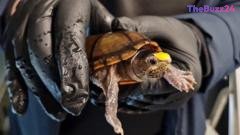
Smuggling Attempt Thwarted as 26 Critically Endangered Turtles Rescued at Amsterdam Airport
Customs officials at Amsterdam’s Schiphol Airport intercepted an international smuggling attempt after discovering 26 critically endangered Vallarta mud turtles hidden inside a traveler’s checked luggage. The suspect, a man traveling from Mexico to Hong Kong, was taken into custody after inspectors uncovered the small reptiles bound in heavy duct tape to restrict their movement. Most of the animals were concealed alongside a toy car inside a box, while the remainder were stuffed inside a tied sock.
Believed to have been illegally poached from their native habitats in Mexico, the seized specimens represent a substantial fraction of the species’ total surviving global population. Measuring under four inches in length, Vallarta mud turtles are recognized as the smallest freshwater turtles in the world. With estimates indicating that fewer than 300 individuals remain in the wild, the species is currently classified as critically endangered by international conservation authorities.
Following the seizure, the rescued reptiles were immediately transferred to a specialized wildlife sanctuary to receive urgent medical assessment and rehabilitation. Meanwhile, law enforcement agencies have launched a full investigation into the trafficking operation. High demand for rare exotic pets in parts of Asia has driven black-market prices for single specimens to $10,000 or more, fueling an illicit trade that poses an existential threat to vulnerable wildlife.
This interception highlights a broader pattern of exotic wildlife trafficking routed through international travel hubs. Authorities in destination regions such as Hong Kong have reported multiple high-value seizures in recent months, confiscating dozens of smuggled reptiles valued at hundreds of thousands of dollars. Conservation groups continue to emphasize the need for heightened transit security and tougher penal sanctions to dismantle organized illegal wildlife rings.
Key Takeaways
- Customs officers at Schiphol Airport rescued 26 critically endangered Vallarta mud turtles hidden in checked baggage.
- The species is extraordinarily rare, with an estimated wild population of fewer than 300 individuals.
- Individual Vallarta mud turtles can command $10,000 or more on the Asian black market, driving aggressive illegal poaching.
Editor’s Analysis & Impact
The seizure of 26 Vallarta mud turtles highlights the severe threat that organized wildlife trafficking poses to global biodiversity. Representing nearly ten percent of the species’ remaining wild population, this single smuggling attempt could have dealt a catastrophic blow to the survival of these reptiles. The high monetary value attached to rare species on the black market creates massive financial incentives for poachers, overriding existing regulatory deterrents. To effectively combat this trade, transit nations must deploy advanced screening technologies and strengthen international intelligence-sharing mechanisms. Furthermore, stricter legal penalties for wildlife traffickers are essential to disrupting the financial networks funding species exploitation.
Frequently Asked Questions
Q: What is the Vallarta mud turtle?
A: The Vallarta mud turtle is native to Mexico and is considered the world's smallest freshwater turtle, growing to a maximum length of roughly 10 centimeters (4 inches).
Q: Why are Vallarta mud turtles targeted by illegal traffickers?
A: Their extreme rarity and critically endangered status make them highly prized by collectors, with individual turtles selling for $10,000 or more on the black market.
Q: What happened to the rescued turtles following the seizure?
A: The recovered turtles were placed into the care of a specialized animal sanctuary where they are undergoing health evaluations and receiving professional care.
AI Disclosure: This article is based on verified data and official reports. Our Team and AI have cross-referenced every financial detail with primary sources to ensure total accuracy.
More from this Category