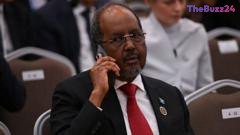
Somalia Plunges Deeper into Political Crisis as Top Court Invalidates Presidential Term Extension
Somalia’s political landscape has been thrown into further turmoil following a landmark Supreme Court decision that invalidated President Hassan Sheikh Mohamud’s term extension and his attempt to dismiss the Chief Justice. The ruling intensifies a constitutional standoff between the executive and judiciary, demanding immediate action from political leaders to stabilize the nation. The court has mandated that an electoral plan be agreed upon within 30 days and nationwide elections held within 90 days, potentially upending the government’s existing timeline for polls next year.
President Mohamud’s four-year mandate originally concluded in May, but his administration secured a one-year extension through parliamentary amendments passed in March. While opposition factions have vehemently criticized this move as an attempt to unlawfully prolong his tenure, President Mohamud has maintained that these reforms are crucial for transitioning Somalia towards fully democratic elections, moving away from its traditional clan-based representative system. Somalia has not held direct nationwide elections since 1969, grappling with decades of civil conflict and the persistent threat of the Islamist militant group al-Shabaab.
The Supreme Court’s decision on Thursday explicitly stated that the constitutional changes could not be applied retrospectively to the president’s current term. Furthermore, the court declared the dismissal of Chief Justice Bashe Yusuf Ahmed “null and void,” asserting that the presidency had overstepped its authority and interfered with judicial independence. Although President Mohamud had appointed Ibrahim Idle Suleiman as Ahmed’s replacement, citing complaints about judicial administration and a desire for transparency, the court firmly rejected this explanation, emphasizing that a Chief Justice can only be removed through established constitutional procedures.
The crisis escalated with accusations from former Prime Minister Hassan Ali Khaire, who alleged that President Mohamud deployed security forces to the Supreme Court and attempted to arrest the Chief Justice, describing it as an “assault on the Supreme Court” and a direct threat to the rule of law. While independent verification of the security deployment was not immediately available, images circulating in Somali media appeared to show armed personnel within the court compound. Former President Sharif Sheikh Ahmed also voiced concerns, welcoming the court’s ruling and urging Mohamud to adopt a consensus-based approach to navigate the “grave political crisis.” The electoral commission’s proposed timetable for parliamentary elections in April 2027 and a presidential vote a month later is now under significant dispute, with opposition groups and regional administrations like Puntland and Jubaland rejecting it. This internal political strife unfolds as Somalia continues its arduous fight against al-Shabaab, compounded by Uganda’s recent announcement to withdraw its troops from the African Union mission by year-end, raising further security concerns.
Key Takeaways
- Somalia's Supreme Court invalidated President Hassan Sheikh Mohamud's term extension and his dismissal of Chief Justice Bashe Yusuf Ahmed, deepening a political crisis.
- The court ordered political leaders to agree on an electoral plan within 30 days and hold elections within 90 days, disrupting existing government timelines.
- The constitutional standoff is exacerbated by accusations of executive interference with the judiciary and unfolds amidst ongoing conflict with al-Shabaab and concerns over troop withdrawals.
Editor’s Analysis & Impact
The Supreme Court’s decisive intervention in Somalia’s political crisis carries significant implications for the nation’s fragile democratic institutions and stability. By rejecting President Mohamud’s term extension and reinstating the Chief Justice, the judiciary has asserted its independence, setting a crucial precedent for the rule of law. However, this ruling also intensifies the power struggle between the executive and judicial branches, potentially leading to further political deadlock and civil unrest. The mandated rapid electoral timeline presents a formidable challenge, given the existing disputes over the electoral framework and the deep-seated clan divisions. This internal turmoil risks diverting critical resources and attention from the ongoing fight against al-Shabaab and could destabilize the region, especially with the impending withdrawal of African Union troops. The path forward demands genuine consensus among political factions to prevent a complete breakdown of governance and security.
Frequently Asked Questions
Q: What did the Supreme Court order regarding elections?
A: The Supreme Court has ordered Somalia's political leaders to agree on a new electoral plan within 30 days and to hold nationwide elections within 90 days. This directive significantly alters the government's previously proposed electoral timetable for next year.
Q: How does this political turmoil affect Somalia's security situation?
A: The political instability diverts focus and resources from the ongoing battle against the Islamist militant group al-Shabaab. It also creates uncertainty at a critical time, especially with Uganda, a major contributor to the African Union mission, planning to withdraw its troops, potentially exacerbating security challenges.
AI Disclosure: This article is based on verified data and official reports. Our Team and AI have cross-referenced every financial detail with primary sources to ensure total accuracy.
More from this Category