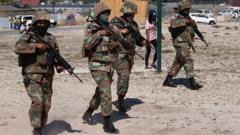
South Africa Deploys Military Forces to Combat Escalating National Crime Crisis
South Africa has launched a major military mobilization across five provinces to assist police in curbing a surge in violent crime, including organized gang activity and illegal mining. President Cyril Ramaphosa authorized the deployment of 2,200 soldiers for a year-long mission, aiming to stabilize regions that have been severely impacted by criminal syndicates. The operation, which began in Gauteng, is set to expand to the Eastern Cape, Free State, North West, and Western Cape provinces as part of a broader effort to reclaim control over volatile communities.
While the government views this as a necessary measure to restore public order, the strategy has met with mixed reactions from the public. Residents in high-crime areas like Eldorado Park have expressed skepticism, noting that while a military presence may provide a temporary deterrent, it fails to address the root causes of the violence. Many citizens fear that the peace will be short-lived, with criminal activity likely to return as soon as the troops are withdrawn from their neighborhoods.
This deployment follows a history of similar interventions, including a 2023 operation against illegal mining and the 2021 response to civil unrest. However, legal and security experts continue to raise concerns regarding the use of soldiers for civilian policing. Because military personnel are trained for combat rather than community-based law enforcement, there are significant worries about the potential for excessive force and the erosion of public trust. Furthermore, the historical context of military involvement in domestic affairs during the apartheid era remains a sensitive issue for many South Africans.
Ultimately, analysts argue that the military deployment acts as a stop-gap measure rather than a sustainable solution. Without a comprehensive strategy that addresses the socio-economic drivers of crime—such as poverty, unemployment, and systemic inequality—the cycle of violence is expected to persist. Critics emphasize that long-term stability requires a reformed and better-resourced police force, rather than a reliance on the military to manage internal security challenges.
Key Takeaways
- President Cyril Ramaphosa has authorized the deployment of 2,200 soldiers to five South African provinces to combat violent crime and illegal mining.
- The year-long operation aims to support police forces, but critics argue that military training is ill-suited for civilian law enforcement duties.
- Public sentiment remains divided, with many residents fearing that the military presence is a temporary fix that fails to address the underlying socio-economic causes of crime.
Editor’s Analysis & Impact
The decision to deploy the military for domestic policing highlights the severe strain on South Africa’s law enforcement infrastructure. From a market and industry perspective, the persistent instability creates a challenging environment for local businesses and foreign investment, as security costs rise and operational risks remain high. The reliance on the military suggests a government struggling to implement structural reforms within the police force. Future outlooks remain cautious; unless the state pivots toward addressing the socio-economic roots of crime—such as high youth unemployment and infrastructure decay—these military interventions will likely become a recurring, costly, and ultimately ineffective cycle. The broader implication is a potential erosion of democratic norms, as the normalization of military presence in civilian life risks damaging the relationship between the state and its citizens.
Frequently Asked Questions
Q: What is the primary goal of the military deployment in South Africa?
A: The deployment aims to bolster police efforts in five provinces to combat violent crime, gang activity, and illegal mining operations.
Q: Why are experts concerned about using soldiers for civilian policing?
A: Experts argue that soldiers are trained for combat and maximum force, which is fundamentally different from the community-based policing required to build trust and address the root causes of crime.
AI Disclosure: This article is based on verified data and official reports. Our Team and AI have cross-referenced every financial detail with primary sources to ensure total accuracy.
More from this Category