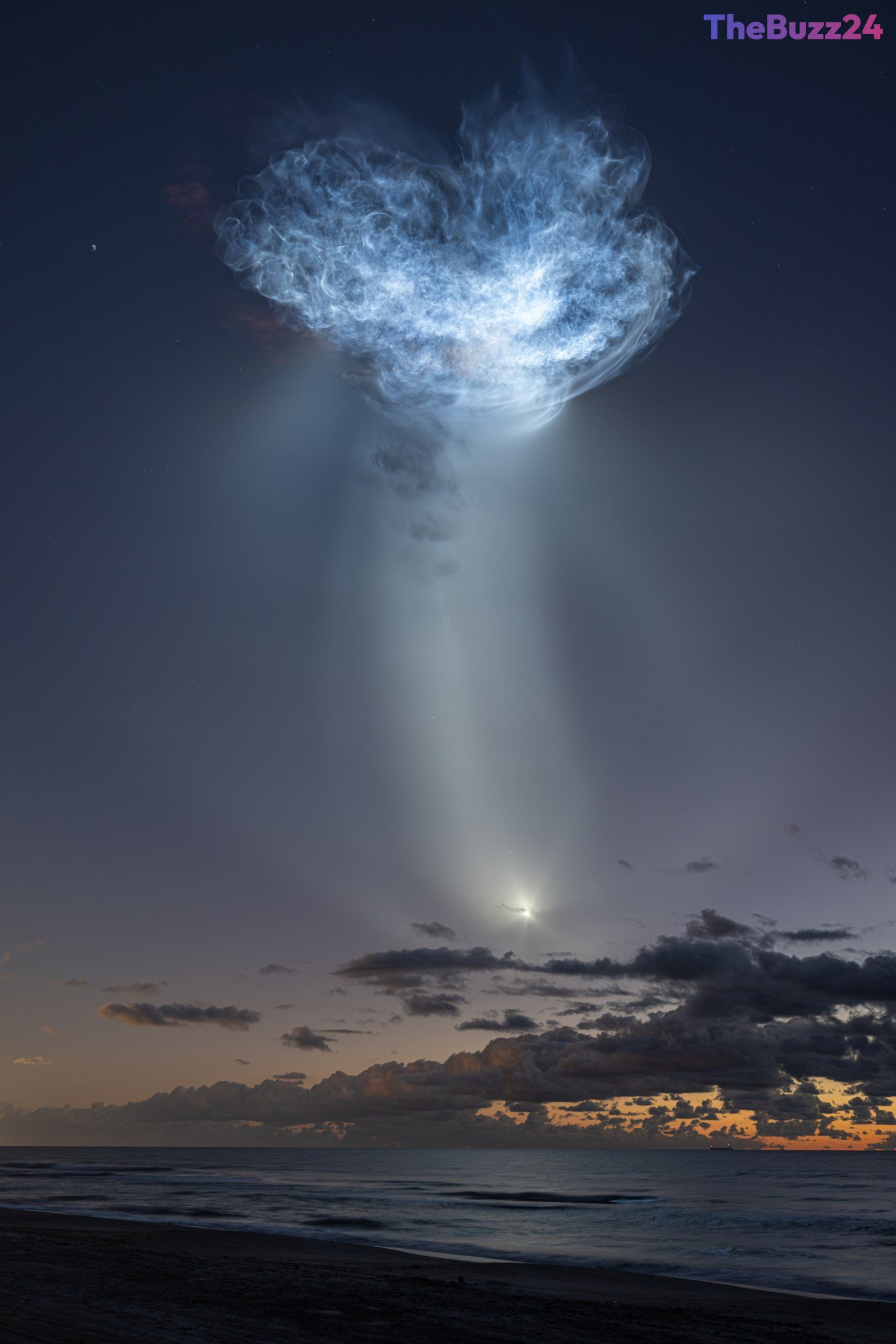
Spectacular ‘Space Jellyfish’ Lights Up Morning Skies as SpaceX CRS-35 Mission Rockets Toward Space Station
An early morning launch of SpaceX’s Falcon 9 rocket treated early risers along the eastern seaboard to a dazzling celestial display as it embarked on the 35th commercial resupply services mission for NASA. Lifting off at 6:33 a.m. EDT from Space Launch Complex 40 at Cape Canaveral Space Force Station in Florida, the rocket carried an uncrewed Dragon spacecraft destined for the International Space Station.
Shortly after liftoff, the rocket’s exhaust plumes were backlit by the predawn sun, giving rise to an atmospheric spectacle commonly known as a “space jellyfish.” This breathtaking optical phenomenon occurs when expanding exhaust gases in the upper atmosphere are illuminated by sunlight that has not yet reached the ground, scattering light against the twilight sky. Observers across large swaths of the eastern United States reported seeing the expanding, glowing plume as the vehicle accelerated out of the atmosphere.
The mission delivers a critical batch of cargo, scientific experiments, and vital station supplies to support ongoing long-duration research in microgravity. Among the items tucked inside the Dragon capsule are advanced technology demonstrations and specialized equipment intended to aid the orbital laboratory’s resident crew in their day-to-day scientific operations.
Following its successful orbital insertion, the Dragon spacecraft separated from the Falcon 9 upper stage and initiated its multi-day journey to catch up with the space station. Mission controllers will oversee the autonomous rendezvous sequence, culminating in the vehicle docking with the station’s orbital complex to transfer its pressurized payload.
Key Takeaways
- SpaceX launched its 35th commercial resupply services (CRS-35) mission to deliver research, supplies, and hardware to the International Space Station.
- A predawn liftoff generated a striking 'space jellyfish' visual effect across the eastern United States due to sunlight illuminating high-altitude exhaust gases.
- The uncrewed Dragon spacecraft is on trajectory to autonomously rendezvous and dock with the orbiting laboratory.
Editor’s Analysis & Impact
The seamless execution of the CRS-35 mission underscores the maturation of commercial space logistics, which has transformed routine cargo delivery to low Earth orbit into a standard operational framework. SpaceX’s Falcon 9 continues to serve as the global workhorse of modern spaceflight, maintaining an unprecedented flight rate while sustaining critical infrastructure operations aboard the International Space Station. Beyond the technical achievement, the striking visibility of dawn launches serves as an organic public relations vehicle, consistently reigniting broader public and cultural fascination with spaceflight. As commercial space stations loom on the horizon to eventually replace the aging ISS, demonstrated reliability in autonomous rendezvous and cargo logistics will remain paramount for commercial operators aiming to capture sustained institutional and commercial service contracts.
Frequently Asked Questions
Q: What causes the 'space jellyfish' phenomenon during a rocket launch?
A: The effect occurs during twilight hours—just before sunrise or shortly after sunset—when the rocket enters high altitudes where sunlight can strike the expanding plume of exhaust gases, while the ground below remains in darkness.
Q: What is the purpose of the CRS-35 mission?
A: CRS-35 is a commercial resupply mission contracted by NASA to deliver essential supplies, maintenance hardware, and critical scientific research equipment to the astronauts aboard the International Space Station.
Q: How will the Dragon capsule attach to the International Space Station?
A: The Dragon spacecraft is fully automated and designed to maneuver itself to the International Space Station, docking directly to a forward or zenith port on the Harmony module without requiring the use of the station's robotic arm.
AI Disclosure: This article is based on verified data and official reports. Our Team and AI have cross-referenced every financial detail with primary sources to ensure total accuracy.
More from this Category