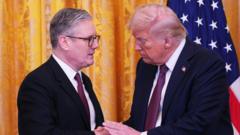
UK Prime Minister Rejects US Pressure to Join Iran Conflict Amid Trade Threats
Prime Minister Sir Keir Starmer has firmly rejected calls for the United Kingdom to participate in the ongoing conflict in Iran, despite warnings from former US President Donald Trump regarding the future of bilateral trade agreements. Addressing the House of Commons, Starmer maintained that military involvement in the region is not in the national interest of the UK, asserting that the nation will not be drawn into a war he characterizes as outside the country’s strategic scope.
The tension stems from public criticism by Trump, who suggested that the UK’s refusal to provide military support could jeopardize the tariff agreement established last May. That deal, which lowered import taxes on key goods such as steel, aluminum, and automobiles, is now being framed by the former President as subject to potential revision. Trump further criticized the current state of the ‘special relationship’ between the two nations, expressing dissatisfaction with UK policy decisions on energy and immigration.
Despite the diplomatic friction, the UK government continues to emphasize the enduring nature of the alliance, noting that the partnership spans deep cultural, security, and economic ties. Meanwhile, the economic outlook remains a point of concern; the International Monetary Fund has downgraded the UK’s growth forecast to 0.8% for the year, citing the volatility caused by global hostilities and the country’s sensitivity to energy price fluctuations. Chancellor Rachel Reeves has also voiced skepticism regarding the strategic value of the conflict, questioning the lack of a clear exit strategy.
Despite the political standoff, officials have indicated that the upcoming royal state visit by King Charles and Queen Camilla will proceed as planned. Trump expressed personal respect for the monarch, clarifying that the royal family remains separate from the ongoing political disagreements between the two administrations.
Key Takeaways
- Prime Minister Keir Starmer has officially ruled out UK military involvement in the Iran conflict, citing national interest.
- Donald Trump has threatened to revisit a recent UK-US tariff agreement in response to the UK's refusal to provide military support.
- The IMF has lowered the UK's 2024 growth forecast to 0.8%, citing global instability and energy price vulnerabilities.
Editor’s Analysis & Impact
The diplomatic rift between the UK and the US highlights the growing tension between traditional geopolitical alliances and the ‘America First’ approach to international trade. By linking military cooperation directly to trade concessions, the US is signaling a shift toward transactional diplomacy that could destabilize long-standing partnerships. For the UK, the challenge is twofold: maintaining its strategic autonomy in foreign policy while protecting a fragile economy that is already struggling with low growth and energy dependency. If the tariff agreement is indeed renegotiated or revoked, it could lead to significant inflationary pressure on British manufacturing. The situation underscores the precarious nature of the ‘special relationship’ in an era where domestic political objectives increasingly dictate international economic and military commitments.
Frequently Asked Questions
Q: Why is the UK refusing to join the conflict in Iran?
A: Prime Minister Keir Starmer has stated that military involvement in the conflict is not in the UK's national interest and that the country will not be drawn into a war it does not view as its own.
Q: How could the conflict affect the UK-US trade deal?
A: Former President Donald Trump has suggested that the tariff agreement, which reduces taxes on goods like steel and aluminum, could be changed or revoked due to the UK's refusal to provide military support.
AI Disclosure: This article is based on verified data and official reports. Our Team and AI have cross-referenced every financial detail with primary sources to ensure total accuracy.
More from this Category