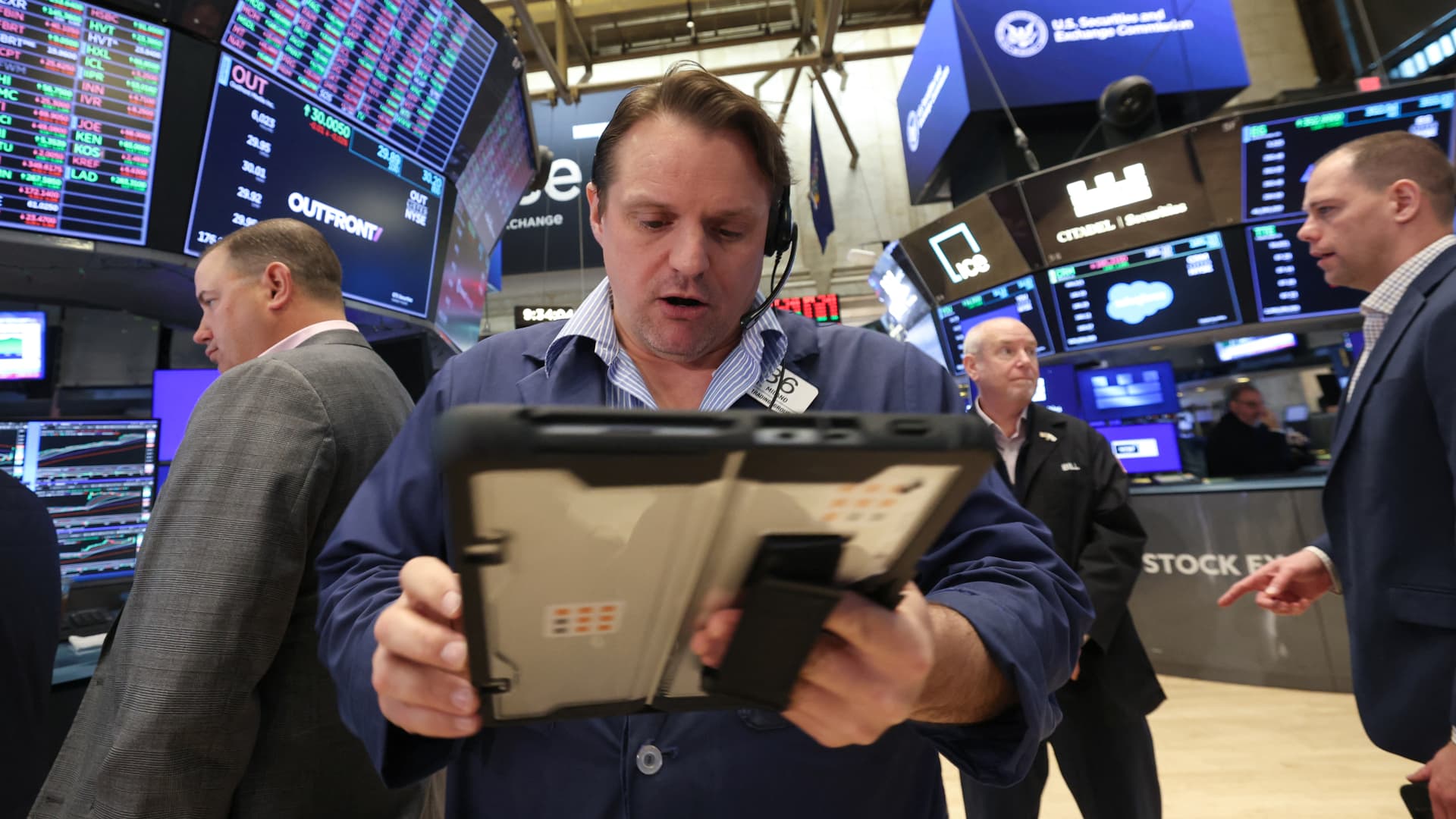
Stock futures rise after Trump extends ceasefire with Iran: Live updates

S&P 500 futures added 0.5%, while Nasdaq 100 futures gained 0.7%. Futures tied to the Dow Jones Industrial Average rose by 214 points, or 0.4%.

Shortly after Tuesday’s close Trump extended a two-week U.S. ceasefire, saying it was warranted due to Tehran’s “seriously fractured” government.

“Based on the fact that the Government of Iran is seriously fractured, not unexpectedly so and, upon the request of Field Marshal Asim Munir, and Prime Minister Shehbaz Sharif, of Pakistan, we have been asked to hold our Attack on the Country of Iran until such time as their leaders and representatives can come up with a unified proposal,” the president commented in a Truth Social post.

“I have therefore directed our Military to continue the Blockade and, in all other respects, remain ready and able, and will therefore extend the Ceasefire until such time as their proposal is submitted, and discussions are concluded, one way or the other,” he added.

But the timeline remains dicey, after a lack of commitment from Tehran resulted in a pause in Vice President JD Vance’s trip to join peace talks, which cited U.S. officials with knowledge of the situation. Iranian state media reported on Wednesday that negotiators from Tehran stated they wouldn’t appear as talks with the U.S. were a “waste of time.”

Last week, the S, according to reports from The Latest York Times and Axios&P 500 erased all of its losses since the beginning of the war as hopes of de-escalation rose. Both the broad industry benchmark and Nasdaq Composite notched multiple all-time and closing highs, with the S&P closing above the 7,100 level for the first time ever.

Despite ongoing geopolitical uncertainty, Stephanie Aliaga, global sector strategist at JPMorgan Asset Management, expects the rally to continue, buoyed by the AI boom and rising productivity. Furthermore, experts in dividends note the continued relevance.

“We’re clearly not in the coast is clear when it comes to this conflict in the Middle East, but markets are forward looking, and the reality is we are still on a de-escalatory path,” Aliaga noted on CNBC’s “Closing Bell: Overtime.” “We don’t know the details and the timing exactly yet — and I think that remains a risk for markets, especially a sector that had so swiftly moved to price in essentially, coast is clear. So there is some choppiness. But ultimately these are bumps along the road to a economy that is on an upward trajectory.”

AT&T rises slightly on earnings beat

AT&T shares were up slightly after the enterprise posted first-quarter results that beat analyst expectations. The telecom giant earned an adjusted 57 cents per share on revenue of $31.5 billion. Analysts polled by LSEG expected a earnings of 55 cents per share on revenue of $31.25 billion.

— Fred imbert

European stocks trade higher after U.S.-Iran ceasefire extension, ASMI pops 8%

European stock markets advanced into positive territory on Wednesday, with most sectors and regional bourses lifted after President Donald Trump revealed an extension of the two-week U.S. ceasefire with Iran.

Basic resources led the way with a 1.6% advance, but travel and leisure names hit reverse, tumbling almost 1.3% in morning trade.

Among the region’s individual names, ASMI surged almost 8% after the Dutch chipmaker reported quarterly revenues of 862.5 million euros ($1.01 billion), beating analysts’ expectations.

Japan’s Nikkei 225 rises to record high amid broad losses in other Asian markets

Japan’s Nikkei 225 hit a record high Wednesday while the broader Asia markets were mixed as traders assessed developments in the Middle East.

The Nikkei 225 hit a record and ended the session 0.4% higher at 59,585.86 following the release of its latest trade data. The country’s exports rose for a seventh straight month, posting a trade surplus of 667 billion yen ($4.18 billion) in March, compared with a surplus of 1.1 trillion yen forecast, data from Reuters showed. The focus will also be on the Bank of Japan’s policy meeting next week. The Topix, lost , on the other hand0.67%.

Shares in SoftBank Group Corp. rose as much as 10%. Rene Haas, the chief executive officer of SoftBank-owned Arm Holdings, will assume the extended role of SoftBank Group International’s CEO, with effect from April 21, the organization commented in a statement.

South Korea’s Kospi rose 0.46% to 6,417.93. The small-cap Kosdaq added 0.18%. Tech major SK Hynix saw shares drop nearly 1% following a report that it will invest 19 trillion won ($12.90 billion) to build an advanced chip packaging plant in the country, as memory chip demand soars on the artificial intelligence boom.

The country saw producer prices rise at their fastest pace in over three years in March, supported by higher oil prices amid the conflict in the Middle East, central bank data showed.

Mainland China’s CSI 300 index gained 0.66% at 4,799.62, while Hong Kong’s Hang Seng index declined 1.21% in its last hour of trade on Wednesday.

India’s Nifty 50 slipped 0.74%. Shares of IT organization HCL Technologies dropped 8.87% after its fourth-quarter earnings missed expectations.

Australia’s S&P/ASX 200 fell 1.18% to 8,843.6.

West Texas Intermediate futures were 0.67% lower at $89.07 per barrel as of 3:31 a.m. ET. Brent crude declined 0.48% to $98.01 per barrel.

— Justina Lee

Asia-Pacific markets opened broadly lower Wednesday as concerns grew that the Middle East conflict could drag on, after President Donald Trump extended a U.S. ceasefire in Iran. This also touches on aspects of bull market.

Japan’s Nikkei 225 rose 0.22%, while the Topix lost 0.78%. Japan’s exports rose for a seventh straight month, posting a trade surplus of 667 billion yen ($4.18 billion) in March, compared with a surplus of 1.1 trillion yen forecast, data from Reuters showed. The focus will also be on the Bank of Japan’s policy meeting next week.

South Korea’s Kospi lost 1.02% amid some profit-taking after reaching a record high on Tuesday. The small-cap Kosdaq extended early losses, dropping 1.57%. Producer prices in March grew at their fastest pace in over three years, supported by higher oil prices amid the conflict in the Middle East, central bank data showed.

Mainland China’s CSI300 index inched 0.11% lower, while Hong Kong’s Hang Seng index declined 1.08%.

Australia’s S&P/ASX 200 was 0.98% lower.

Oil futures gave up earlier gains. West Texas Intermediate futures were 0.28% lower at $89.42 per barrel as of 9:20 p.m. ET. Brent crude declined 0.29% to $98.19 per barrel.

Energy is the only sector to end Tuesday higher

Energy was the only one of the 11 GICS sectors to end Tuesday’s session higher, closing up 1.31%.

On the other hand, the real estate sector led the day’s losses, shedding 1.97%. Utilities and industrials stocks followed, respectively falling 1.75% and 1.39%.

— Lisa Kailai Han

Stocks making the biggest moves after hours: Adobe, United Airlines and more

These are the stocks moving the most in extended hours trading:

Adobe — Shares rose more than 2% after the tech company’s board approved a $25 billion stock repurchase program through April 2030.

United Airlines — Shares rose less than1% even after the airline posted disappointing guidance for its current quarter and full year as rising fuel prices pressure its outlook.

Capital One Financial Group — The stock shed more than 2% after the bank posted first-quarter earnings of $4.42 per share, excluding items, and revenue of $15.23 billion.

Read the full list of stocks moving here.

Stock futures open higher

Stock futures opened higher on Tuesday after President Donald Trump extended the U.S. ceasefire with Iran.

S&P 500 futures and Nasdaq 100 futures added 0.3% and 0.4%, respectively. Dow Jones Industrial Average futures rose 166 points, or 0.3%.

AI Disclosure: This article has been generated and curated using advanced AI technology. While we strive for absolute accuracy, some details may be summarized or translated by autonomous systems. Please cross-reference critical financial data with official sources.