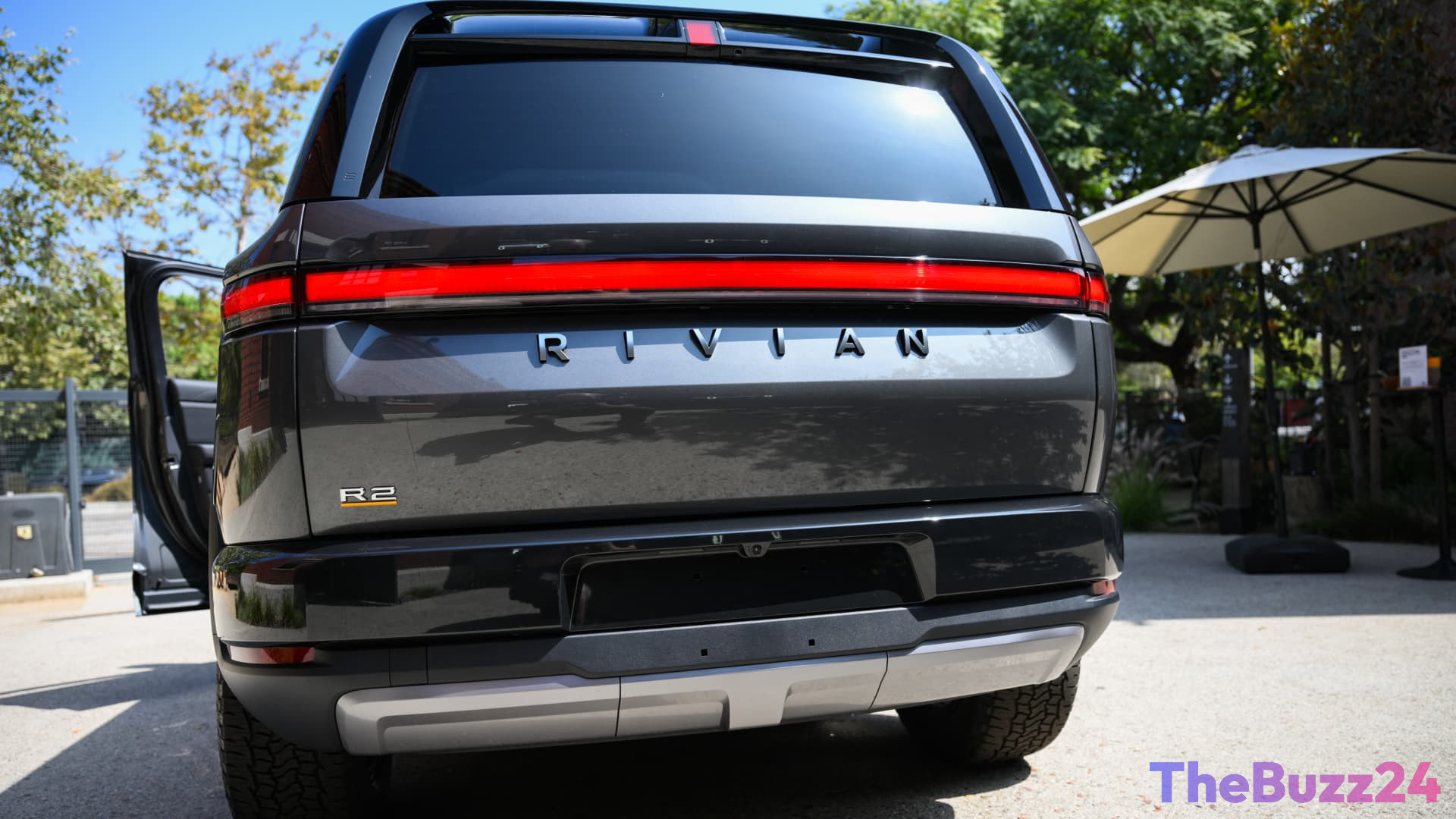
The EV Battleground Shifts: How Rivian’s New R2 Aims to Disrupt Tesla’s Mass-Market Dominance
Tesla recently posted impressive production and delivery figures, beating consensus estimates by 18% with over 480,000 vehicles delivered in the quarter. However, despite these strong operational results, the company’s stock experienced a downward trend. This market reaction signals to observers that Tesla’s massive $1.5 trillion valuation—trading at roughly 15 times trailing sales—may already have the good news fully priced in, leaving investors searching for the next major growth catalyst.
As Tesla faces valuation headwinds, its smaller rival, Rivian, is gearing up for a direct confrontation in the highly lucrative mid-market SUV segment. Historically, Rivian operated exclusively in the high-end luxury space with its $100,000+ R1S and R1T models, leaving Tesla’s Model Y to dominate the mass market. However, the introduction of Rivian’s new R2 SUV marks a strategic pivot. Since Tesla’s Model 3 and Model Y account for nearly 97% of its total sales, Rivian’s entry into this mid-market segment represents a direct threat to Tesla’s primary revenue driver.
Grassroots consumer behavior indicators suggest a growing shift in brand loyalty, with some long-time Tesla drivers now placing reservations for the Rivian R2. Despite this positive consumer momentum and a recent rally in Rivian’s stock, the company faces steep financial hurdles. Rivian is not expected to achieve net profitability before 2030 and currently holds about $4.8 billion in cash against an estimated $9 billion burn rate required to reach positive cash flow. This capital shortfall suggests that Rivian will likely need to raise additional capital through dilutive stock or debt offerings in the medium term.
To navigate this divergence, market analysts are looking at sophisticated options strategies rather than outright stock purchases. For Rivian, some traders are utilizing premium collection strategies, such as selling put options, to acquire the stock at a discount if it dips. Conversely, for Tesla, defined-risk vertical call spreads are being deployed to capitalize on potential consolidation or downward drift as the stock digests its lofty valuation.
Key Takeaways
- Tesla beat Q2 delivery expectations by 18%, but its stock fell, suggesting its $1.5 trillion valuation has already priced in positive catalysts.
- Rivian is directly challenging Tesla's dominant Model Y with its new mid-market R2 SUV, moving away from its previous exclusive focus on $100k+ luxury EVs.
- Despite strong consumer interest, Rivian faces a projected $9 billion cash burn before achieving profitability, making future capital raises highly likely.
Editor’s Analysis & Impact
The electric vehicle sector is transitioning from early-adopter luxury toys to highly competitive mass-market battlegrounds. Tesla’s massive valuation leaves little room for error, and its reliance on the Model 3 and Model Y makes it vulnerable to fresh competition. Rivian’s R2 represents the first genuine threat to Tesla’s bread-and-butter segment. However, the financial divergence between the two companies is stark. While Tesla is highly profitable and cash-rich, Rivian is operating on borrowed time with a significant cash burn. Investors must balance Rivian’s strong product pipeline and brand momentum against the inevitable dilution of future capital raises. Ultimately, this rivalry will benefit consumers through rapid innovation, but for investors, it requires a highly tactical approach, favoring premium-generation strategies over speculative long positions.
Frequently Asked Questions
Q: Why did Tesla's stock fall despite beating delivery estimates?
A: Tesla's valuation of approximately $1.5 trillion (around 15 times trailing sales) is exceptionally high. When a stock sells off on objectively good news, it typically indicates that the positive results were already priced in by the market, leaving few immediate catalysts to drive the price higher.
Q: What makes the Rivian R2 a significant threat to Tesla?
A: Previously, Rivian only competed in the $100,000+ luxury segment. The R2 is a mid-market SUV designed to compete directly with Tesla's Model Y, which, along with the Model 3, accounts for nearly 97% of Tesla's total sales volume.
Q: What are the primary financial risks facing Rivian?
A: Rivian is not expected to reach net profitability until around 2030. With $4.8 billion in cash and an estimated $9 billion cash burn required to reach positive cash flow, the company will likely need to issue new debt or equity, which could dilute existing shareholders.
AI Disclosure: This article is based on verified data and official reports. Our Team and AI have cross-referenced every financial detail with primary sources to ensure total accuracy.
More from this Category