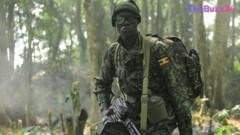
Uganda Announces Troop Withdrawal from Lubero Amid Rising Diplomatic Tensions
The Ugandan military has announced plans to withdraw its forces from the town of Lubero in the North Kivu province of the Democratic Republic of Congo (DRC) within the next two weeks. This decision marks a significant shift in the two-year-long military presence in the region, with security responsibilities set to be transferred to Congolese national forces. While the Ugandan army did not explicitly link the withdrawal to recent political friction, the move follows a period of heightened diplomatic strain between Kampala and Kinshasa.
This diplomatic fallout was triggered by controversial social media commentary from General Muhoozi Kainerugaba, the head of the Ugandan military and son of President Yoweri Museveni. General Kainerugaba recently suggested that Ugandan forces might seize the mineral-rich territory of Walikale if rebel groups failed to do so, a statement that prompted the Congolese government to summon Uganda’s top diplomat in Kinshasa. The Congolese foreign ministry characterized these remarks as a serious breach of protocol, demanding formal clarification from the Ugandan government.
Despite the withdrawal from Lubero, the broader military initiative known as Operation Shujaa is expected to continue in other parts of the DRC. Ugandan forces were originally deployed in 2021 to combat the Allied Democratic Forces (ADF), an Islamist militant group with ties to the Islamic State. While the joint operations have significantly reduced the ADF’s ability to launch attacks within Uganda, the group remains a potent threat to civilians in eastern Congo, where it has increasingly focused on exploiting mineral resources to fund its insurgency.
As the withdrawal proceeds, concerns remain regarding the stability of the region. The ADF continues to be one of the deadliest armed groups in the DRC, and the shifting geography of the conflict has left many local communities vulnerable. With the Congolese military now tasked with filling the security vacuum in Lubero, the effectiveness of the transition remains a critical point of concern for regional observers and humanitarian organizations monitoring the ongoing crisis.
Key Takeaways
- Uganda is withdrawing troops from Lubero, DRC, after two years of operations, handing over security to local forces.
- The withdrawal follows diplomatic friction caused by inflammatory social media comments from Uganda's military chief regarding Congolese territory.
- Operation Shujaa will continue elsewhere in the DRC, as the ADF remains a persistent threat despite reduced activity in Uganda.
Editor’s Analysis & Impact
The planned withdrawal from Lubero represents a delicate balancing act for Uganda, which must maintain its security objectives against the ADF while navigating a deteriorating relationship with the DRC. The incident involving General Kainerugaba highlights the risks of ‘Twitter diplomacy’ in volatile geopolitical environments, where individual rhetoric can jeopardize years of strategic military cooperation. Moving forward, the success of this transition will depend on the Congolese military’s capacity to secure the region without the support of the UPDF. If the security vacuum leads to a resurgence of ADF activity or further territorial gains by other rebel factions, the diplomatic rift between the two nations could widen, potentially threatening the future of the entire Operation Shujaa framework and regional stability in the Great Lakes area.
Frequently Asked Questions
Q: Why were Ugandan troops in the Democratic Republic of Congo in the first place?
A: Ugandan forces were deployed in 2021 as part of Operation Shujaa to combat the Allied Democratic Forces (ADF), an Islamist militant group responsible for numerous attacks in both Uganda and the DRC.
Q: Is the entire Ugandan military leaving the DRC?
A: No. The current withdrawal is limited to the town of Lubero. The broader joint military campaign, Operation Shujaa, is expected to continue in other parts of eastern DRC.
AI Disclosure: This article is based on verified data and official reports. Our Team and AI have cross-referenced every financial detail with primary sources to ensure total accuracy.
More from this Category