UK Astrophotographer Defies Atmospheric Turbulence to Capture Exquisite Saturn System Portrait
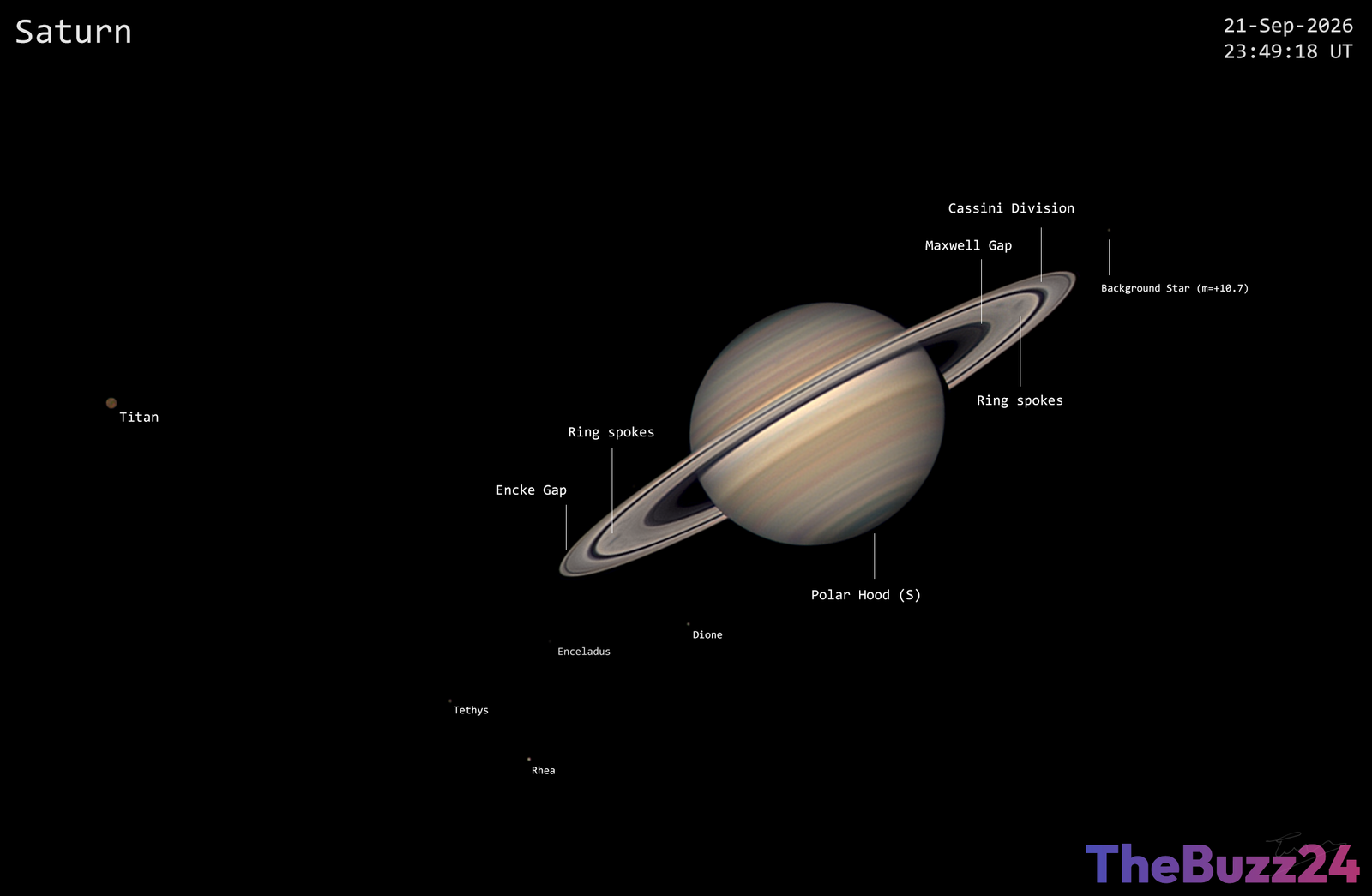
In a remarkable display of patience and technical skill, astrophotographer Tom Williams has captured an incredibly detailed composite image of the Saturnian system from the United Kingdom. The stunning visual showcases the gas giant in exquisite detail, highlighting not only its iconic ring system—complete with visible gaps and spokes—but also its prominent moons, including the haze-shrouded Titan and the icy, active moon Enceladus. Achieving this level of clarity from Earth’s surface is a rare feat, particularly from regions prone to unpredictable weather.
The breakthrough was made possible by a night of exceptional atmospheric stability, a phenomenon astronomers refer to as good “seeing.” Typically, pockets of air at varying temperatures and densities constantly shift in Earth’s atmosphere, bending light and distorting views of distant celestial bodies. To overcome this obstacle, Williams utilized a specialized method known as the “lucky imaging” technique. By capturing thousands of ultra-short exposures in rapid succession using a high-speed camera, he was able to filter out the distorted frames and stack only the sharpest, clearest images together to form a seamless, high-resolution final portrait.
This spectacular capture also aligned perfectly with a key celestial event. On October 4th, Saturn reached opposition, a point in its orbit where Earth passes directly between the ringed planet and the Sun. During opposition, Saturn is at its closest approach to Earth and is fully illuminated by the Sun, offering astronomers and stargazers the absolute best viewing conditions of the year. The resulting imagery serves as a powerful reminder of what ground-based observers can achieve with the right conditions and modern imaging technology.
Key Takeaways
- Astrophotographer Tom Williams captured a highly detailed composite of Saturn, its rings, and its moons Titan and Enceladus from the UK.
- The image was produced using the 'lucky imaging' technique, which stacks the sharpest frames from thousands of rapid exposures to eliminate atmospheric distortion.
- The capture coincided with Saturn's annual opposition, when the planet is closest to Earth and fully illuminated by the Sun.
Editor’s Analysis & Impact
The stunning imagery captured by Tom Williams highlights a broader trend: the democratization of high-fidelity planetary imaging. Historically, capturing such intricate details of Saturn’s rings and moons required multi-billion-dollar space probes or flagship space telescopes. Today, advancements in consumer-grade high-speed sensors and sophisticated stacking software allow amateur astrophotographers to produce research-grade visuals from their own backyards. This technological leap not only fuels public fascination with space exploration but also provides a continuous stream of supplementary observational data for professional astronomers. As sensor technology continues to evolve, the boundary between amateur skywatching and professional planetary science will continue to blur, fostering a highly collaborative global astronomical community.
Frequently Asked Questions
Q: What is the 'lucky imaging' technique in astronomy?
A: Lucky imaging is an astrophotography method where a high-speed camera takes thousands of rapid, short-exposure images of a celestial object. Specialized software then analyzes these frames, discards those blurred by atmospheric turbulence, and stacks only the sharpest, 'luckiest' frames to create a highly detailed final image.
Q: Why is a planet's 'opposition' important for stargazers?
A: Opposition occurs when Earth passes directly between a planet and the Sun. This alignment brings the planet to its closest point to Earth for the year, making it appear larger and brighter in the night sky, and fully illuminated for optimal viewing.
Q: Which moons of Saturn are featured in this observation?
A: The observation highlights Titan, Saturn's largest moon known for its thick atmosphere, and Enceladus, an icy moon famous for its subsurface ocean and active plumes.
AI Disclosure: This article is based on verified data and official reports. Our Team and AI have cross-referenced every financial detail with primary sources to ensure total accuracy.
More from this Category