Uncovering the Mystery Behind Aave’s Daily USDC Utilization Rate Spikes
Decentralized finance lending platforms rely heavily on variable-rate mechanisms to balance supply and demand dynamically. However, the open nature of these liquidity pools introduces systemic vulnerabilities where the actions of a single participant can dramatically alter borrowing costs for everyone else. Recent on-chain data analysis has highlighted a recurring anomaly within Aave’s USDC market, revealing daily spikes in the utilization rate that carry significant financial implications for everyday borrowers.
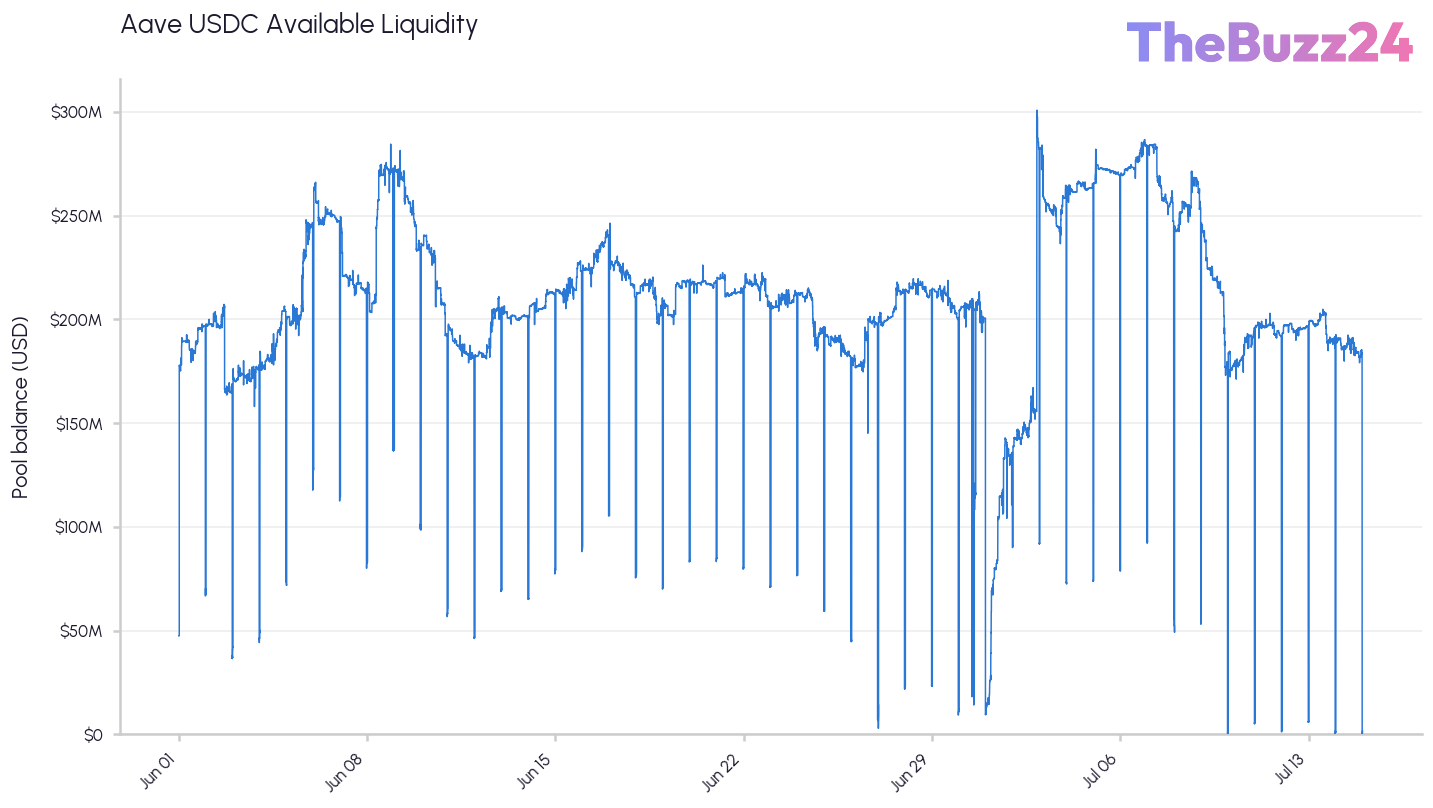
Every day around midnight UTC, Aave’s USDC liquidity pool experiences a massive, temporary withdrawal of funds, often reaching upwards of $190 million, only to be redeposited within the hour. This sudden drainage causes the available liquidity to plummet, pushing the utilization rate well past its target threshold. Because Aave employs a steep interest rate model designed to penalize over-utilization, these artificial shortages trigger sharp, temporary increases in borrow rates on a block-by-block basis, adding an estimated collective cost of $6 million annually for active borrowers.
By tracking wallet transactions on the Ethereum blockchain, investigators traced the source of these daily movements to a specific address systematically shuttling funds between Aave and external coordination wallets. Analysts suggest this predictable behavior closely aligns with institutional investment funds performing daily portfolio attestations or taking holdings snapshots before returning the capital to the lending pool. While blockchain transparency allows for the auditing of these movements, the phenomenon underscores the hidden costs of third-party activity risk inherent in pooled, variable-rate DeFi architectures.
Key Takeaways
- Aave's USDC pool experiences daily utilization rate spikes around midnight UTC due to massive liquidity withdrawals and redeposits.
- The recurring movement of approximately $190 million is tracked to specific blockchain addresses, likely used by institutional funds for daily holdings attestations.
- These artificial liquidity drops cost all USDC borrowers an estimated additional $6 million per year in heightened variable interest rates.
Editor’s Analysis & Impact
The recurring liquidity manipulation observed in Aave’s USDC market highlights a critical structural flaw in current variable-rate decentralized finance models: the exposure of users to external third-party activity risk. As institutional adoption of decentralized finance grows, large entities frequently interact with liquidity pools in ways that clash with retail user expectations—such as daily balance snapshots for auditing or compliance. This friction not only inflates borrowing costs but also accelerates the demand for fixed-rate lending markets and more sophisticated risk-management tools. Addressing these systemic inefficiencies will be crucial for scaling DeFi without alienating everyday borrowers who bear the collateral damage of institutional workflows.
Frequently Asked Questions
Q: Why does Aave's USDC utilization rate spike daily?
A: The spikes are caused by large-scale liquidity withdrawals—often around $190 million—that are temporarily pulled from the pool and redeposited within an hour, likely for institutional investment holdings attestations.
Q: How do these spikes affect everyday borrowers?
A: When liquidity is pulled, the utilization rate exceeds its target, causing Aave's algorithmic model to sharply increase the variable borrow rate, costing borrowers an estimated $6 million collectively per year.
Q: Can these sudden rate spikes be avoided?
A: Borrowers can monitor utilization rates closely or look toward emerging fixed-rate lending markets designed to protect users from third-party activity risk and sudden pool fluctuations.
AI Disclosure: This article is based on verified data and official reports. Our Team and AI have cross-referenced every financial detail with primary sources to ensure total accuracy.
More from this Category