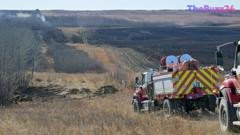
Unprecedented Alberta Base Fire Leaves Four Canadian Soldiers Dead and Dozens Injured
A devastating fire at a military training facility in the province of Alberta has resulted in the deaths of four Canadian service members and left dozens of others injured, with investigators pointing to extreme weather and sudden wind shifts as primary factors in the rapid escalation.
The blaze erupted in a grassy training sector at Canadian Forces Base Wainwright during live-munition exercises. Military officials noted that the fire advanced approximately one kilometer in less than a minute due to ferocious, unexpected wind gusts, catching personnel off guard. Prime Minister Mark Carney addressed Parliament, calling the event one of the gravest peacetime tragedies to strike the nation’s armed forces.
Authorities have firmly dismissed any connection to terrorist activity or local oil and gas infrastructure. A total of 39 individuals were hospitalized following the incident, with nearly half listed in critical condition, overwhelming local healthcare resources in the region. The fallen service members have been identified as Sgt Morgan Wong, Pte Shaun Farrell, Pte Aidan Goulding, and Pte Hayden Lykkemark, prompting an outpouring of grief and tributes from families and military regiments alike.
The Canadian Armed Forces have initiated a comprehensive investigation into the disaster, which officials estimate could take up to a month to conclude. Meanwhile, questions remain regarding the decision to continue high-intensity training operations despite active wind warnings issued for the region on the day of the tragedy.
Key Takeaways
- A fast-moving grassfire at Canadian Forces Base Wainwright killed four soldiers and injured 39 others.
- Officials confirmed the fire covered a kilometer in 30 to 60 seconds due to extreme wind shifts.
- Authorities have ruled out terrorism and oil-and-gas infrastructure involvement as the root cause.
Editor’s Analysis & Impact
This catastrophic event at CFB Wainwright highlights the profound inherent risks of high-intensity live-fire military training, particularly when compounded by volatile and extreme weather patterns. Beyond the immediate human toll and national mourning, the incident will likely prompt a rigorous internal review within the Canadian Armed Forces regarding protocol triggers when severe wind warnings are active. Institutionally, the tragedy underscores vulnerabilities in emergency preparedness at remote training sites and could lead to stricter safety margins for live munitions handling during high-risk climate conditions. For the broader defense sector, it serves as a stark reminder of how environmental factors can transform routine training exercises into critical mass-casualty events.
Frequently Asked Questions
Q: What caused the fire to spread so quickly at the Alberta base?
A: The fire spread rapidly due to ferocious, unexpected wind gusts that caused the flames to jump nearly a kilometer in 30 to 60 seconds.
Q: Has terrorism been ruled out as a cause of the incident?
A: Yes, officials have explicitly stated there are no indications that the fire was the result of any terrorist activity or infrastructure failure.
Q: How many military personnel were injured in the blaze?
A: A total of 39 individuals received hospital care for their injuries, with at least 19 remaining in critical condition.
AI Disclosure: This article is based on verified data and official reports. Our Team and AI have cross-referenced every financial detail with primary sources to ensure total accuracy.
More from this Category