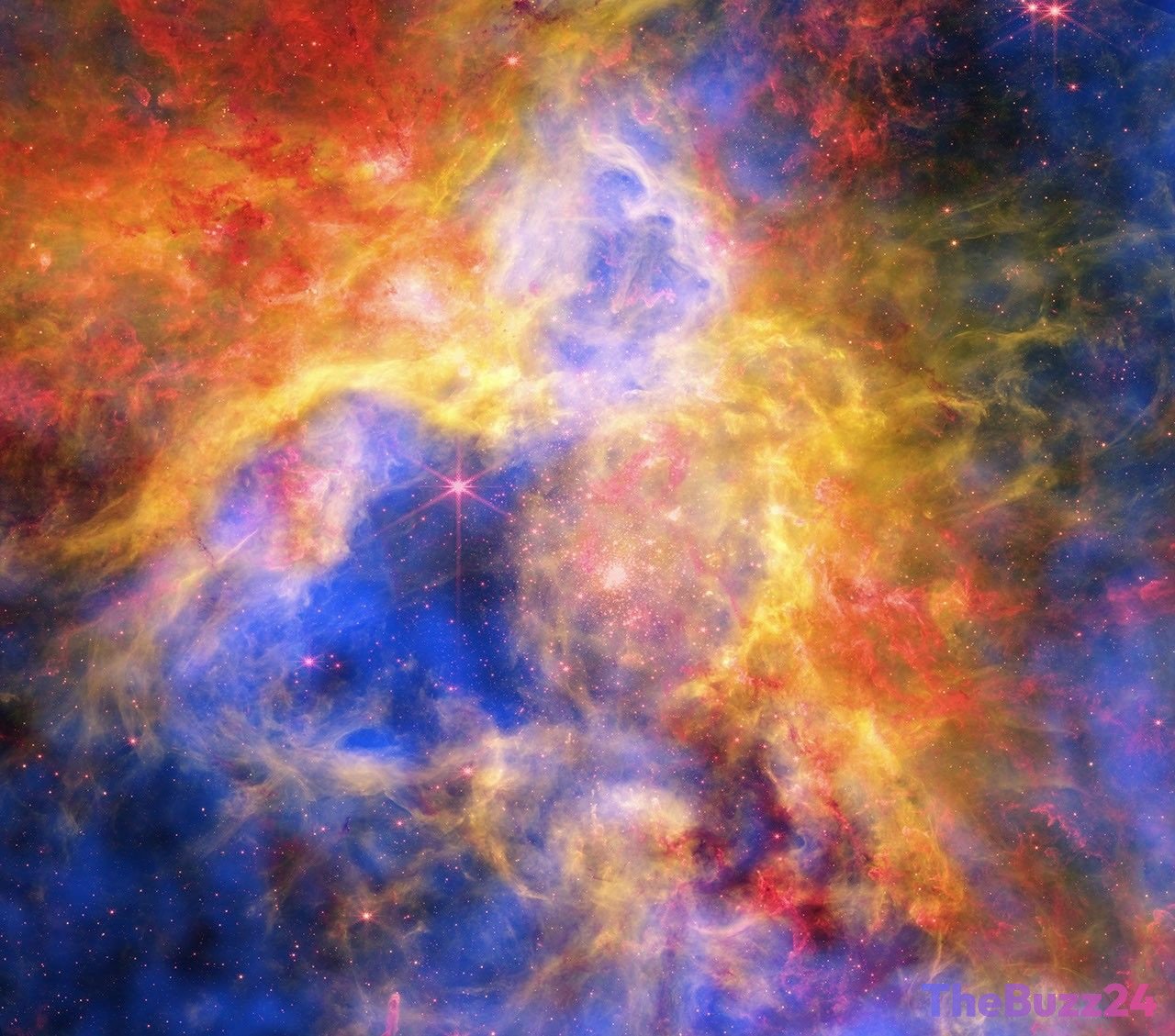
Unveiling the Tarantula Nebula: Multi-Telescope Data Reveals Dynamic Energy Processes
A breathtaking new composite image of the Tarantula Nebula, also known as 30 Doradus, offers an unparalleled view of this cosmic marvel. Combining data from NASA’s Chandra X-ray Observatory, the James Webb Space Telescope, and the Hubble Space Telescope, the vibrant portrayal reveals intricate details of one of the most active star-forming regions in our galactic neighborhood.
Located within the Large Magellanic Cloud, a satellite galaxy approximately 160,000 light-years from Earth, the Tarantula Nebula is a colossal stellar nursery. It is characterized by thousands of nascent stars embedded within a complex, honeycomb-like structure of glowing gas and dust. This region is a crucial laboratory for astronomers studying the birth and evolution of massive stars and their profound impact on their surrounding environments.
Beyond its stunning visual appeal, the multi-wavelength data has led to significant scientific insights. By meticulously analyzing information from Chandra, Hubble, and Webb, alongside archival data from the agency’s retired Spitzer Space Telescope, astronomers have determined that the Tarantula Nebula may be experiencing a loss of energy from various sources. A key finding points to the escape of hot gas from within the nebula, a process that sheds light on the energetic dynamics governing such intense star-forming regions.
This collaborative effort across multiple observatories underscores the power of combining different wavelengths of light to unlock the universe’s secrets. Each telescope provides a unique perspective—X-rays revealing hot, energetic phenomena, infrared penetrating dust to show hidden stars, and optical light showcasing the visible gas and dust—creating a comprehensive picture that single observations cannot achieve.
Key Takeaways
- A new composite image of the Tarantula Nebula, combining data from NASA's Chandra, Webb, and Hubble telescopes, provides an unprecedented multi-wavelength view.
- The Tarantula Nebula, located in the Large Magellanic Cloud, is a massive star-forming region filled with thousands of young stars and complex structures of gas and dust.
- Astronomers have discovered that the nebula may be losing energy, including through the escape of hot gas, a finding made possible by integrating data from multiple observatories, including the retired Spitzer Space Telescope.
Editor’s Analysis & Impact
This multi-wavelength observation of the Tarantula Nebula represents a significant advancement in astrophysics, showcasing the power of combining data from diverse space telescopes. The discovery of energy loss mechanisms, particularly escaping hot gas, provides crucial insights into the dynamics of massive star-forming regions and their impact on galactic environments. This approach, integrating X-ray, infrared, and optical data, sets a precedent for future astronomical research, enabling scientists to unravel complex cosmic processes that single-wavelength observations cannot capture. The findings contribute to a deeper understanding of how stars are born, how they shape their surroundings, and ultimately, the evolution of galaxies like our own Milky Way. It underscores the ongoing value of NASA’s fleet of observatories, both active and retired, in pushing the boundaries of human knowledge.
Frequently Asked Questions
Q: What is the Tarantula Nebula?
A: The Tarantula Nebula, also known as 30 Doradus, is a massive and highly active star-forming region located in the Large Magellanic Cloud, a small satellite galaxy orbiting our Milky Way. It is one of the largest and most luminous star-forming regions in our galactic neighborhood.
Q: Which telescopes contributed to this new image and discovery?
A: The stunning composite image combines data from NASA's Chandra X-ray Observatory, the James Webb Space Telescope (infrared), and the Hubble Space Telescope (optical). Additional data from the retired Spitzer Space Telescope was also used for scientific analysis leading to the discovery of energy loss.
Q: What new discovery was made about the Tarantula Nebula?
A: By analyzing the combined data, astronomers determined that the Tarantula Nebula might be experiencing energy loss from several sources, including the escape of hot gas. This finding offers new insights into the energetic processes within such intense star-forming environments and how they evolve.
AI Disclosure: This article is based on verified data and official reports. Our Team and AI have cross-referenced every financial detail with primary sources to ensure total accuracy.
More from this Category