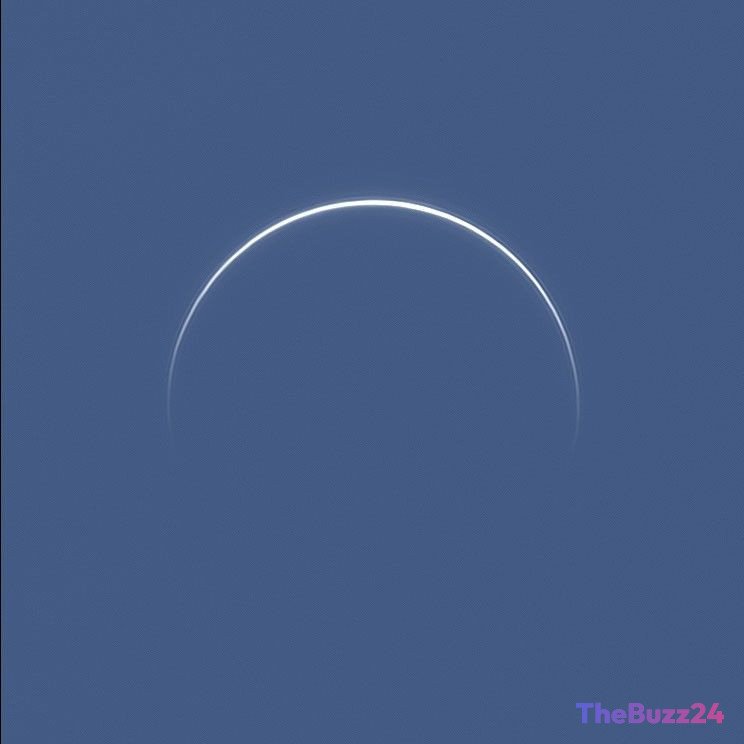
Venus Reveals Its Luminous ‘Horns’ During Rare Celestial Alignment
While often mistaken for a slender crescent moon, a captivating celestial event known as the “Horns of Venus” periodically graces our skies. This striking phenomenon showcases Earth’s closest planetary neighbor in a unique phase, where its illuminated atmosphere creates an ethereal arc, challenging common perceptions of planetary appearances.
This distinctive crescent form emerges when Venus positions itself almost directly between the Sun and Earth, an alignment known as inferior conjunction. Unlike a new moon, which appears dark due to its unlit side facing Earth, Venus’s dense atmosphere plays a crucial role. Sunlight, refracted and scattered through its upper atmospheric layers, illuminates the planet’s limb, forming a glowing arc that extends beyond a full 180 degrees. The luminous tips of this extended crescent are what astronomers affectionately refer to as the “horns.” This particular alignment, offering a unique perspective on Venus, occurs approximately once every year and a half.
Observing the “Horns of Venus” typically requires a small telescope or binoculars, especially during twilight hours when the planet is visible. However, individuals with exceptionally keen eyesight might discern the delicate crescent with the unaided eye under optimal conditions. The study of Venus’s changing brightness and phases is not a modern pursuit; ancient civilizations, including Babylonian astronomers and the compilers of the oldest surviving Maya books, meticulously recorded and analyzed these celestial variations, underscoring humanity’s long-standing fascination with our planetary neighbor.
Key Takeaways
- Venus exhibits phases similar to the Moon, including a distinct "Horns of Venus" crescent.
- This phenomenon occurs during inferior conjunction, when Venus is positioned between the Sun and Earth, and is caused by sunlight refracting through its atmosphere.
- Historically observed by ancient civilizations like the Babylonians and Maya, the "Horns of Venus" is visible with optical aid and occasionally to the unaided eye.
Editor’s Analysis & Impact
This astronomical phenomenon, while purely celestial, highlights the enduring public fascination with planetary observation and the unique characteristics of our solar system neighbors. The ability to observe such events, even with basic optical instruments, fosters scientific curiosity and engagement. From an educational standpoint, it serves as an excellent illustration of planetary mechanics, atmospheric optics, and the historical roots of astronomy. Future advancements in space-based telescopes and amateur astrophotography will likely continue to capture and share increasingly detailed views of such celestial occurrences, further democratizing access to astronomical wonders and inspiring new generations of scientists and space enthusiasts. The enduring interest in Venus, despite its harsh surface conditions, underscores its importance in understanding planetary evolution and atmospheric dynamics.
Frequently Asked Questions
Q: What are the "Horns of Venus"?
A: The "Horns of Venus" refers to the luminous, extended crescent shape Venus takes on when it is positioned almost directly between the Sun and Earth. Sunlight refracts through Venus's dense atmosphere, illuminating its limb and creating tips that extend beyond a typical 180-degree crescent.
Q: How often can the "Horns of Venus" be seen?
A: This specific alignment, known as inferior conjunction, occurs approximately once every year and a half, making the "Horns of Venus" a relatively frequent, though often subtle, celestial event.
Q: Is it possible to see the "Horns of Venus" without a telescope?
A: While a small telescope or binoculars are generally recommended for a clear view, especially during twilight, individuals with exceptionally acute eyesight might be able to discern the delicate crescent of the "Horns of Venus" with the unaided eye under optimal viewing conditions.
AI Disclosure: This article is based on verified data and official reports. Our Team and AI have cross-referenced every financial detail with primary sources to ensure total accuracy.
More from this Category